About this artwork
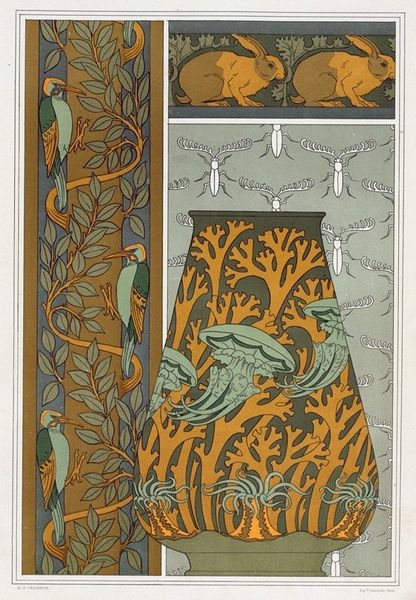
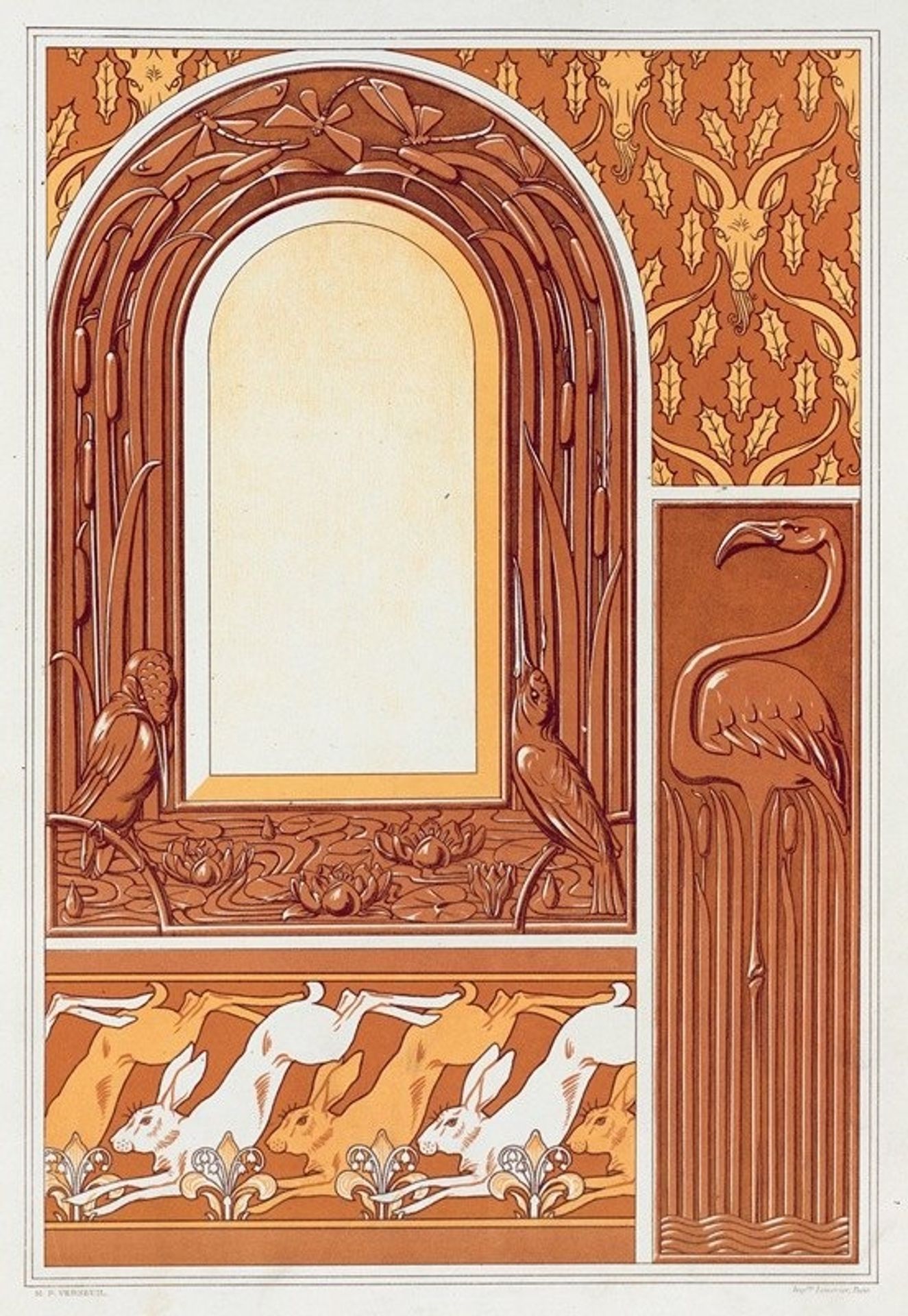
This is an undated cast copper plate by Maurice Pillard Verneuil, titled "Têtes de chèvres, semis. Flamant". The work is dominated by its muted, earthy colour palette, where browns and creams create a sense of depth and layering. This colour scheme gives the piece a somewhat organic feel. The composition is geometrically divided into distinct pictorial sections: a portal-like archway decorated with flora and fauna; to its right a vertical panel with a flamingo; below, a frieze of leaping rabbits; above, a repeating motif of goat heads alternating with oak leaves. This structured layout is typical of Art Nouveau, which sought to integrate art into everyday life through decorative patterns. Each section is densely filled with stylized forms, demonstrating Verneuil’s skill in pattern design. The overall effect is one of harmonious complexity, where Verneuil uses structure and form to explore themes of nature and decoration, and reflect the broader artistic and philosophical concerns of his time.
Têtes de chèvres, semis. Flamant, plaque cuivre fondu. 1897

Artwork details
- Medium
- drawing, print, paper
- Copyright
- Public Domain: Artvee
Tags
drawing
art-nouveau
landscape
stain glass
figuration
paper
geometric
line
art nouveau
decorative-art
Comments
No comments
About this artwork
This is an undated cast copper plate by Maurice Pillard Verneuil, titled "Têtes de chèvres, semis. Flamant". The work is dominated by its muted, earthy colour palette, where browns and creams create a sense of depth and layering. This colour scheme gives the piece a somewhat organic feel. The composition is geometrically divided into distinct pictorial sections: a portal-like archway decorated with flora and fauna; to its right a vertical panel with a flamingo; below, a frieze of leaping rabbits; above, a repeating motif of goat heads alternating with oak leaves. This structured layout is typical of Art Nouveau, which sought to integrate art into everyday life through decorative patterns. Each section is densely filled with stylized forms, demonstrating Verneuil’s skill in pattern design. The overall effect is one of harmonious complexity, where Verneuil uses structure and form to explore themes of nature and decoration, and reflect the broader artistic and philosophical concerns of his time.
Comments
No comments