About this artwork
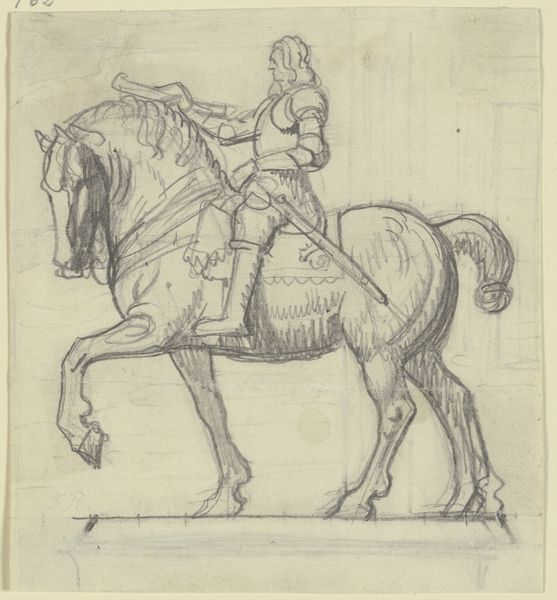
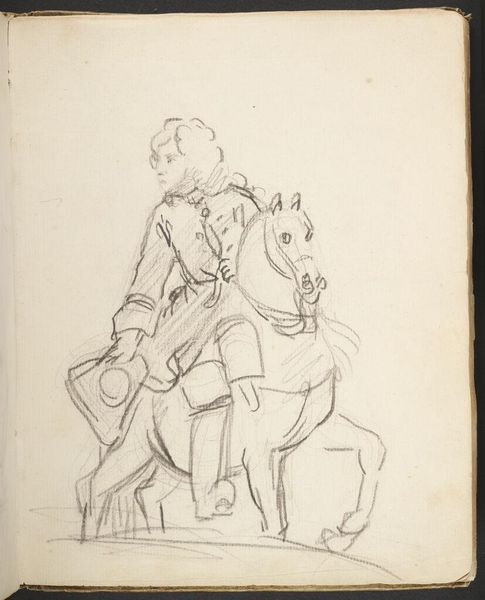
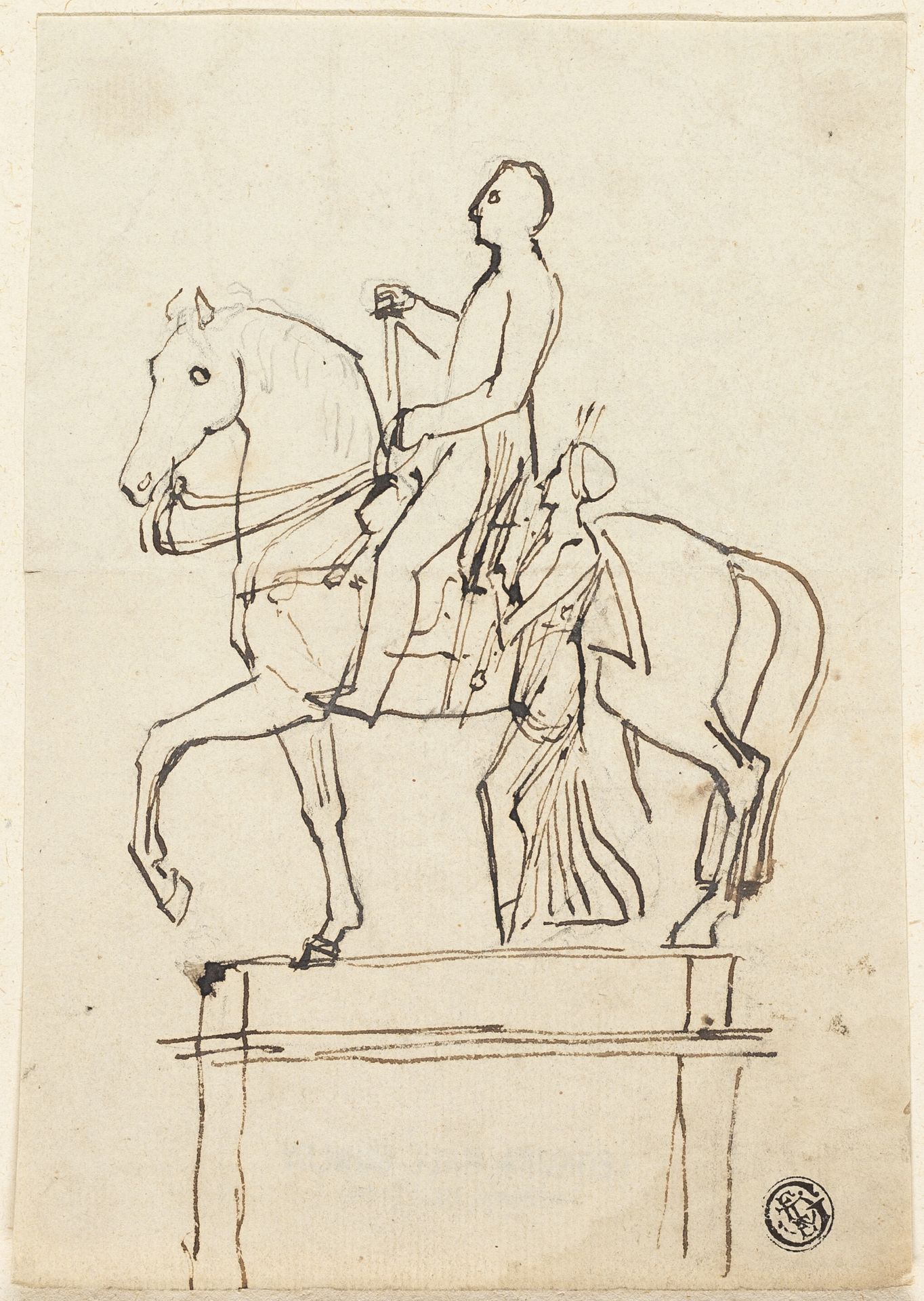
Editor: So, here we have "Sculpture of a Horseman Accompanied by Standing Woman," an ink and graphite drawing of unknown date by Thomas Stothard. The lines are so sparse! It almost feels like I'm looking at an ancient ruin sketched in someone’s notebook. What do you see in this piece? Curator: I see a powerful commentary on the societal structures that elevate certain individuals while simultaneously rendering others invisible or subservient. Who does the horseman represent, and who is the standing woman? Is she support, or burden, or simply a forgotten piece of the monument itself? Consider the period – the late 18th and early 19th centuries, with their rigid class structures, and Britain's colonial expansion. Could this image be subtly critiquing the very idea of the heroic monument? Editor: That's fascinating. I hadn't considered a critique. I just saw it as a study for a sculpture, but you’re right – the woman is almost like an afterthought, clinging to the horse. The drawing's incompleteness seems to enhance that tension. Does the stark style reinforce that critique, perhaps stripping away the grandiosity usually associated with such monuments? Curator: Absolutely. The starkness prevents us from idealizing the scene. We're forced to confront the power dynamics. Think about feminist critiques of art history that expose the historical silencing of women's voices. How might we apply that lens here, to the woman's passive stance, to the implied narrative surrounding the horseman’s presumed dominance? Even the act of drawing itself-- Stothard had the power to decide who is depicted and how. Editor: That connection to feminist theory makes the drawing much more compelling. I’ll never look at equestrian statues the same way. Curator: That’s the goal, isn’t it? To use art as a tool for seeing the world anew. Editor: Definitely something to ponder, thanks!
Sculpture of a Horseman Accompanied by Standing Woman
n.d.


Artwork details
- Medium
- drawing, print, paper, ink, ink-drawings, graphite, pen
- Dimensions
- 176 × 125 mm
- Location
- The Art Institute of Chicago
- Copyright
- Public Domain
Tags
Comments
Share your thoughts
About this artwork
Editor: So, here we have "Sculpture of a Horseman Accompanied by Standing Woman," an ink and graphite drawing of unknown date by Thomas Stothard. The lines are so sparse! It almost feels like I'm looking at an ancient ruin sketched in someone’s notebook. What do you see in this piece? Curator: I see a powerful commentary on the societal structures that elevate certain individuals while simultaneously rendering others invisible or subservient. Who does the horseman represent, and who is the standing woman? Is she support, or burden, or simply a forgotten piece of the monument itself? Consider the period – the late 18th and early 19th centuries, with their rigid class structures, and Britain's colonial expansion. Could this image be subtly critiquing the very idea of the heroic monument? Editor: That's fascinating. I hadn't considered a critique. I just saw it as a study for a sculpture, but you’re right – the woman is almost like an afterthought, clinging to the horse. The drawing's incompleteness seems to enhance that tension. Does the stark style reinforce that critique, perhaps stripping away the grandiosity usually associated with such monuments? Curator: Absolutely. The starkness prevents us from idealizing the scene. We're forced to confront the power dynamics. Think about feminist critiques of art history that expose the historical silencing of women's voices. How might we apply that lens here, to the woman's passive stance, to the implied narrative surrounding the horseman’s presumed dominance? Even the act of drawing itself-- Stothard had the power to decide who is depicted and how. Editor: That connection to feminist theory makes the drawing much more compelling. I’ll never look at equestrian statues the same way. Curator: That’s the goal, isn’t it? To use art as a tool for seeing the world anew. Editor: Definitely something to ponder, thanks!
Comments
Share your thoughts