drawing, paper, pencil
#
drawing
#
16_19th-century
#
pencil sketch
#
landscape
#
paper
#
pencil
#
realism
Dimensions: height 188 mm, width 326 mm
Copyright: Rijks Museum: Open Domain
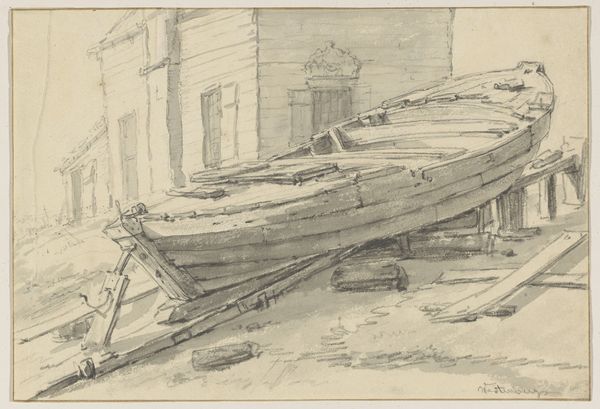
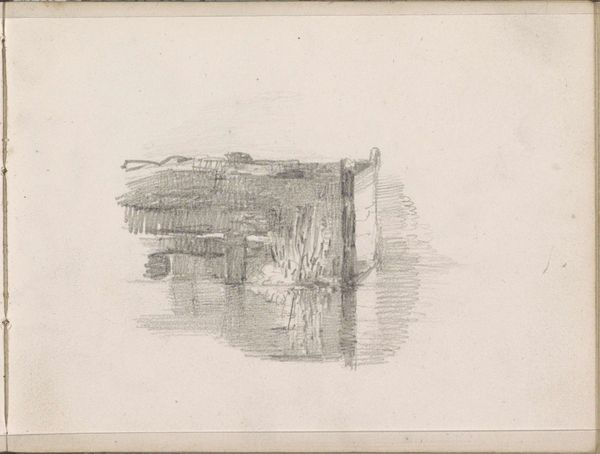
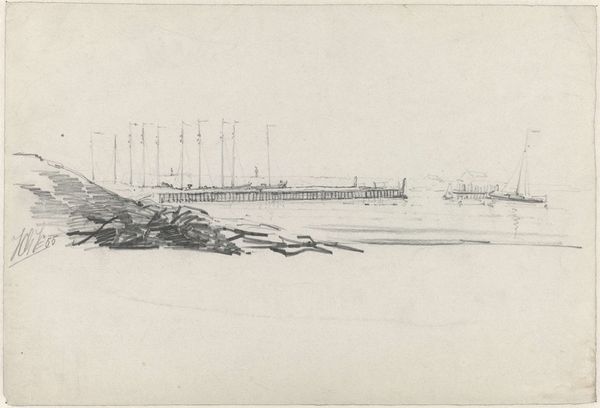
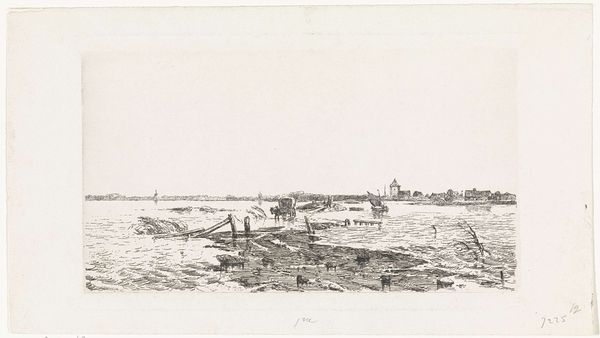
Curator: "Schip Cuba Packet gezien vanaf de wal," or "The Cuba Packet Ship Seen from the Shore," is the title of this intriguing pencil drawing, likely dating to 1857, by Willem Anthonie van Deventer. Editor: It’s… quiet. Very gray. There’s a wistful, almost haunting quality in its stark simplicity. You feel a world on the cusp of enormous change being observed, rendered almost ghostly. Curator: You pick up on something very interesting. Consider the "Cuba Packet" itself—not just a vessel, but a tangible link connecting Europe to the complex socio-political tapestry of the Americas during a time of intense colonial activity and, of course, the horrors of the transatlantic slave trade. Editor: So this isn’t just a tranquil seascape. It’s a portrait of global power dynamics, veiled beneath delicate pencil strokes. The ship, viewed from the shore, almost feels like a barrier, the rough wood contrasting against the smooth hull. It subtly whispers of distance and disconnect, even as people occupy both realms. Curator: Precisely. Van Deventer positions us, the viewers, firmly on the side of the "shore"— the observers, rather than the participants. What I find interesting is the raw quality of the sketch. It wasn’t meant to be beautiful. It's social commentary, almost in confidence. Editor: The choice of pencil lends to that intimacy. It's immediacy over perfect representation. Van Deventer caught a moment, as if it were a secret. I keep thinking of the passengers aboard, their lives moving irrevocably toward what could be great promise or great danger—a ship as portal. Curator: Yes, I think this little sketch manages to compress immense ideas of transport, both of people and ideas, with tremendous efficiency. Its roughness isn't carelessness. It reflects, instead, something fundamental about change and witnessing it. Editor: For all of its starkness, it gives a sense of almost unbearable vulnerability. It shows the strange power that even the most basic sketches possess: holding moments—and meanings—for longer than they might naturally last.
Comments
No comments
Be the first to comment and join the conversation on the ultimate creative platform.
 Collect
 React
React Comment
More like this