About this artwork
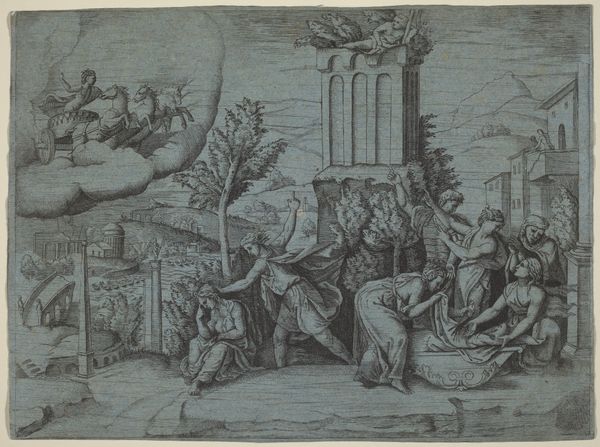
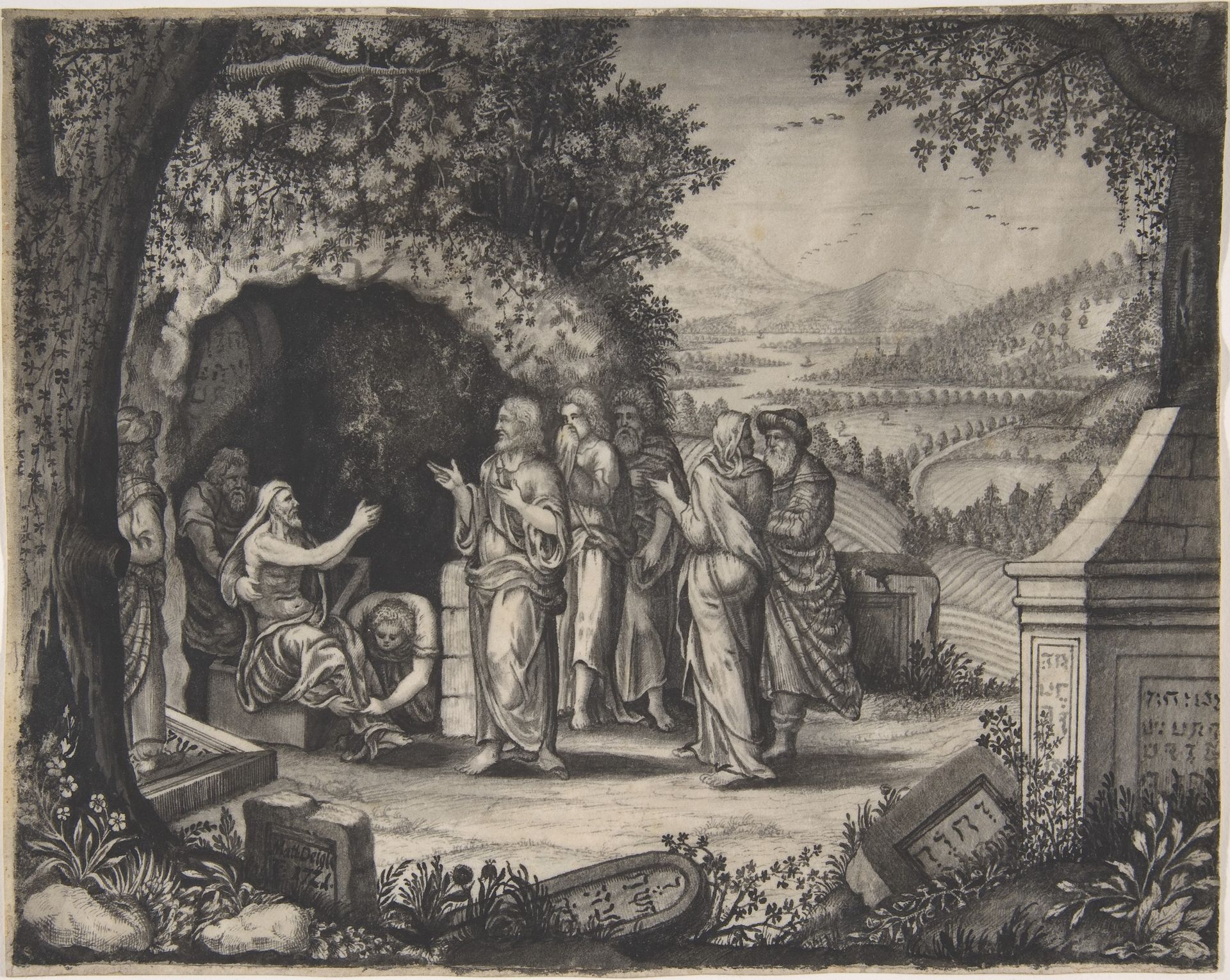
Matthias Deigle created this ink drawing, "The Raising of Lazarus," on a sheet of paper. Deigle’s work invites us to consider the complex relationship between faith, power, and the body. The scene depicts the biblical narrative of Lazarus being raised from the dead by Jesus. We see Lazarus emerging from a dark tomb, surrounded by a crowd of onlookers, some in disbelief, others in awe. The landscape, rendered in delicate lines, provides a stark contrast to the intense human drama unfolding in the foreground. Consider the historical context: religious art often served as a tool for social control, reinforcing doctrines of the church. Yet, Deigle's interpretation, with its emphasis on human emotion and vulnerability, offers a counter-narrative. It asks us to reflect on the power dynamics inherent in religious belief. It also presents an alternative, more intimate vision of spirituality. How does the artist use light and shadow to convey the tension between mortality and resurrection?
The Raising of Lazarus
1700 - 1800

Matthias Deigle
@matthiasdeigle
The Metropolitan Museum of Art
Metropolitan Museum of Art, New York, NYArtwork details
- Medium
- drawing, print, engraving
- Dimensions
- sheet: 7 9/16 x 9 7/16 in. (19.2 x 23.9 cm)
- Location
- Metropolitan Museum of Art, New York, NY
- Copyright
- Public Domain
Tags
Comments
Share your thoughts
About this artwork
Matthias Deigle created this ink drawing, "The Raising of Lazarus," on a sheet of paper. Deigle’s work invites us to consider the complex relationship between faith, power, and the body. The scene depicts the biblical narrative of Lazarus being raised from the dead by Jesus. We see Lazarus emerging from a dark tomb, surrounded by a crowd of onlookers, some in disbelief, others in awe. The landscape, rendered in delicate lines, provides a stark contrast to the intense human drama unfolding in the foreground. Consider the historical context: religious art often served as a tool for social control, reinforcing doctrines of the church. Yet, Deigle's interpretation, with its emphasis on human emotion and vulnerability, offers a counter-narrative. It asks us to reflect on the power dynamics inherent in religious belief. It also presents an alternative, more intimate vision of spirituality. How does the artist use light and shadow to convey the tension between mortality and resurrection?
Comments
Share your thoughts