About this artwork
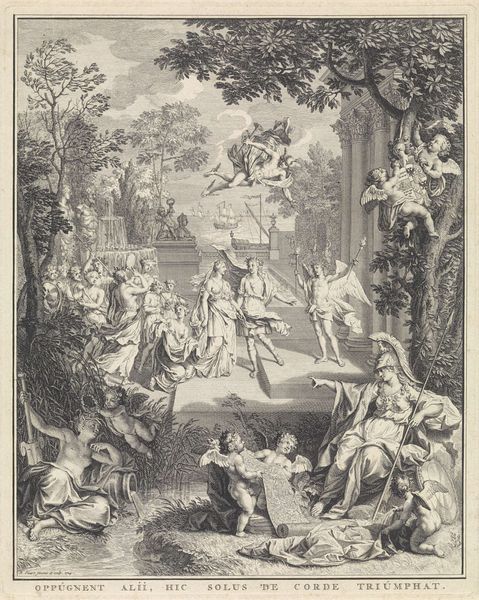
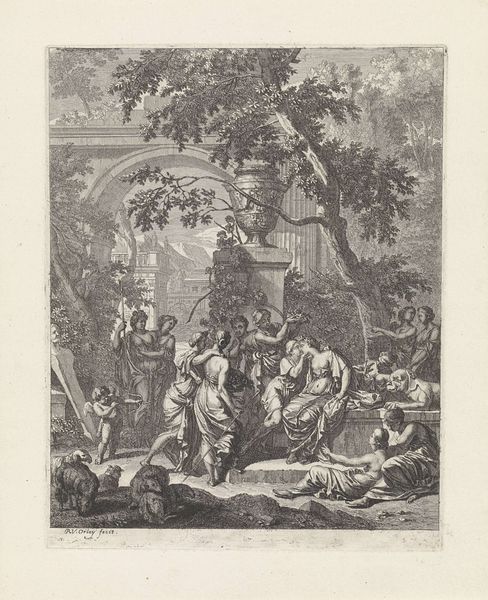
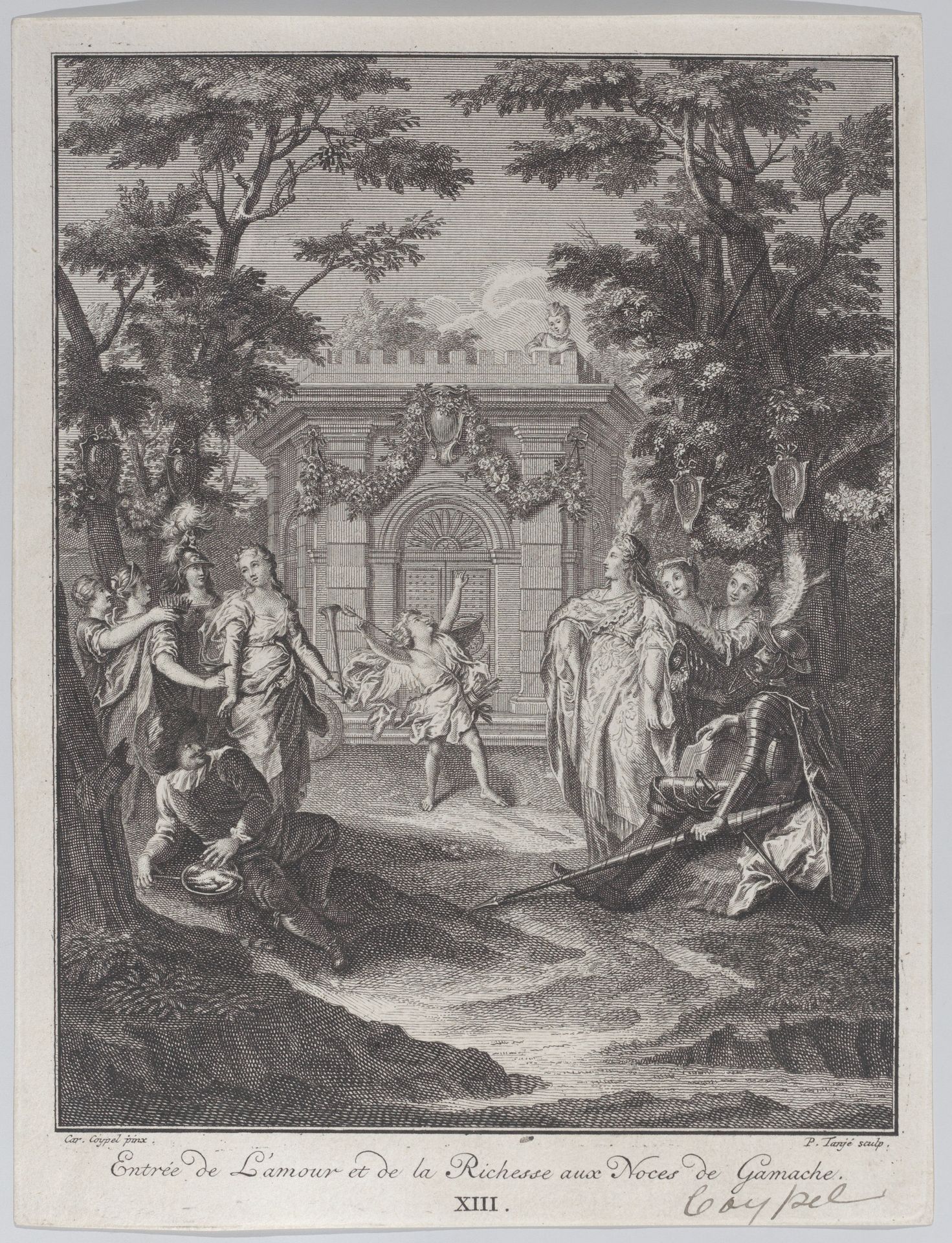
Pieter Tanjé's etching, made around 1706-1761, depicts allegorical figures of love and wealth entering Gamache's wedding. Cupid, with his bow, represents desire and affection, while wealth is symbolized by lavish attire and a regal bearing. These figures echo throughout art history. Cupid's presence can be traced back to classical antiquity, where Eros, the Greek counterpart, was a primal force. Wealth, often depicted through symbols of cornucopia or precious metals, has always been a potent symbol of power and prosperity. Consider how Cupid's image has transformed from a divine being to a playful cherub, a shift reflecting evolving views on love. Wealth, too, has seen transformations in its visual representation, mirroring societal values. This non-linear progression—a constant return and reinterpretation—is a testament to the enduring power of symbols in capturing our collective imagination and subconscious desires.
Plate 13: entrance of Love and Wealth to Gamache's wedding (Entrée de L'amour et de la Richesse aux Noces de Gamache)
1745


Artwork details
- Medium
- drawing, print, etching
- Dimensions
- Sheet (Trimmed): 8 3/8 × 6 5/16 in. (21.2 × 16.1 cm)
- Location
- Metropolitan Museum of Art, New York, NY
- Copyright
- Public Domain
Tags
Comments
Share your thoughts
About this artwork
Pieter Tanjé's etching, made around 1706-1761, depicts allegorical figures of love and wealth entering Gamache's wedding. Cupid, with his bow, represents desire and affection, while wealth is symbolized by lavish attire and a regal bearing. These figures echo throughout art history. Cupid's presence can be traced back to classical antiquity, where Eros, the Greek counterpart, was a primal force. Wealth, often depicted through symbols of cornucopia or precious metals, has always been a potent symbol of power and prosperity. Consider how Cupid's image has transformed from a divine being to a playful cherub, a shift reflecting evolving views on love. Wealth, too, has seen transformations in its visual representation, mirroring societal values. This non-linear progression—a constant return and reinterpretation—is a testament to the enduring power of symbols in capturing our collective imagination and subconscious desires.
Comments
Share your thoughts