About this artwork
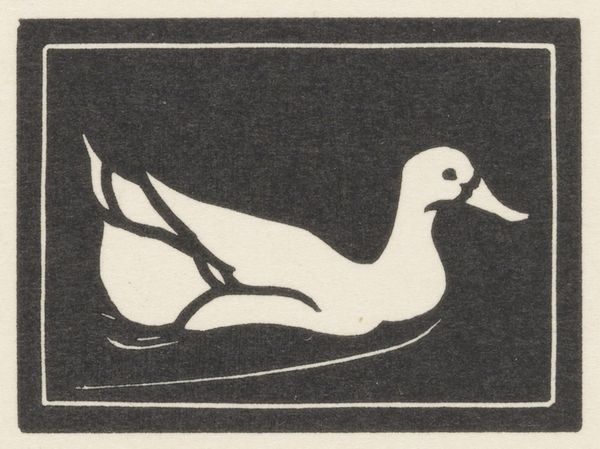
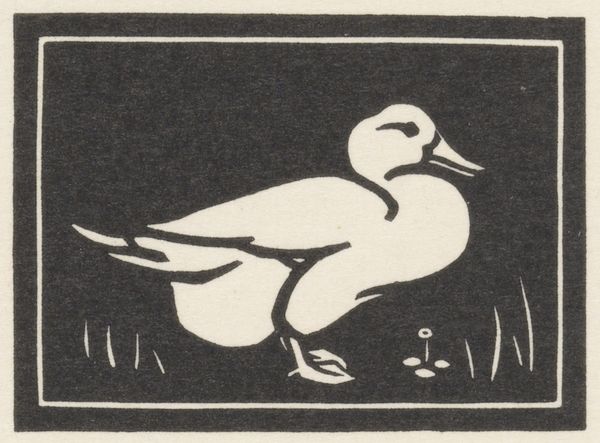
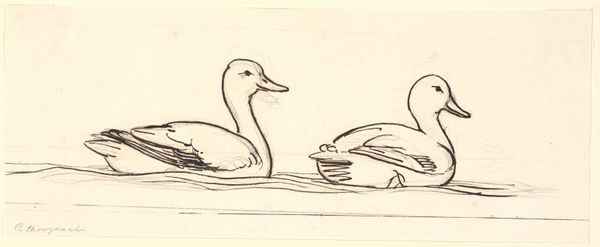
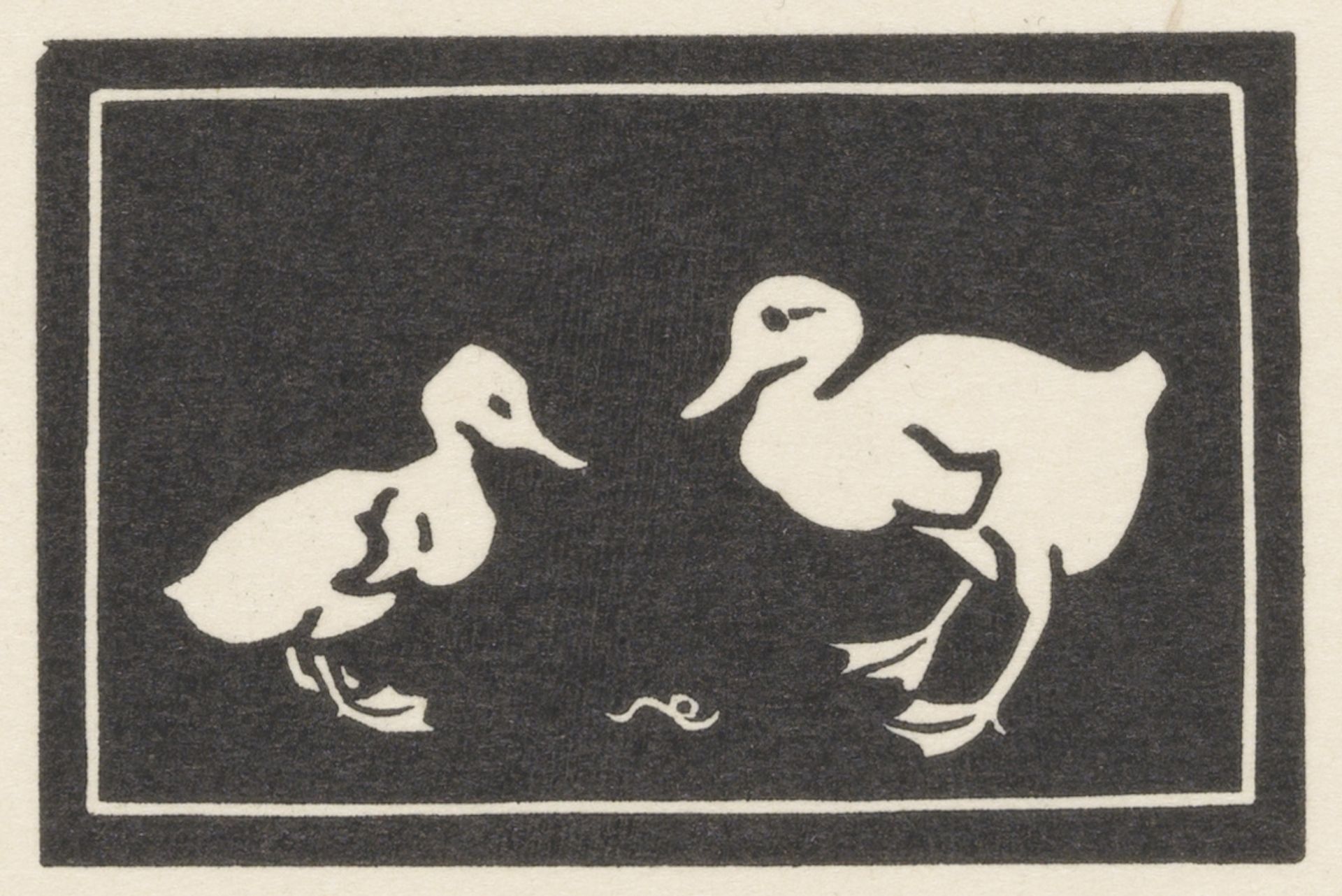
Editor: Here we have Julie de Graag's "Twee eendenkuikens," or "Two Ducklings," a woodcut print made around 1923-1924. The stark black and white creates a very graphic image; the shapes are simple but incredibly evocative. What strikes you about it? Curator: What I appreciate first is the composition. Consider the stark contrast, a high-key interplay between the positive form of the ducklings and the negative space of the background, accentuated by that strong, deliberate line of the border. Note how the composition adheres to the most essential elements. De Graag masterfully balances simplicity and representation. Editor: The line is indeed striking, it feels modern even now. But beyond the graphic quality, is there something to read into the scene itself, beyond its formal qualities? Curator: From a formalist perspective, narrative is secondary. However, we can still observe relationships. The interplay between the two ducklings, their postures—one observant, one perhaps more adventurous—engages the eye. Consider too the implied line connecting their gazes, intersecting at what seems to be a small worm, further anchoring their relationship spatially within the frame. Does this offer any reading on your part? Editor: It is like a study in the essential lines that communicate the whole idea of "duckling-ness". So would you say the power of this image lies in the effective use of shape and contrast, rather than any narrative? Curator: Precisely. De Graag has reduced the subject to its most fundamental components. This is about line, shape, and the spatial relationships created by their interaction. A compelling reminder of how much can be conveyed with minimal means. Editor: It’s amazing how the reduction allows for such expression! Looking at it this way really illuminates the effectiveness of De Graag's artistic choices.

Artwork details
- Dimensions
- height 238 mm, width 153 mm, height 40 mm, width 61 mm
- Location
- Rijksmuseum
- Copyright
- Rijks Museum: Open Domain
Comments
Be the first to share your thoughts about this work.
About this artwork
Editor: Here we have Julie de Graag's "Twee eendenkuikens," or "Two Ducklings," a woodcut print made around 1923-1924. The stark black and white creates a very graphic image; the shapes are simple but incredibly evocative. What strikes you about it? Curator: What I appreciate first is the composition. Consider the stark contrast, a high-key interplay between the positive form of the ducklings and the negative space of the background, accentuated by that strong, deliberate line of the border. Note how the composition adheres to the most essential elements. De Graag masterfully balances simplicity and representation. Editor: The line is indeed striking, it feels modern even now. But beyond the graphic quality, is there something to read into the scene itself, beyond its formal qualities? Curator: From a formalist perspective, narrative is secondary. However, we can still observe relationships. The interplay between the two ducklings, their postures—one observant, one perhaps more adventurous—engages the eye. Consider too the implied line connecting their gazes, intersecting at what seems to be a small worm, further anchoring their relationship spatially within the frame. Does this offer any reading on your part? Editor: It is like a study in the essential lines that communicate the whole idea of "duckling-ness". So would you say the power of this image lies in the effective use of shape and contrast, rather than any narrative? Curator: Precisely. De Graag has reduced the subject to its most fundamental components. This is about line, shape, and the spatial relationships created by their interaction. A compelling reminder of how much can be conveyed with minimal means. Editor: It’s amazing how the reduction allows for such expression! Looking at it this way really illuminates the effectiveness of De Graag's artistic choices.
Comments
Be the first to share your thoughts about this work.