About this artwork
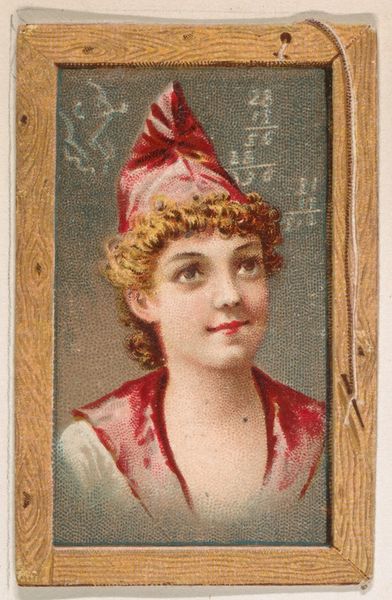
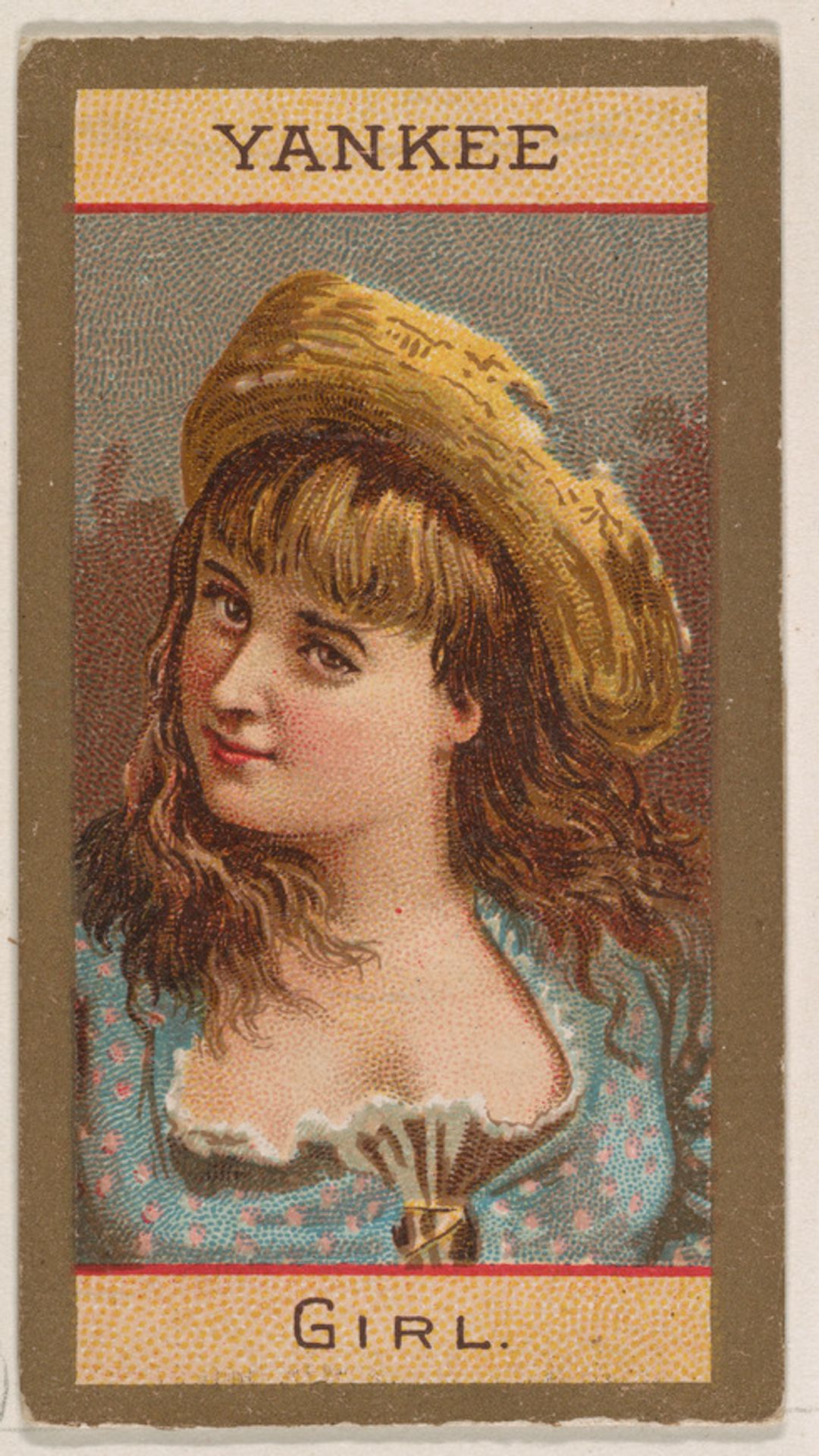
Curator: Here we have a trading card titled "Yankee Girl," produced around 1890 by the Kinney Brothers Tobacco Company. It’s part of their “Types of Nationalities” series. What strikes you about it? Editor: Well, aside from the overt marketing, it’s charming in its idealized portrayal. There's a naivete in that gaze. What exactly makes her "Yankee," I wonder? Curator: Ah, that's where it gets interesting. These cards were designed to sell cigarettes, so they capitalized on popular notions of identity and beauty. She’s embodying the late 19th-century ideal of American femininity, meant to be aspirational, to associate their product with this…ideal. Editor: Right, the gaze is part of that. Wide-eyed, almost innocent, but aware. And that floppy straw hat – it speaks of summer, leisure, a certain class… There's also a hint of the provocative with the low cut of her dress, don't you think? It’s playing with notions of purity and enticement. Curator: Precisely. This image circulated within a rapidly changing social landscape. Industrialization was booming, immigration was increasing, and notions of "Americanness" were being negotiated and codified. The card presented a digestible, marketable vision of who "we" were. Editor: So this wasn’t really about portraiture at all, but cultural branding. Curator: Precisely! And notice how “Yankee” is being presented visually – through clothing, gaze, hairstyle…all shorthand symbols that attempt to define a cultural type. The “Yankee Girl” embodies not just a person, but a set of assumed values linked to American identity during the era. These are less "types" of people and more marketing tropes! Editor: Yes, now I notice it. The caricature softens the sales push to suggest aspiration. I guess, as an Iconographer, the cultural power of this simple image continues to resonate, highlighting how popular culture can shape perceptions and stereotypes over time. Curator: And as a Historian, it reminds us how images are rarely innocent, always embedded within power dynamics and economic incentives. Always question the image and what forces created it!
Yankee Girl, from Types of Nationalities (N240) issued by Kinney Bros.
1890

Kinney Brothers Tobacco Company
1869 - 2011
The Metropolitan Museum of Art
Metropolitan Museum of Art, New York, NYArtwork details
- Medium
- drawing, print
- Dimensions
- Sheet (Folded): 2 11/16 × 1 7/16 in. (6.8 × 3.7 cm) Sheet (Unfolded): 6 7/8 × 1 7/16 in. (17.4 × 3.7 cm)
- Location
- Metropolitan Museum of Art, New York, NY
- Copyright
- Public Domain
Tags
Comments
Share your thoughts
About this artwork
Curator: Here we have a trading card titled "Yankee Girl," produced around 1890 by the Kinney Brothers Tobacco Company. It’s part of their “Types of Nationalities” series. What strikes you about it? Editor: Well, aside from the overt marketing, it’s charming in its idealized portrayal. There's a naivete in that gaze. What exactly makes her "Yankee," I wonder? Curator: Ah, that's where it gets interesting. These cards were designed to sell cigarettes, so they capitalized on popular notions of identity and beauty. She’s embodying the late 19th-century ideal of American femininity, meant to be aspirational, to associate their product with this…ideal. Editor: Right, the gaze is part of that. Wide-eyed, almost innocent, but aware. And that floppy straw hat – it speaks of summer, leisure, a certain class… There's also a hint of the provocative with the low cut of her dress, don't you think? It’s playing with notions of purity and enticement. Curator: Precisely. This image circulated within a rapidly changing social landscape. Industrialization was booming, immigration was increasing, and notions of "Americanness" were being negotiated and codified. The card presented a digestible, marketable vision of who "we" were. Editor: So this wasn’t really about portraiture at all, but cultural branding. Curator: Precisely! And notice how “Yankee” is being presented visually – through clothing, gaze, hairstyle…all shorthand symbols that attempt to define a cultural type. The “Yankee Girl” embodies not just a person, but a set of assumed values linked to American identity during the era. These are less "types" of people and more marketing tropes! Editor: Yes, now I notice it. The caricature softens the sales push to suggest aspiration. I guess, as an Iconographer, the cultural power of this simple image continues to resonate, highlighting how popular culture can shape perceptions and stereotypes over time. Curator: And as a Historian, it reminds us how images are rarely innocent, always embedded within power dynamics and economic incentives. Always question the image and what forces created it!
Comments
Share your thoughts