#
pop art-esque
#
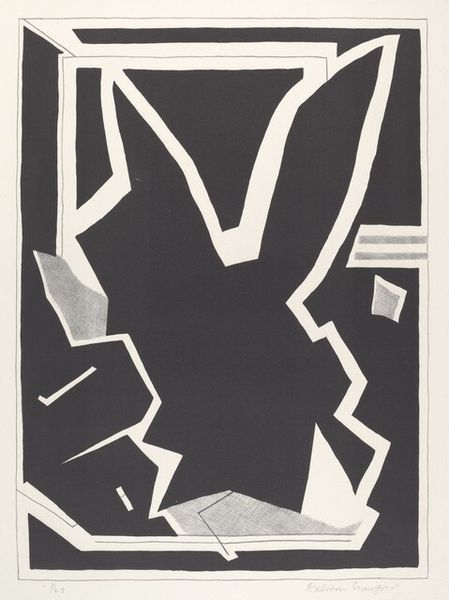
shape in negative space
#
shading to add clarity
# print
#
teenage art
#
bold defined shape
#
limited contrast and shading
#
tonal art
#
bright with minimal shading
#
shading experimentation
#
positive shape
Dimensions: overall: 65.5 x 50.5 cm (25 13/16 x 19 7/8 in.)
Copyright: National Gallery of Art: CC0 1.0
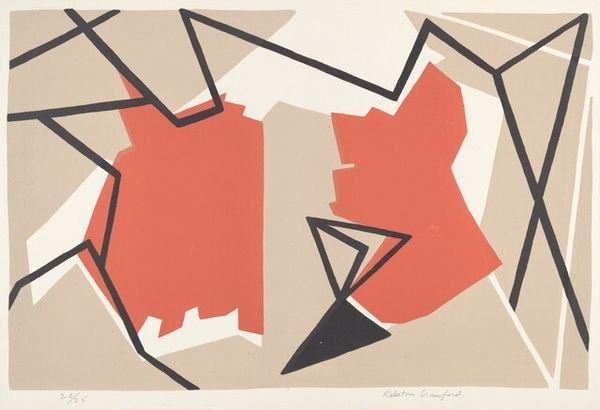
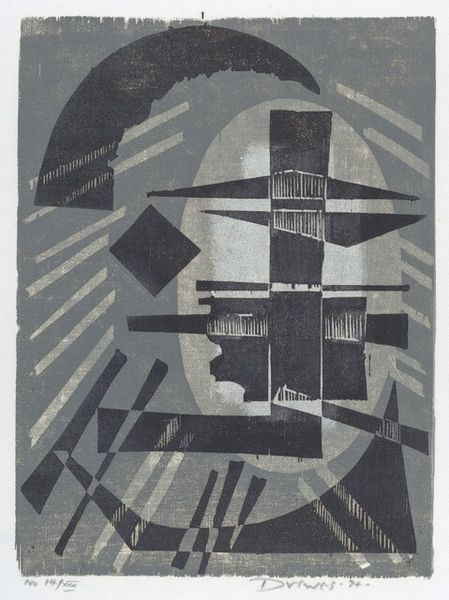
Curator: This is Ralston Crawford’s "Broken Window #2" from 1954. It’s a print. Editor: Stark! My first reaction is just… fractured. I feel a sense of violence in its simplicity. The black form dominates. Curator: Crawford was deeply interested in geometric abstraction, and how industrial subjects, from bridges to shipyards, could be rendered through it. Here, that geometry expresses a state of decay. Think about post-war anxieties – urban blight, the breakdown of social structures… Editor: Yes! That’s where my mind went immediately. There's this implied narrative, right? What broke the window? Was it neglect, or something more active, a deliberate act of destruction? I also think about the mid-century focus on urban renewal and the displacement it caused. The brokenness could represent that. Curator: Exactly. Crawford often found beauty and order in unexpected places, even in subjects others might overlook. But here, the composition, that jagged central shape, it’s undeniably unsettling. Consider too, his involvement as a combat artist in WWII; seeing such violence and then having to aestheticize its legacy. Editor: The grayscale palette reinforces the sense of desolation, almost like an abandoned crime scene. Even the limited shading, rather than adding clarity, creates more ambiguity, heightening the tension. Those grey shard shapes aren’t merely window fragments to me. Curator: Interesting. For Crawford, there was perhaps, some hope amidst all this brokenness. He captured what many other artists avoided during this historical period. We begin to find complexity within Crawford's body of work by noticing these anomalies of subject and matter. Editor: I agree, the anomaly that makes the viewer step back. So this window, then, acts as a dark mirror reflecting the uncertainties of the era. A truly relevant artwork for our current anxieties too. Curator: Absolutely. And by studying these stark representations, we can delve deeper into how that era impacted the human experience. Editor: Thank you. It really changes the way I now see it: not just a broken window, but a fragmented representation of a fragile world.
Comments
No comments
Be the first to comment and join the conversation on the ultimate creative platform.
 Collect
 React
React Comment
More like this