About this artwork
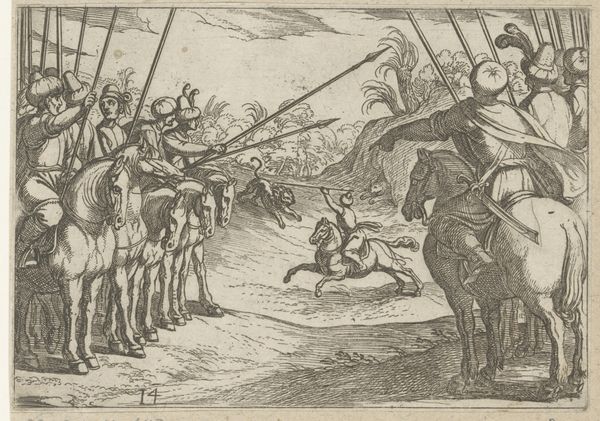
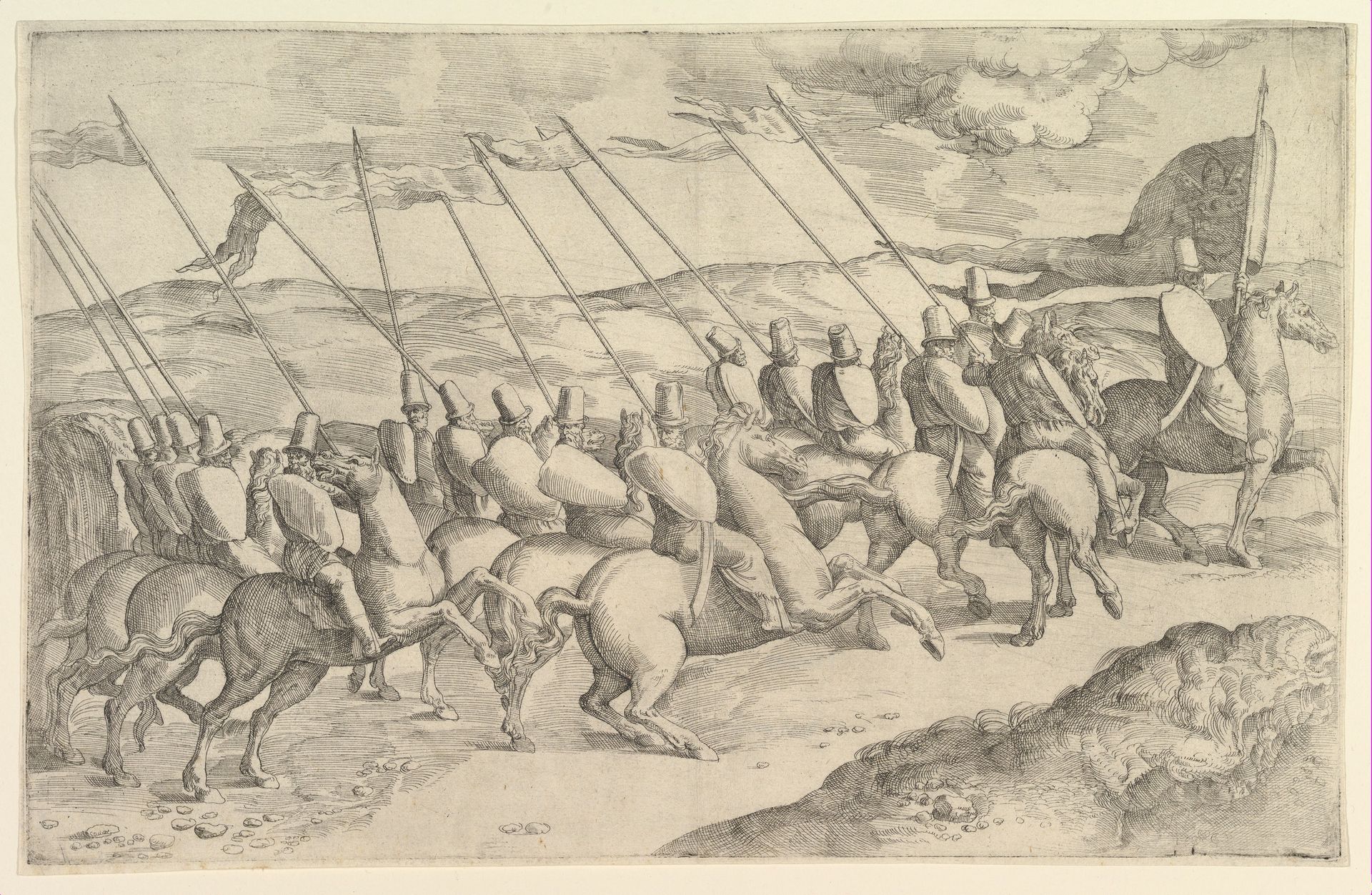
Battista Franco created this engraving, "A company of horsemen riding to the right", around the mid-16th century. The composition is dominated by a procession of riders moving across a stark landscape, each figure delineated with fine, precise lines that capture the texture of their garments and the musculature of their mounts. Franco's use of line is particularly striking. Notice how he creates depth and movement through closely spaced parallel lines for shading, a technique that animates the scene. The repetition of forms—the horses, the riders, and the lances—creates a rhythmic pattern, giving the impression of an inexorable march. The print engages with the Renaissance fascination with classical themes and the study of human anatomy, while also reflecting the period's interest in military subjects. What is communicated here is a display of power and order. The formal rigor of the composition reinforces this sense of control. This artwork, with its detailed rendering and dynamic arrangement, invites us to reflect on the interplay between form and content.
A company of horsemen riding to the right
1525 - 1535


Artwork details
- Medium
- drawing, print, etching, engraving
- Dimensions
- sheet: 10 13/16 x 16 13/16 in. (27.4 x 42.7 cm) trimmed to platemark
- Location
- Metropolitan Museum of Art, New York, NY
- Copyright
- Public Domain
Tags
Comments
Share your thoughts
About this artwork
Battista Franco created this engraving, "A company of horsemen riding to the right", around the mid-16th century. The composition is dominated by a procession of riders moving across a stark landscape, each figure delineated with fine, precise lines that capture the texture of their garments and the musculature of their mounts. Franco's use of line is particularly striking. Notice how he creates depth and movement through closely spaced parallel lines for shading, a technique that animates the scene. The repetition of forms—the horses, the riders, and the lances—creates a rhythmic pattern, giving the impression of an inexorable march. The print engages with the Renaissance fascination with classical themes and the study of human anatomy, while also reflecting the period's interest in military subjects. What is communicated here is a display of power and order. The formal rigor of the composition reinforces this sense of control. This artwork, with its detailed rendering and dynamic arrangement, invites us to reflect on the interplay between form and content.
Comments
Share your thoughts