About this artwork
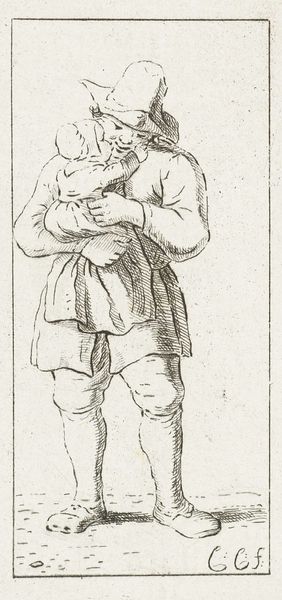
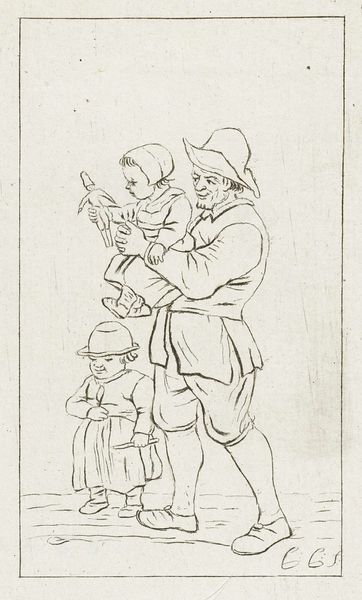
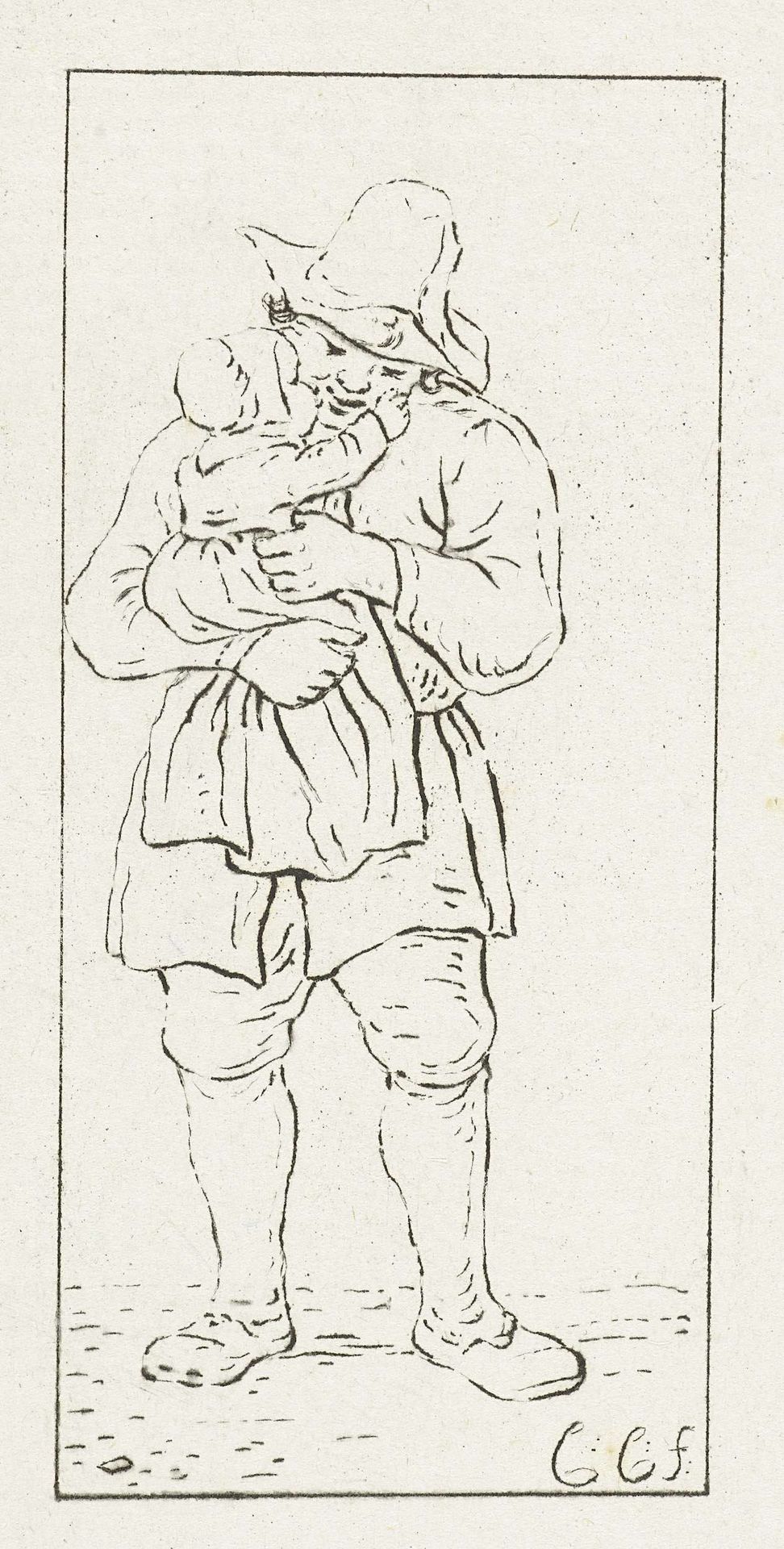
Editor: This drawing, “Vader met kind,” or “Father with Child,” made sometime between 1758 and 1808 by Christina Chalon, shows exactly that – a father cradling his child. It’s a simple pen and ink drawing, but there’s something really tender about the way the figures are rendered, even in just a few lines. What do you see in this piece, focusing on the way it's constructed? Curator: Let us observe how Chalon structures the composition. The work’s emotional depth arises not solely from the figures’ interaction but also from the stark linearity itself. The economy of line emphasizes the essential form, allowing the viewer to concentrate on the figures' interconnectedness. Note, for instance, how the father’s hat subtly echoes the child’s form. This reinforces the theme through repetition, an artful technique in minimizing distraction, compelling our attention to the core relationship presented. Do you notice any variations in line thickness or density that could affect our interpretation? Editor: I see what you mean about the hat echoing the child's form. It's subtle but it definitely draws them together visually. And now that you mention the lines, there's definitely more detail etched around the face of the father, especially around his expression. The child, on the other hand, is much less defined. Is that just about focal point, or is there something more there? Curator: The subtle manipulation of line invites interpretation. The detail in the father's face guides us toward his emotional experience, making it a focal point, while the child's softer depiction directs us to view it as an innocent figure dependent on this care. Focus on the line work in father's clothing against that of the child; contrast is a foundational method of guiding an audience through an artist’s construction of the work. Editor: That's a perspective I hadn't considered before. It makes me think about how much emotion and story can be told through simple forms. Curator: Indeed. Recognizing the artifice helps reveal its art.

Artwork details
- Medium
- drawing, ink, pen
- Dimensions
- height 102 mm, width 56 mm
- Location
- Rijksmuseum
- Copyright
- Rijks Museum: Open Domain
Tags
Comments
Share your thoughts
About this artwork
Editor: This drawing, “Vader met kind,” or “Father with Child,” made sometime between 1758 and 1808 by Christina Chalon, shows exactly that – a father cradling his child. It’s a simple pen and ink drawing, but there’s something really tender about the way the figures are rendered, even in just a few lines. What do you see in this piece, focusing on the way it's constructed? Curator: Let us observe how Chalon structures the composition. The work’s emotional depth arises not solely from the figures’ interaction but also from the stark linearity itself. The economy of line emphasizes the essential form, allowing the viewer to concentrate on the figures' interconnectedness. Note, for instance, how the father’s hat subtly echoes the child’s form. This reinforces the theme through repetition, an artful technique in minimizing distraction, compelling our attention to the core relationship presented. Do you notice any variations in line thickness or density that could affect our interpretation? Editor: I see what you mean about the hat echoing the child's form. It's subtle but it definitely draws them together visually. And now that you mention the lines, there's definitely more detail etched around the face of the father, especially around his expression. The child, on the other hand, is much less defined. Is that just about focal point, or is there something more there? Curator: The subtle manipulation of line invites interpretation. The detail in the father's face guides us toward his emotional experience, making it a focal point, while the child's softer depiction directs us to view it as an innocent figure dependent on this care. Focus on the line work in father's clothing against that of the child; contrast is a foundational method of guiding an audience through an artist’s construction of the work. Editor: That's a perspective I hadn't considered before. It makes me think about how much emotion and story can be told through simple forms. Curator: Indeed. Recognizing the artifice helps reveal its art.
Comments
Share your thoughts