About this artwork
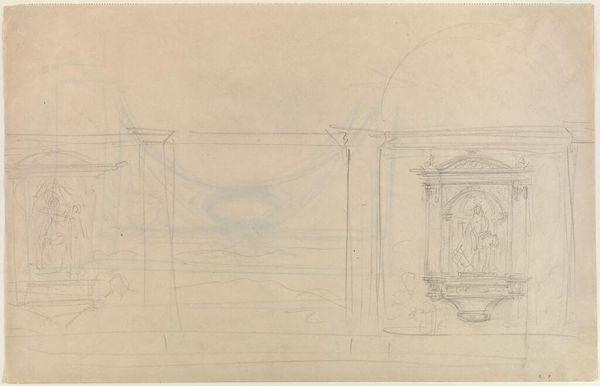
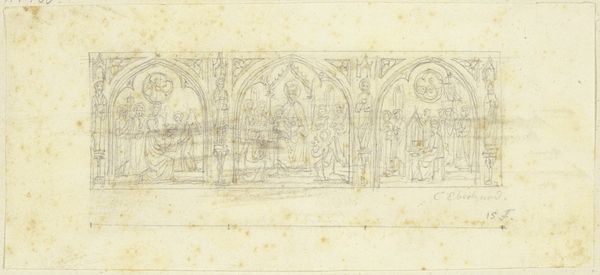
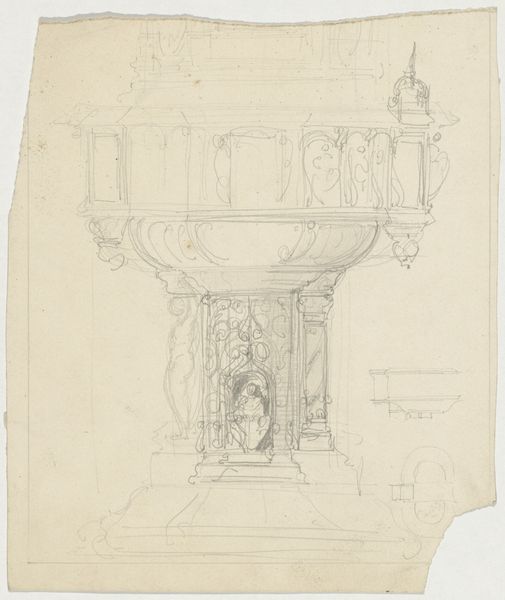
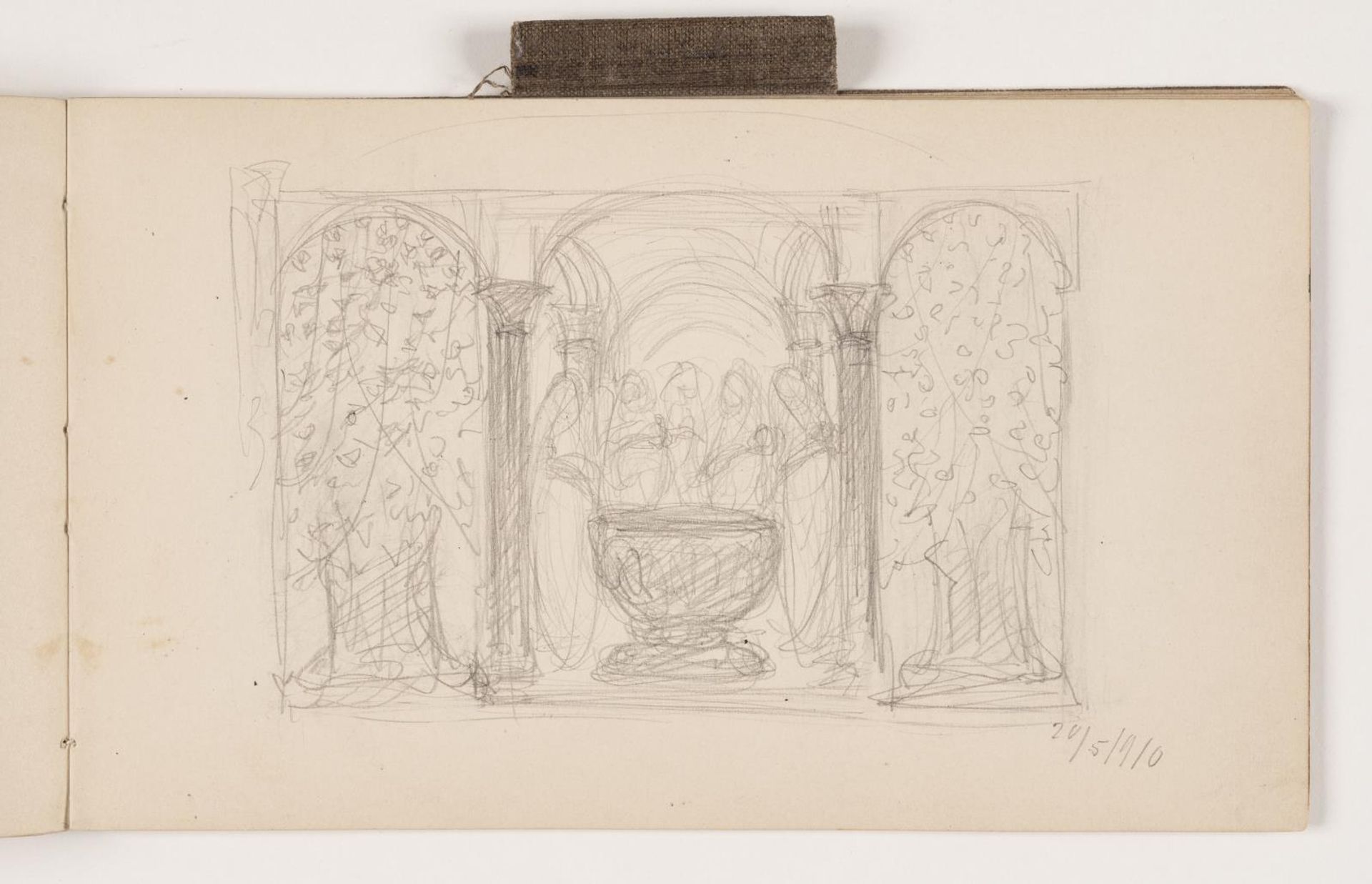
Editor: This is Agnes Slott-Møller's pencil sketch from 1910, "Skitse til 'Fædrelandets Vaar'", which translates to "Sketch for 'Springtime of the Fatherland.'" It’s on paper, and feels quite… fragile, almost tentative, yet the composition suggests a grand scale. What strikes you about it? Curator: I'm drawn to the central figures clustered around what appears to be a baptismal font or a communal vessel. Given the title, "Springtime of the Fatherland," consider how this scene evokes themes of national identity and renewal. Who is being reborn in this "spring"? Editor: That’s interesting, I was so focused on the figures. So you see this as representing rebirth for a nation, not necessarily just individuals? Curator: Exactly. Remember this was sketched during a period of intense national romanticism across Europe. What symbols are at play? What does "fatherland" even mean here? It's not just a geographic space but also a socially constructed entity steeped in gendered and often exclusionary ideals. Editor: Exclusionary? In what way? Curator: Think about who is included in this vision of the "fatherland," and who might be marginalized. Does this image reinforce a homogenous idea of national identity, potentially erasing diverse voices or experiences? It would be very interesting to study Slott-Møller's larger body of work through an intersectional lens, seeing how her depictions either challenge or uphold existing power structures. Who has access to that “springtime"? Editor: That adds such a critical layer to viewing this. I originally just saw a historical drawing, but it seems charged with social commentary about identity and belonging. Curator: Exactly, viewing this sketch provides an opportunity to dissect historical and social undertones within it, broadening it from mere art appreciation to an important moment of contemplation.
Skitse til "Fædrelandets Vaar"
1910


Artwork details
- Medium
- drawing, paper, pencil
- Dimensions
- 120 mm (height) x 205 mm (width) (bladmaal)
- Location
- SMK - Statens Museum for Kunst
Tags
Comments
Share your thoughts
About this artwork
Editor: This is Agnes Slott-Møller's pencil sketch from 1910, "Skitse til 'Fædrelandets Vaar'", which translates to "Sketch for 'Springtime of the Fatherland.'" It’s on paper, and feels quite… fragile, almost tentative, yet the composition suggests a grand scale. What strikes you about it? Curator: I'm drawn to the central figures clustered around what appears to be a baptismal font or a communal vessel. Given the title, "Springtime of the Fatherland," consider how this scene evokes themes of national identity and renewal. Who is being reborn in this "spring"? Editor: That’s interesting, I was so focused on the figures. So you see this as representing rebirth for a nation, not necessarily just individuals? Curator: Exactly. Remember this was sketched during a period of intense national romanticism across Europe. What symbols are at play? What does "fatherland" even mean here? It's not just a geographic space but also a socially constructed entity steeped in gendered and often exclusionary ideals. Editor: Exclusionary? In what way? Curator: Think about who is included in this vision of the "fatherland," and who might be marginalized. Does this image reinforce a homogenous idea of national identity, potentially erasing diverse voices or experiences? It would be very interesting to study Slott-Møller's larger body of work through an intersectional lens, seeing how her depictions either challenge or uphold existing power structures. Who has access to that “springtime"? Editor: That adds such a critical layer to viewing this. I originally just saw a historical drawing, but it seems charged with social commentary about identity and belonging. Curator: Exactly, viewing this sketch provides an opportunity to dissect historical and social undertones within it, broadening it from mere art appreciation to an important moment of contemplation.
Comments
Share your thoughts