About this artwork
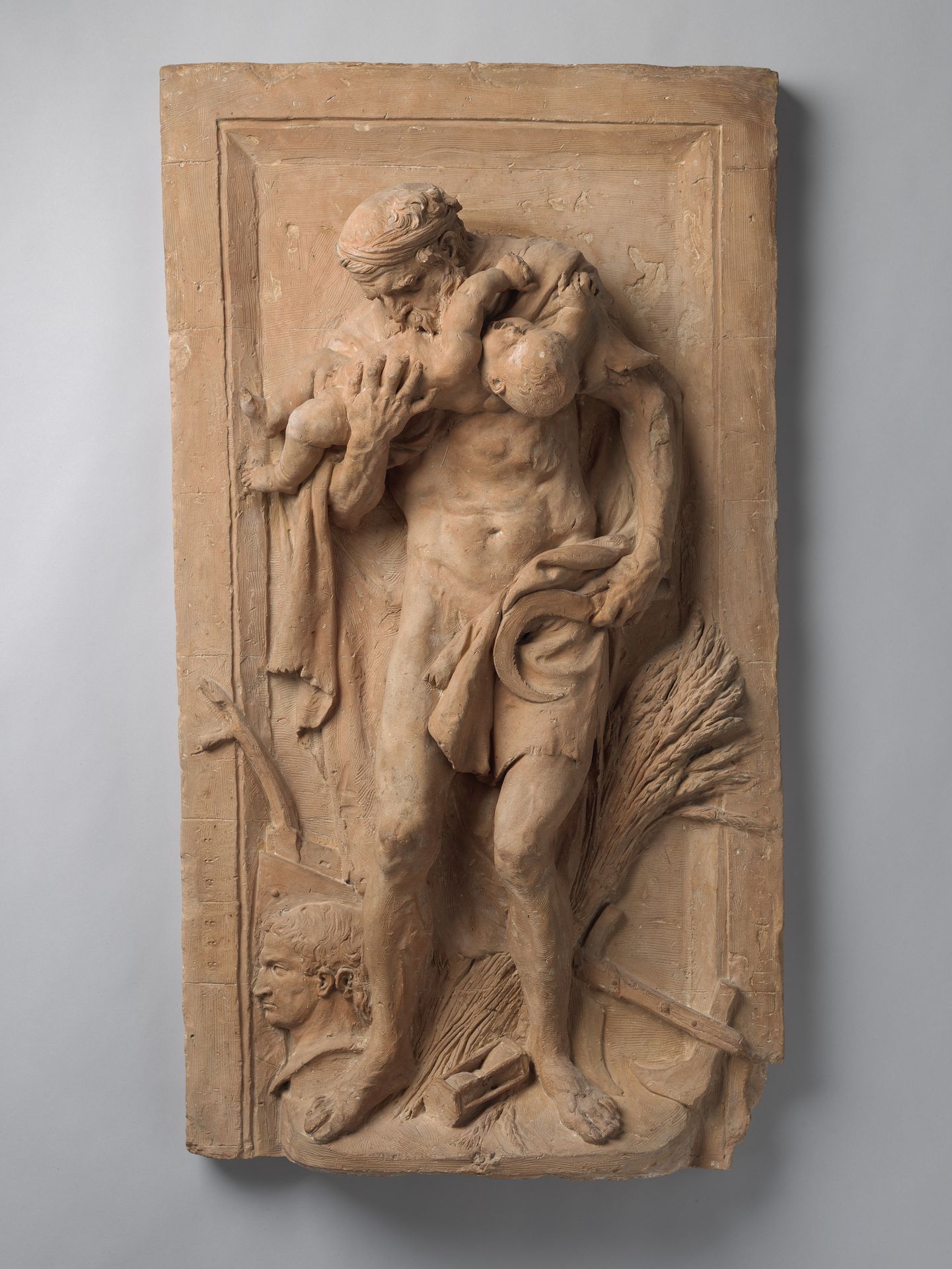
Editor: So, this terracotta relief is “Saturn, Model for a High Relief in the Amsterdam Town Hall” created around 1652-1653 by Artus Quellinus. It's imposing and dramatic, and evokes such a tragic feeling. What can you tell me about it? Curator: It’s powerful, isn't it? Notice how Saturn, a titan from mythology, dominates the composition. What do you make of his holding the child? Editor: It's... unsettling. He’s got one child on his shoulder and seems to be concealing a sickle in his hand. What does it mean? Curator: Saturn, or Chronos in Greek, was fated to be overthrown by his own son. To prevent this, he devoured each of his children at birth. Consider how this horrifying act became a symbol of time’s destructive power. Do you see any other details that might amplify this? Editor: Yes, at the base there's wheat, so harvest. But is that also a head in armor, staring forlornly? What could that allude to? Curator: Good observation. The wheat speaks to Saturn's association with agriculture in a post-classical interpretation, but the helmeted head, like the sickle, can refer to Saturn ending all things. Editor: The layered meanings are incredible! From the brutal myth to symbols of both destruction and renewal. So this sculpture wasn't just about telling a story, but conveying deeper philosophical ideas about the cycle of time. Curator: Exactly. It reminds us that symbols evolve and accrue new layers of meaning over centuries. The visual language speaks to our collective cultural memory. Editor: I never thought of symbols carrying so much history! It definitely changes how I view art now. Curator: Mine too. The image continues to challenge us to look deeper at its emotional, psychological, and historical connections.
Saturn, Model for a High Relief in the Amsterdam Town Hall (now Royal Palace) at Dam Square
c. 1652 - 1653

Artus (I) Quellinus
1609 - 1668Location
RijksmuseumArtwork details
- Medium
- relief, sculpture
- Dimensions
- height 86 cm, width 48 cm
- Location
- Rijksmuseum
- Copyright
- Rijks Museum: Open Domain
Tags
Comments
Share your thoughts
About this artwork
Editor: So, this terracotta relief is “Saturn, Model for a High Relief in the Amsterdam Town Hall” created around 1652-1653 by Artus Quellinus. It's imposing and dramatic, and evokes such a tragic feeling. What can you tell me about it? Curator: It’s powerful, isn't it? Notice how Saturn, a titan from mythology, dominates the composition. What do you make of his holding the child? Editor: It's... unsettling. He’s got one child on his shoulder and seems to be concealing a sickle in his hand. What does it mean? Curator: Saturn, or Chronos in Greek, was fated to be overthrown by his own son. To prevent this, he devoured each of his children at birth. Consider how this horrifying act became a symbol of time’s destructive power. Do you see any other details that might amplify this? Editor: Yes, at the base there's wheat, so harvest. But is that also a head in armor, staring forlornly? What could that allude to? Curator: Good observation. The wheat speaks to Saturn's association with agriculture in a post-classical interpretation, but the helmeted head, like the sickle, can refer to Saturn ending all things. Editor: The layered meanings are incredible! From the brutal myth to symbols of both destruction and renewal. So this sculpture wasn't just about telling a story, but conveying deeper philosophical ideas about the cycle of time. Curator: Exactly. It reminds us that symbols evolve and accrue new layers of meaning over centuries. The visual language speaks to our collective cultural memory. Editor: I never thought of symbols carrying so much history! It definitely changes how I view art now. Curator: Mine too. The image continues to challenge us to look deeper at its emotional, psychological, and historical connections.
Comments
Share your thoughts