About this artwork
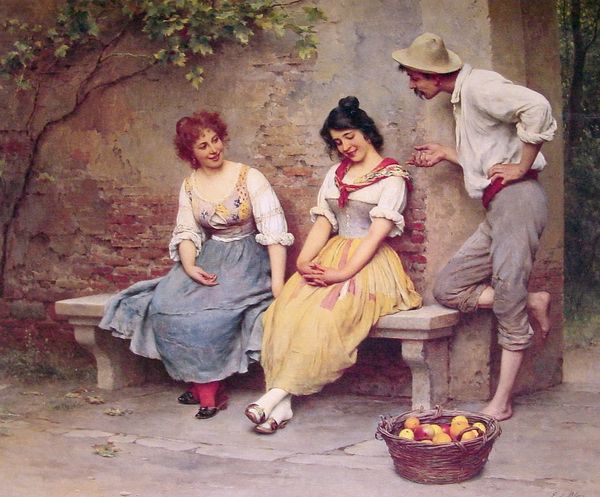
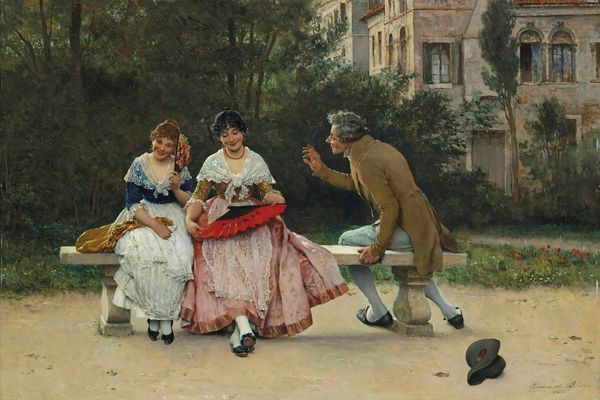
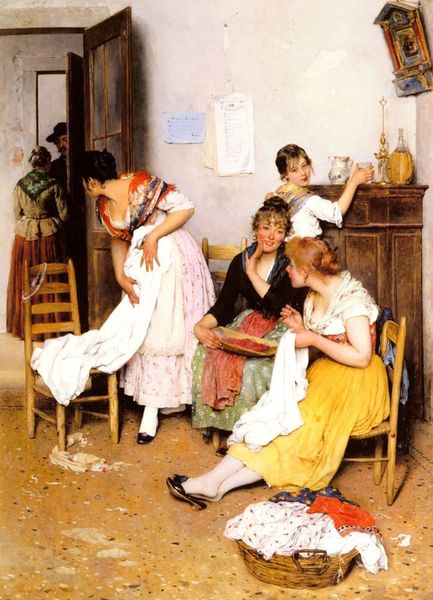
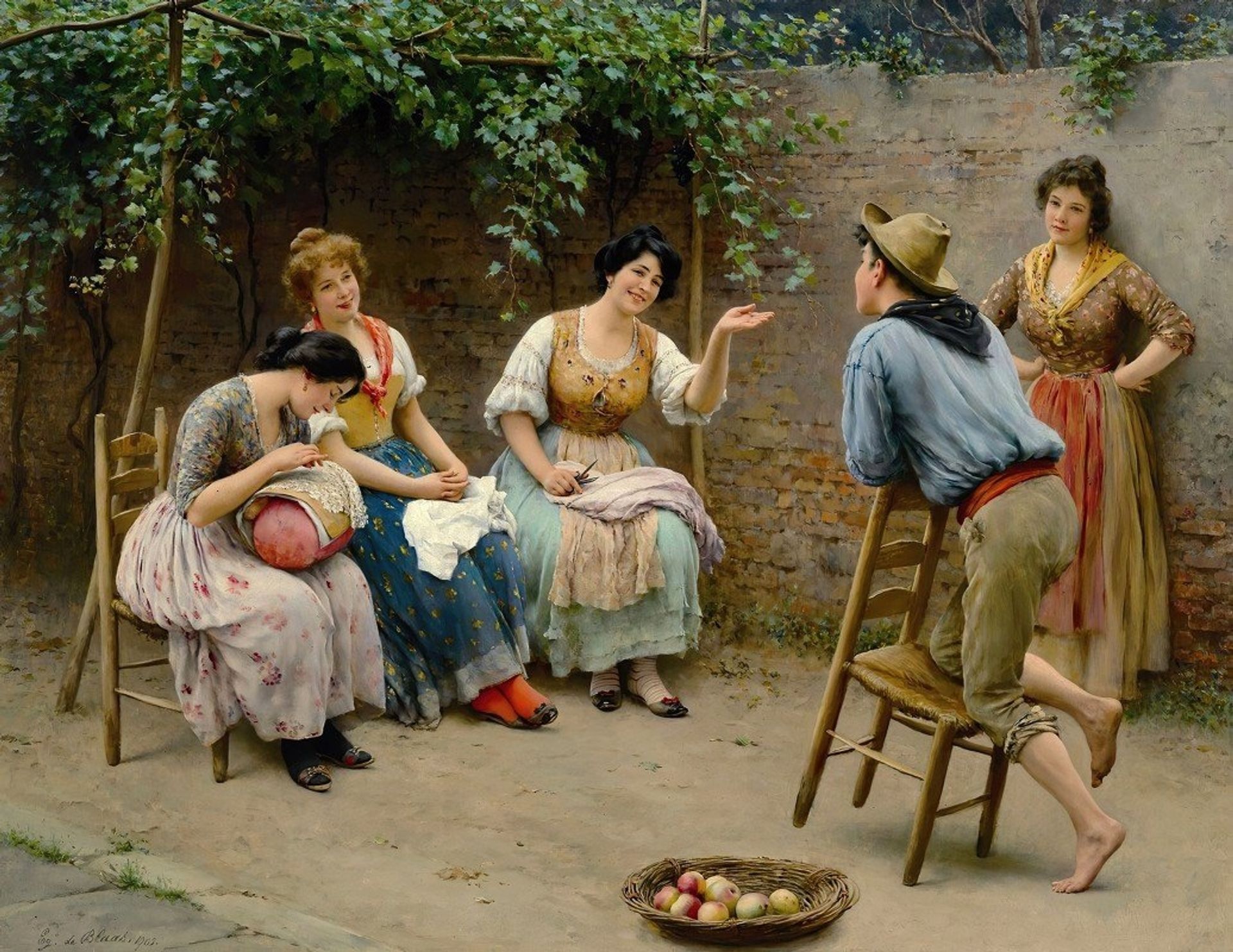
Curator: Here we have Eugen von Blaas’ painting "Plauderei," created around 1905. It's an oil painting portraying a genre scene. Editor: Immediately, I'm struck by the scene’s playful intimacy. The soft light, the women’s ornate attire – it feels deliberately idealized. There's almost an artificiality, wouldn't you say? Curator: Yes, there is a sense of idealized beauty here, perfectly reflective of the Academic style so favored in this time. The artist meticulously captures fabric textures and facial expressions, adding to the feeling that a perfect story is unfolding. Editor: That idealized world, though, feels at odds with the realities of working-class women at the turn of the century. There’s a tension between the presented narrative of jovial chatter and the likely social constraints placed on women. We have to read those absences. Curator: Perhaps. But is it fair to critique it by standards of social realism? The apple basket, the hanging vine, they contribute to the symbolism. One sees cycles of nature as a mirror to their work, hinting to us about traditional values in rural life, too. Editor: That ‘tradition’ needs unpacking. These romanticized depictions of rural life were often deployed to reinforce conservative gender roles and obscure social hierarchies. The male figure—propped on a chair—interrupts what may be their work with his story. We can read it in the light of their roles within patriarchy. Curator: True enough; the placement of the male figure certainly changes the story’s dynamic. Editor: Ultimately, the piece invites us to question the relationship between representation and lived experience. The symbols don’t exist in a vacuum. Curator: Indeed, it’s the push and pull between surface appearance and deeper implications that continues to provoke dialogue about "Plauderei". Editor: For me, that constant critical dialogue with visual heritage is really what allows these pieces to have new lives, and impact beyond their surface image.

Artwork details
- Copyright
- Public Domain: Artvee
Comments
Share your thoughts
About this artwork
Curator: Here we have Eugen von Blaas’ painting "Plauderei," created around 1905. It's an oil painting portraying a genre scene. Editor: Immediately, I'm struck by the scene’s playful intimacy. The soft light, the women’s ornate attire – it feels deliberately idealized. There's almost an artificiality, wouldn't you say? Curator: Yes, there is a sense of idealized beauty here, perfectly reflective of the Academic style so favored in this time. The artist meticulously captures fabric textures and facial expressions, adding to the feeling that a perfect story is unfolding. Editor: That idealized world, though, feels at odds with the realities of working-class women at the turn of the century. There’s a tension between the presented narrative of jovial chatter and the likely social constraints placed on women. We have to read those absences. Curator: Perhaps. But is it fair to critique it by standards of social realism? The apple basket, the hanging vine, they contribute to the symbolism. One sees cycles of nature as a mirror to their work, hinting to us about traditional values in rural life, too. Editor: That ‘tradition’ needs unpacking. These romanticized depictions of rural life were often deployed to reinforce conservative gender roles and obscure social hierarchies. The male figure—propped on a chair—interrupts what may be their work with his story. We can read it in the light of their roles within patriarchy. Curator: True enough; the placement of the male figure certainly changes the story’s dynamic. Editor: Ultimately, the piece invites us to question the relationship between representation and lived experience. The symbols don’t exist in a vacuum. Curator: Indeed, it’s the push and pull between surface appearance and deeper implications that continues to provoke dialogue about "Plauderei". Editor: For me, that constant critical dialogue with visual heritage is really what allows these pieces to have new lives, and impact beyond their surface image.
Comments
Share your thoughts