About this artwork
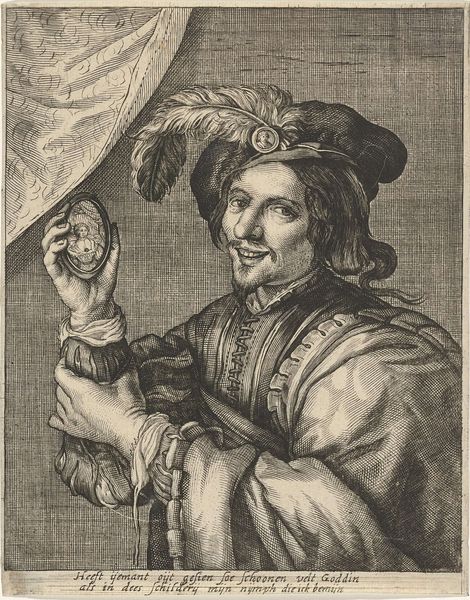
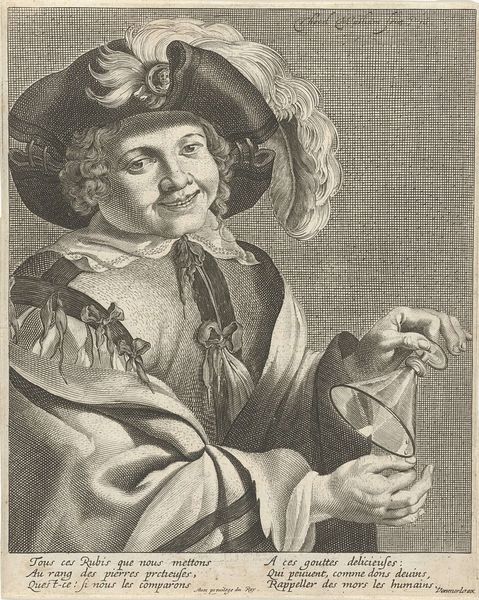
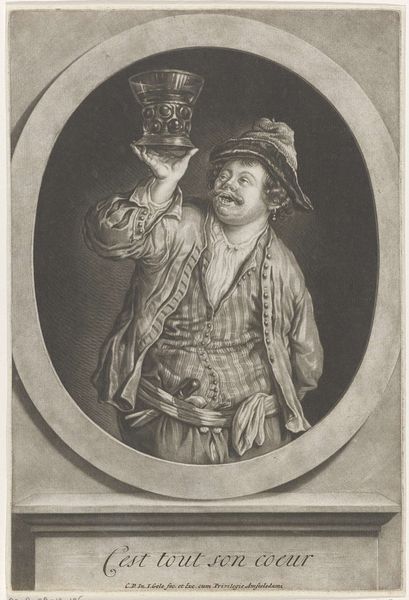
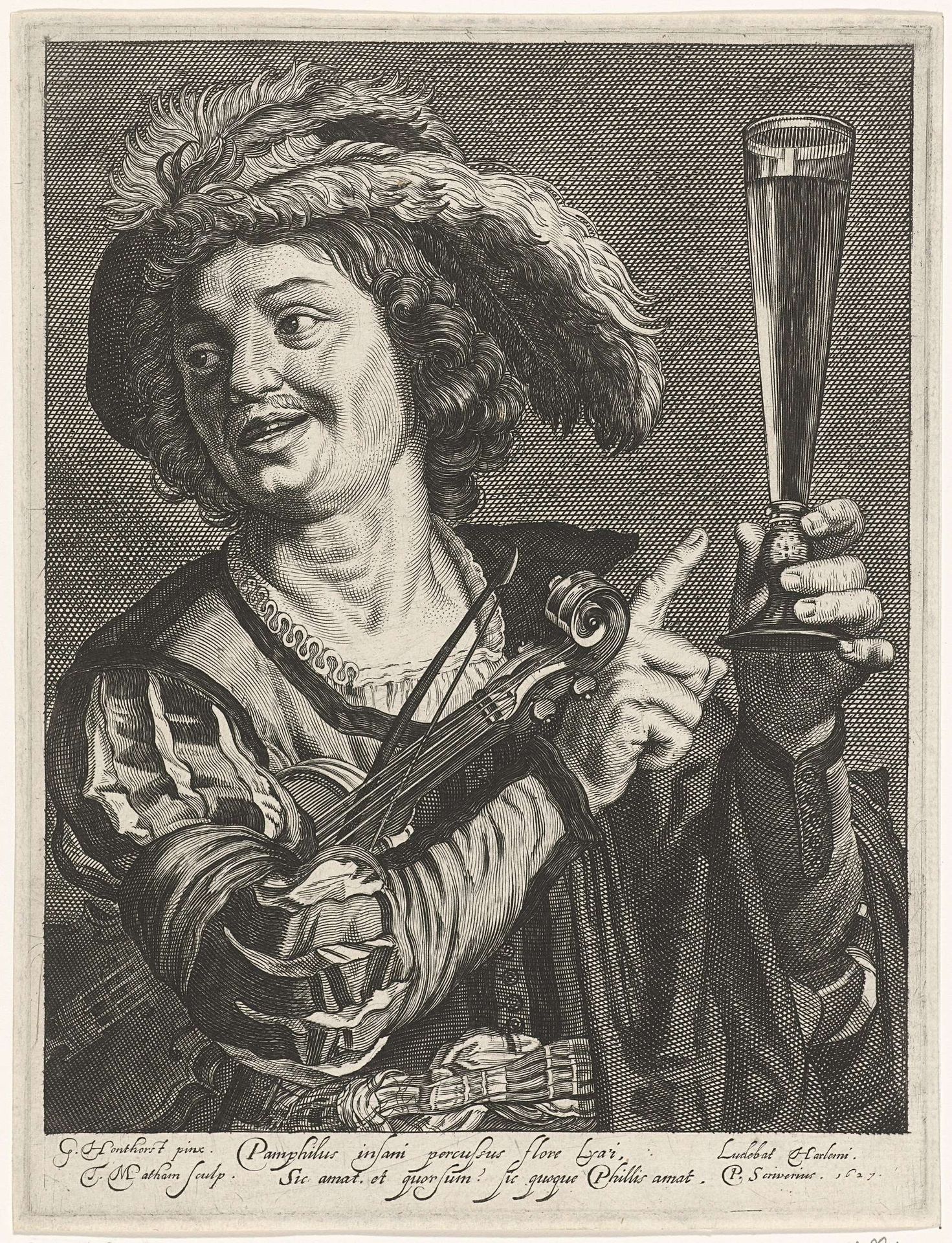
Editor: Here we have Theodor Matham’s “Man wijst naar glas in linkerhand,” an engraving from 1627, currently held at the Rijksmuseum. There’s almost a manic energy to this character; his expression and posture are… theatrical, I guess? What do you see in this piece? Curator: I see a rich tapestry of symbolism interwoven with societal commentary. The glass itself, prominently displayed, transcends its function. What does it represent in the context of 17th-century Dutch culture? Perhaps indulgence, merriment, or even the transience of earthly pleasures? Note the juxtaposition of the violin - a symbol of harmony and art - with the rather unrefined gesture and facial expression. Editor: So, there’s a kind of contrast happening? Between… refinement and something coarser? Curator: Precisely! Consider how this interplay reveals a deeper commentary on social classes, on ideals versus reality. Is he a court jester, a drunken musician, a satirical representation of the bourgeoisie? Or does it perhaps explore our emotional and psychological relationship with material culture. Editor: The glass, the violin… almost props in a performance? Curator: Indeed. Ask yourself, what narrative do these symbols create together? The gaze directed towards the glass -- does it hint at a fleeting joy, a dependence, a warning? Matham is inviting us to look deeper than just the surface-level representation of a man with a drink. Editor: That makes me think about how much an artist relies on existing cultural understandings to get their message across. Thank you! Curator: My pleasure, it’s always fascinating to uncover those layers and discover how much the past continues to speak to us.

Artwork details
- Medium
- glass, engraving
- Dimensions
- height 210 mm, width 159 mm
- Location
- Rijksmuseum
- Copyright
- Rijks Museum: Open Domain
Tags
Comments
Share your thoughts
About this artwork
Editor: Here we have Theodor Matham’s “Man wijst naar glas in linkerhand,” an engraving from 1627, currently held at the Rijksmuseum. There’s almost a manic energy to this character; his expression and posture are… theatrical, I guess? What do you see in this piece? Curator: I see a rich tapestry of symbolism interwoven with societal commentary. The glass itself, prominently displayed, transcends its function. What does it represent in the context of 17th-century Dutch culture? Perhaps indulgence, merriment, or even the transience of earthly pleasures? Note the juxtaposition of the violin - a symbol of harmony and art - with the rather unrefined gesture and facial expression. Editor: So, there’s a kind of contrast happening? Between… refinement and something coarser? Curator: Precisely! Consider how this interplay reveals a deeper commentary on social classes, on ideals versus reality. Is he a court jester, a drunken musician, a satirical representation of the bourgeoisie? Or does it perhaps explore our emotional and psychological relationship with material culture. Editor: The glass, the violin… almost props in a performance? Curator: Indeed. Ask yourself, what narrative do these symbols create together? The gaze directed towards the glass -- does it hint at a fleeting joy, a dependence, a warning? Matham is inviting us to look deeper than just the surface-level representation of a man with a drink. Editor: That makes me think about how much an artist relies on existing cultural understandings to get their message across. Thank you! Curator: My pleasure, it’s always fascinating to uncover those layers and discover how much the past continues to speak to us.
Comments
Share your thoughts