About this artwork
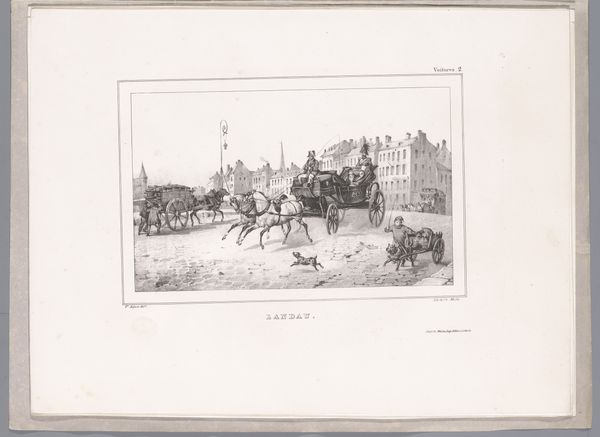
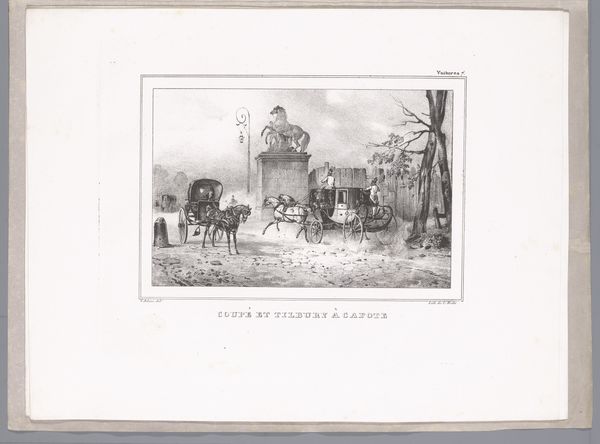
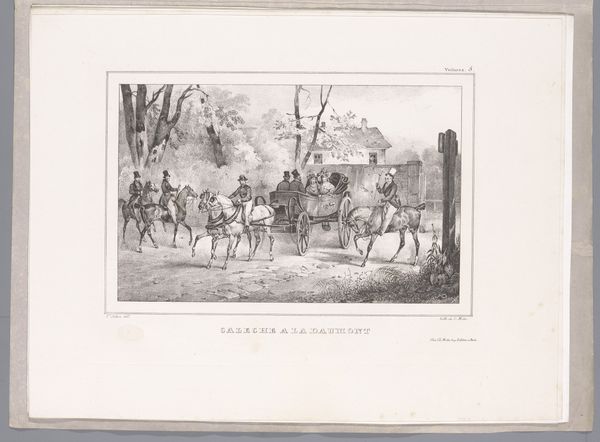
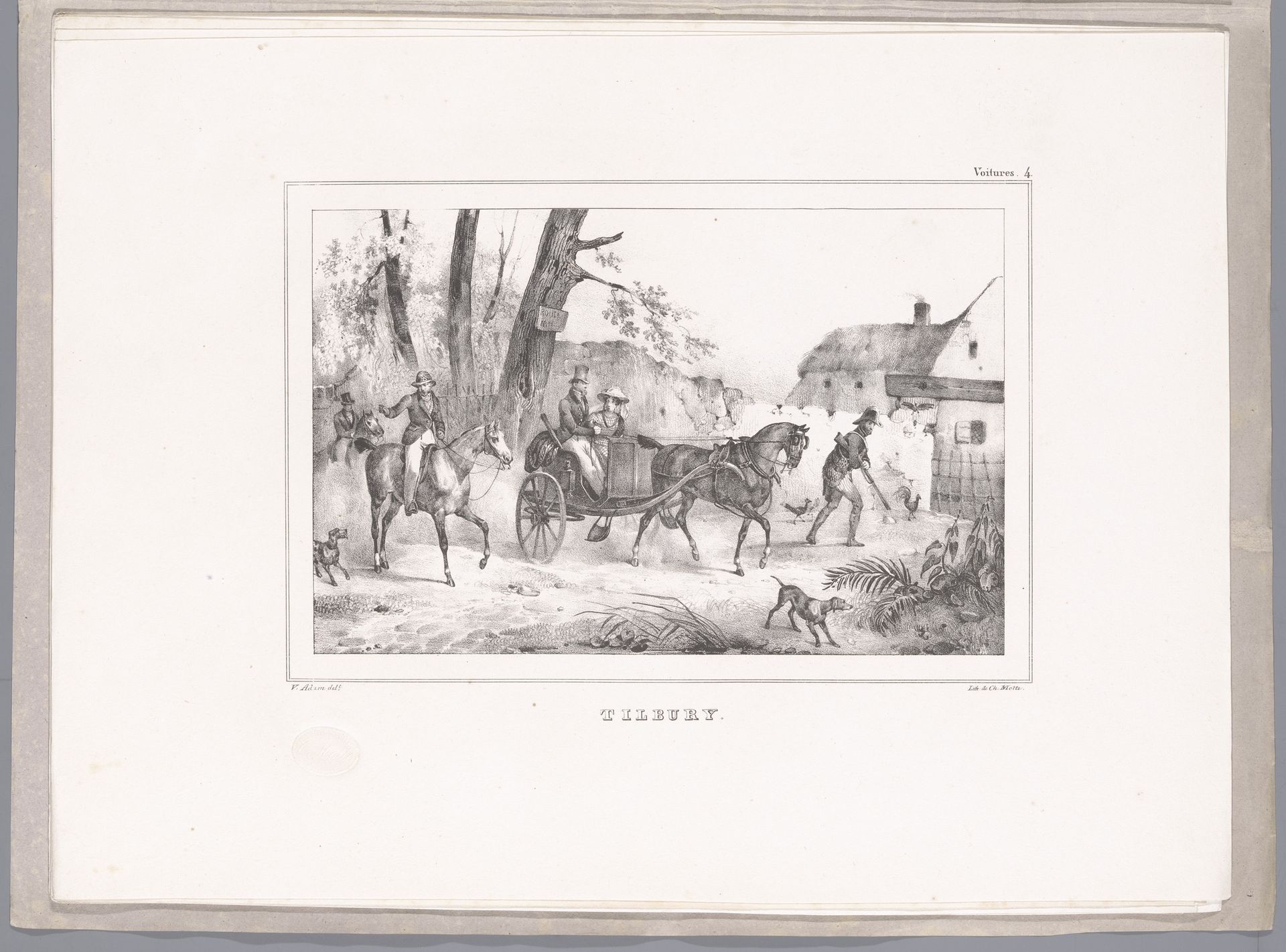
Editor: This engraving by Victor Adam, created around 1827-1828, is called "Echtpaar onderweg in een tilbury," or "Couple traveling in a tilbury". It has such a peaceful feeling, and a snapshot into another time. What do you see in this piece? Curator: What immediately strikes me is the conveyance itself, the tilbury. Think of it as a stage, setting the scene not just for a journey, but for a specific class identity. The very term "tilbury" signals a certain aspiration to upward mobility and the inherent leisure associated with travel, a sharp contrast to more utilitarian carts. Do you notice anything particular about the passengers' expressions or attire? Editor: They look quite relaxed, perhaps even a little proud, but also very ordinary. What does their attire say about them? Curator: Precisely, "ordinary" is a potent observation. While the tilbury represents a certain aspiration, the subjects don't necessarily exude aristocracy. They embody the burgeoning middle class, adopting symbols of wealth, signaling a desire for societal integration rather than innate superiority. Even their clothing has symbolic importance, communicating dignity and aspirations within this early Industrial Era context. It's interesting how these seemingly mundane genre scenes carry the weight of social mobility, isn't it? What has stayed with you? Editor: Definitely, noticing how a simple carriage can tell us so much about society and how people perceived themselves. I never thought of it that way before. Curator: Indeed. It is these everyday items depicted in artworks that show us what people valued, aspired to, and how they defined their place in society through visual representation.

Artwork details
- Medium
- drawing, print, engraving
- Dimensions
- height 255 mm, width 351 mm
- Location
- Rijksmuseum
- Copyright
- Rijks Museum: Open Domain
Tags
Comments
Share your thoughts
About this artwork
Editor: This engraving by Victor Adam, created around 1827-1828, is called "Echtpaar onderweg in een tilbury," or "Couple traveling in a tilbury". It has such a peaceful feeling, and a snapshot into another time. What do you see in this piece? Curator: What immediately strikes me is the conveyance itself, the tilbury. Think of it as a stage, setting the scene not just for a journey, but for a specific class identity. The very term "tilbury" signals a certain aspiration to upward mobility and the inherent leisure associated with travel, a sharp contrast to more utilitarian carts. Do you notice anything particular about the passengers' expressions or attire? Editor: They look quite relaxed, perhaps even a little proud, but also very ordinary. What does their attire say about them? Curator: Precisely, "ordinary" is a potent observation. While the tilbury represents a certain aspiration, the subjects don't necessarily exude aristocracy. They embody the burgeoning middle class, adopting symbols of wealth, signaling a desire for societal integration rather than innate superiority. Even their clothing has symbolic importance, communicating dignity and aspirations within this early Industrial Era context. It's interesting how these seemingly mundane genre scenes carry the weight of social mobility, isn't it? What has stayed with you? Editor: Definitely, noticing how a simple carriage can tell us so much about society and how people perceived themselves. I never thought of it that way before. Curator: Indeed. It is these everyday items depicted in artworks that show us what people valued, aspired to, and how they defined their place in society through visual representation.
Comments
Share your thoughts