About this artwork
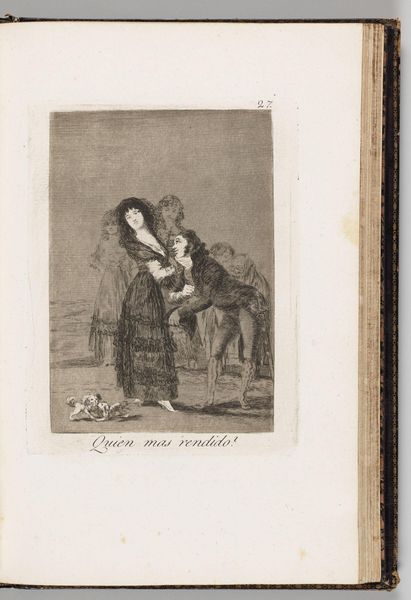
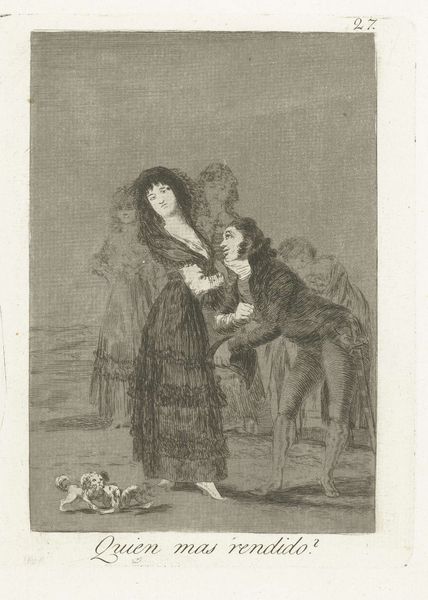
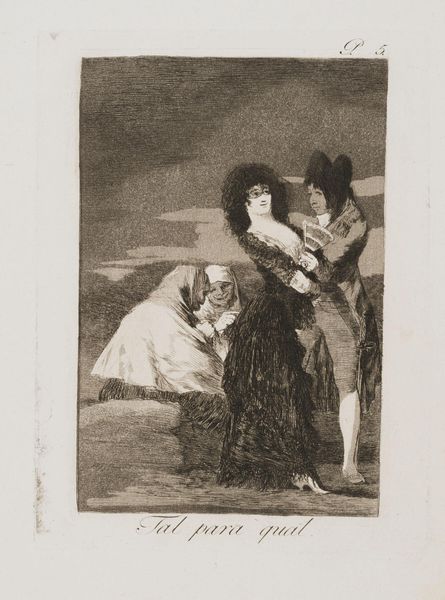
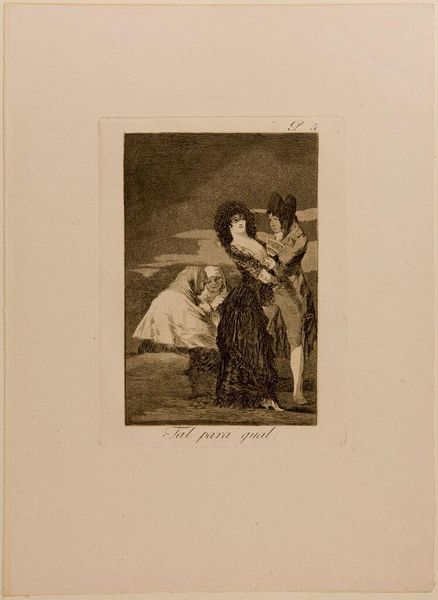
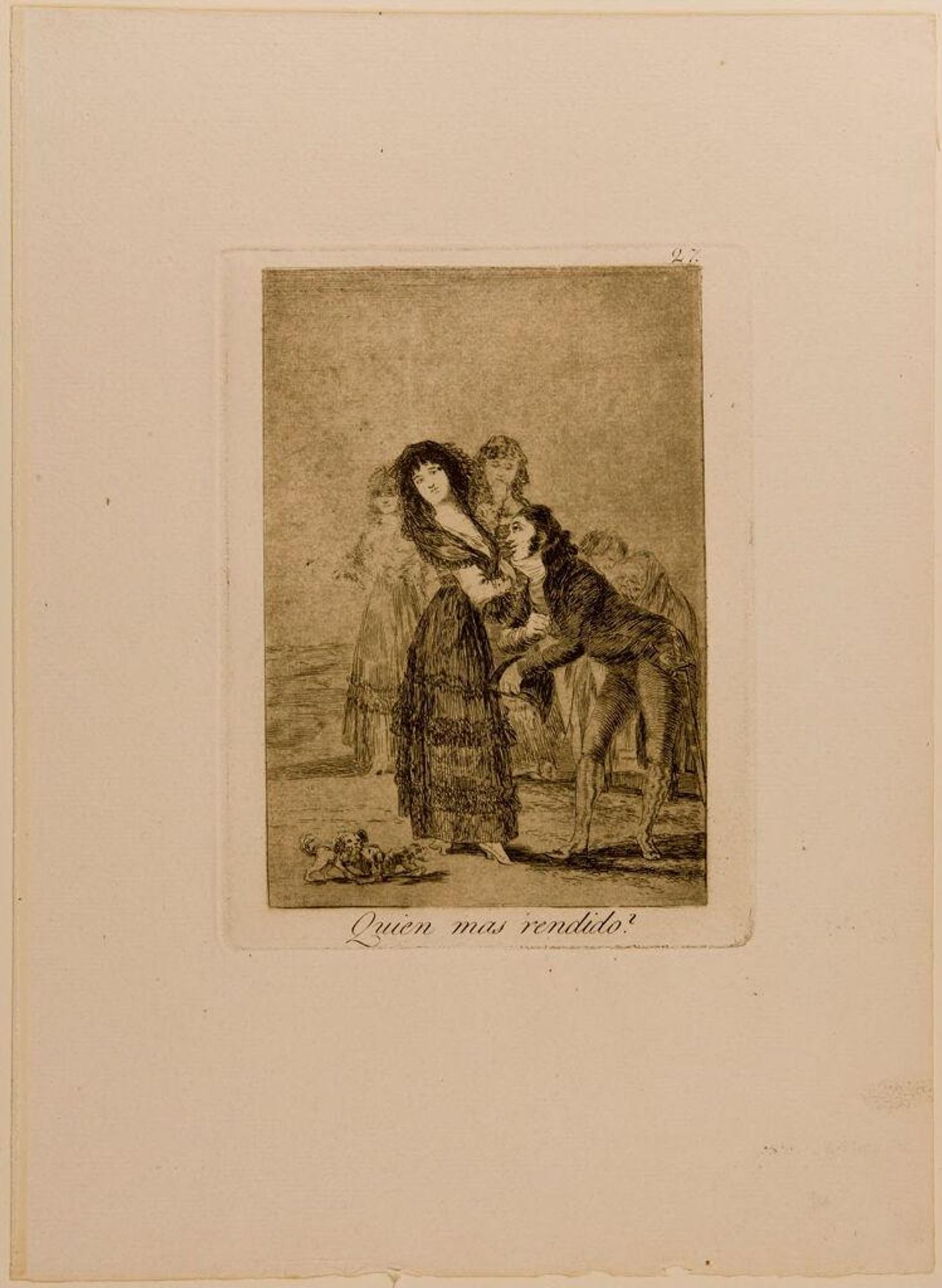
Curator: Goya's print, "Which is the More Overcome?", presents a curious scene. My first impression is a rather unsettling tension between the figures. Editor: Indeed. Focusing on the materiality, Goya’s aquatint technique is quite evident, creating those grainy tonal effects. It’s a process involving acid-etching around resin particles. Curator: Consider the social context. The title itself hints at commentary on power dynamics, the man seemingly enthralled, but the woman... is she truly victorious? Editor: The composition is key. Note how the woman's gaze is directed outward, engaging the viewer, while the man's is fixated, almost desperate. Curator: It makes one consider the labor involved in its production and the market that consumed such imagery. Were these critiques intended for a specific audience aware of these societal imbalances? Editor: Ultimately, the etching's stark contrast emphasizes the underlying psychological drama. It's not merely about who's winning, but about the performance of power itself. Curator: Exactly. It's a commentary wrapped in exquisite, though unsettling, detail. Editor: A powerful exploration of social dynamics, indeed.
Which is the More Overcome? 18th-19th century
Francisco José de Goya y Lucientes
@franciscojosadegoyaylucientes
Harvard Art Museums
Harvard Art MuseumsArtwork details
- Location
- Harvard Art Museums
- Copyright
- CC0 1.0
Comments
No comments
About this artwork
Curator: Goya's print, "Which is the More Overcome?", presents a curious scene. My first impression is a rather unsettling tension between the figures. Editor: Indeed. Focusing on the materiality, Goya’s aquatint technique is quite evident, creating those grainy tonal effects. It’s a process involving acid-etching around resin particles. Curator: Consider the social context. The title itself hints at commentary on power dynamics, the man seemingly enthralled, but the woman... is she truly victorious? Editor: The composition is key. Note how the woman's gaze is directed outward, engaging the viewer, while the man's is fixated, almost desperate. Curator: It makes one consider the labor involved in its production and the market that consumed such imagery. Were these critiques intended for a specific audience aware of these societal imbalances? Editor: Ultimately, the etching's stark contrast emphasizes the underlying psychological drama. It's not merely about who's winning, but about the performance of power itself. Curator: Exactly. It's a commentary wrapped in exquisite, though unsettling, detail. Editor: A powerful exploration of social dynamics, indeed.
Comments
No comments