About this artwork
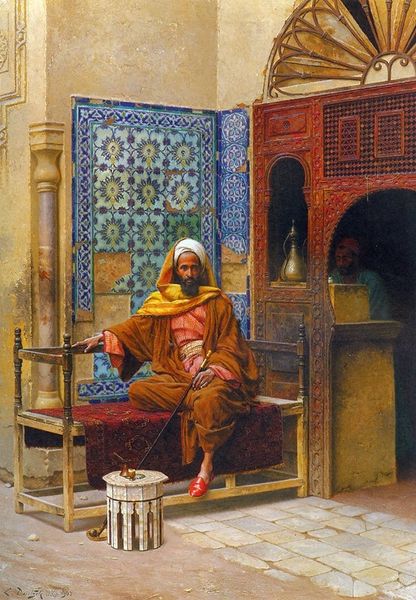
Ludwig Deutsch painted this oil on panel, entitled 'At the Mosque', sometime between the late 19th and early 20th century. Here, materials tell a complex story. Deutsch presents a Black man, possibly a guard or servant, rendered with careful attention to his garments and skin tone. The artist has paid equal attention to the exquisite painted tiles, as well as the metal-bound chest, inlaid with intricate patterns. The artist is clearly interested in the aesthetic qualities of these surfaces. But it is easy to forget the labor that went into producing them. The tiles, for example, were not just painted but carefully fired, and the chest was assembled by a skilled metalsmith. These objects would have been destined for an elite market, creating a division of labor – and also, a racial and class hierarchy – which the painting both observes and reinforces. By directing our attention to materiality and the socio-economic context, we can better appreciate the multiple layers of meaning embedded in this seemingly straightforward composition.

Artwork details
- Medium
- painting, oil-paint
- Copyright
- Public Domain: Artvee
Tags
Comments
Share your thoughts
About this artwork
Ludwig Deutsch painted this oil on panel, entitled 'At the Mosque', sometime between the late 19th and early 20th century. Here, materials tell a complex story. Deutsch presents a Black man, possibly a guard or servant, rendered with careful attention to his garments and skin tone. The artist has paid equal attention to the exquisite painted tiles, as well as the metal-bound chest, inlaid with intricate patterns. The artist is clearly interested in the aesthetic qualities of these surfaces. But it is easy to forget the labor that went into producing them. The tiles, for example, were not just painted but carefully fired, and the chest was assembled by a skilled metalsmith. These objects would have been destined for an elite market, creating a division of labor – and also, a racial and class hierarchy – which the painting both observes and reinforces. By directing our attention to materiality and the socio-economic context, we can better appreciate the multiple layers of meaning embedded in this seemingly straightforward composition.
Comments
Share your thoughts