About this artwork
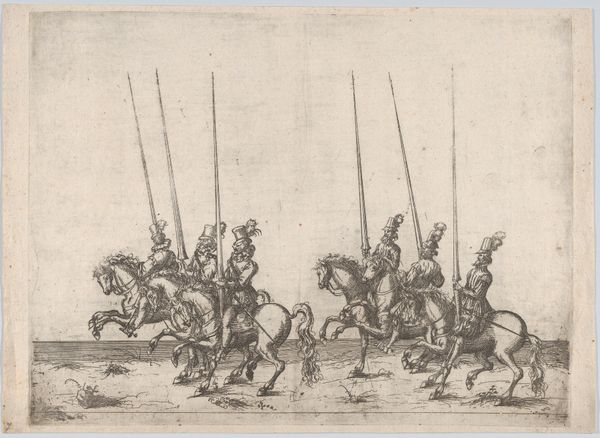
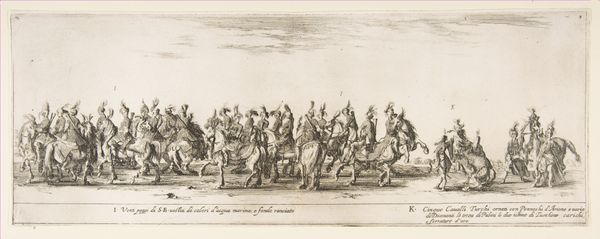
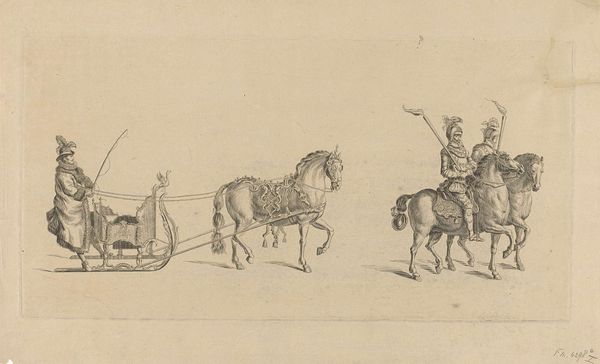
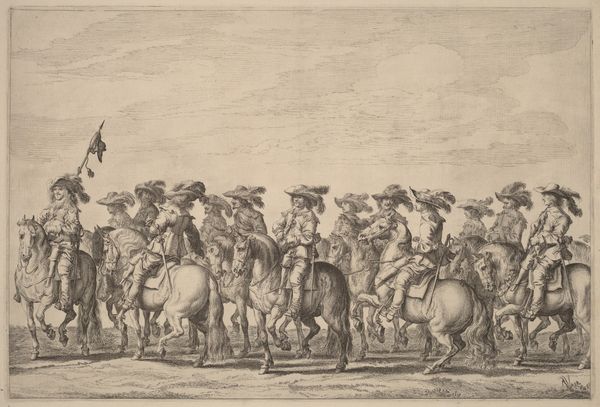
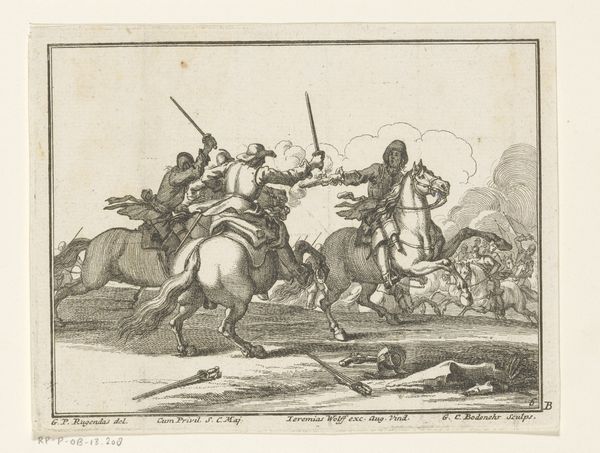
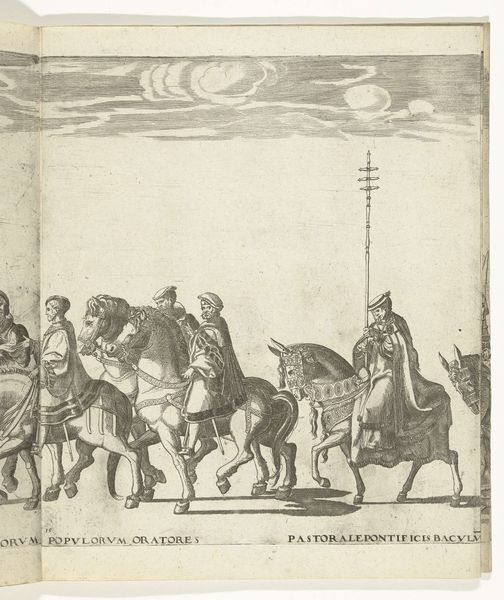
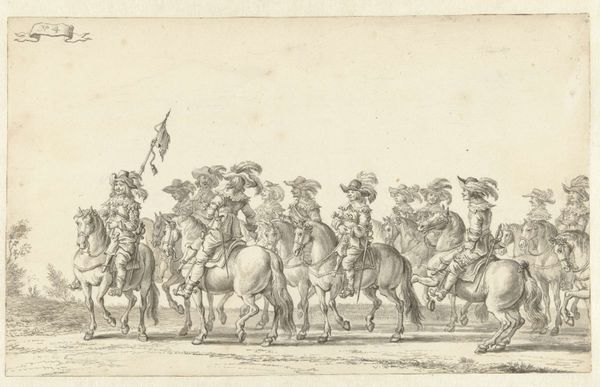
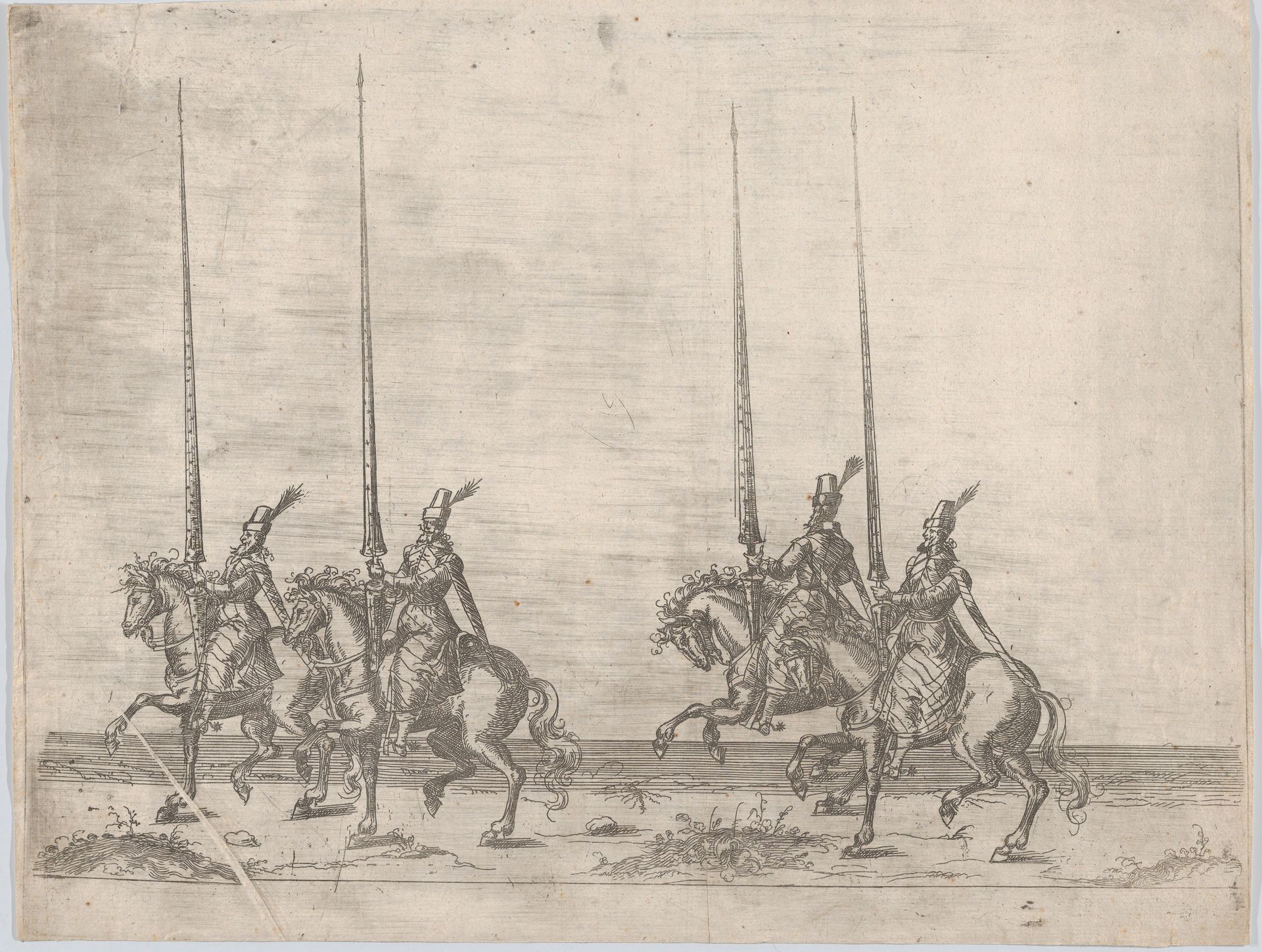
Editor: This engraving, titled "Procession, with four men riding horses," is from the 16th century and created by an anonymous artist. It has an austere quality. What immediately strikes me is how the verticality of the spears contrasts with the horizontal movement of the horses. What do you see in this piece from a formal perspective? Curator: The linear quality is paramount; note how the artist meticulously delineates each figure and element. The emphasis on line, rather than shading or tonal variation, flattens the space and draws attention to the rhythmic repetition of forms: the horses, the riders, and especially the lances. This repetition creates a visual cadence, a procession of visual elements that echoes the subject itself. Do you observe how the composition is divided? Editor: I do. There seem to be two distinct groups. Is this division significant in terms of the piece's structure? Curator: Indeed. The division can be interpreted as a formal device, creating balance while simultaneously inviting comparison. The minute variations in the riders' postures and the horses' gaits become more apparent through this juxtaposition. Observe also the artist's restraint. The landscape is minimal, almost abstract. Editor: So the artist's focus really is on the figures themselves and how they interact visually. I never thought of it that way before! Curator: Precisely. The reduction of extraneous detail directs our attention to the relationships between line, form, and rhythm within the composition. The engraving prompts us to consider how formal elements alone can convey meaning and aesthetic value. What is your understanding now? Editor: Now I can see that it is not simply a historical scene but an exercise in line and form, using those stark visual components to establish hierarchy, motion, and potentially narrative, within the pictorial space. Thank you!
Procession, with four men riding horses
16th century


Artwork details
- Medium
- drawing, print, engraving
- Dimensions
- Sheet: 13 3/16 × 17 1/4 in. (33.5 × 43.8 cm) Plate: 11 5/8 × 16 15/16 in. (29.5 × 43 cm)
- Location
- Metropolitan Museum of Art, New York, NY
- Copyright
- Public Domain
Tags
Comments
Share your thoughts
About this artwork
Editor: This engraving, titled "Procession, with four men riding horses," is from the 16th century and created by an anonymous artist. It has an austere quality. What immediately strikes me is how the verticality of the spears contrasts with the horizontal movement of the horses. What do you see in this piece from a formal perspective? Curator: The linear quality is paramount; note how the artist meticulously delineates each figure and element. The emphasis on line, rather than shading or tonal variation, flattens the space and draws attention to the rhythmic repetition of forms: the horses, the riders, and especially the lances. This repetition creates a visual cadence, a procession of visual elements that echoes the subject itself. Do you observe how the composition is divided? Editor: I do. There seem to be two distinct groups. Is this division significant in terms of the piece's structure? Curator: Indeed. The division can be interpreted as a formal device, creating balance while simultaneously inviting comparison. The minute variations in the riders' postures and the horses' gaits become more apparent through this juxtaposition. Observe also the artist's restraint. The landscape is minimal, almost abstract. Editor: So the artist's focus really is on the figures themselves and how they interact visually. I never thought of it that way before! Curator: Precisely. The reduction of extraneous detail directs our attention to the relationships between line, form, and rhythm within the composition. The engraving prompts us to consider how formal elements alone can convey meaning and aesthetic value. What is your understanding now? Editor: Now I can see that it is not simply a historical scene but an exercise in line and form, using those stark visual components to establish hierarchy, motion, and potentially narrative, within the pictorial space. Thank you!
Comments
Share your thoughts