About this artwork
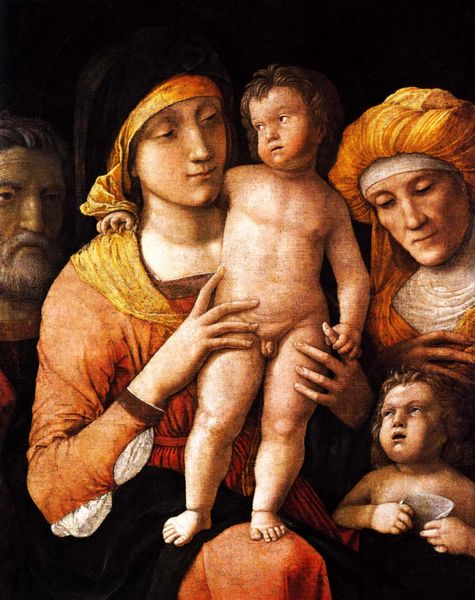
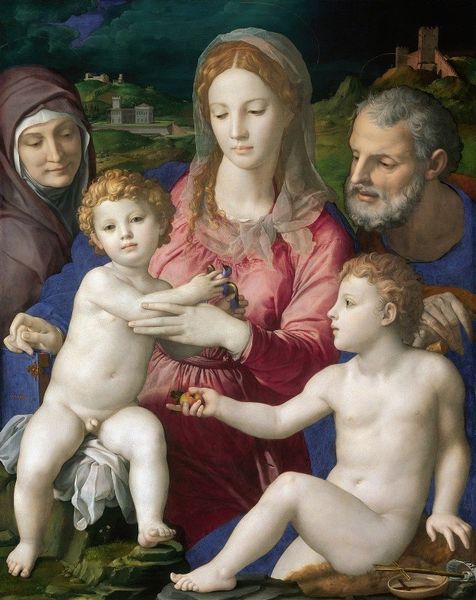
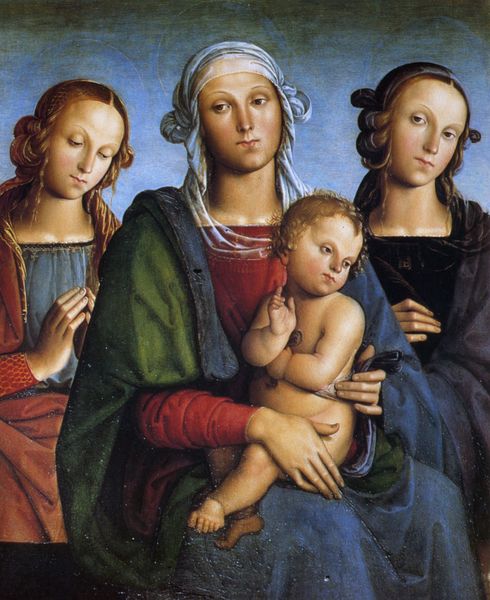
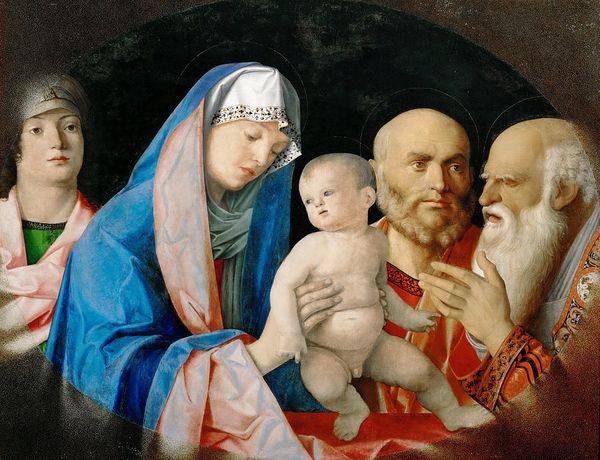
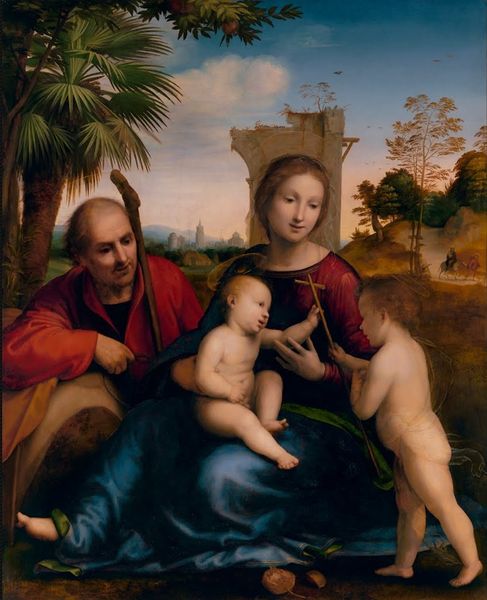
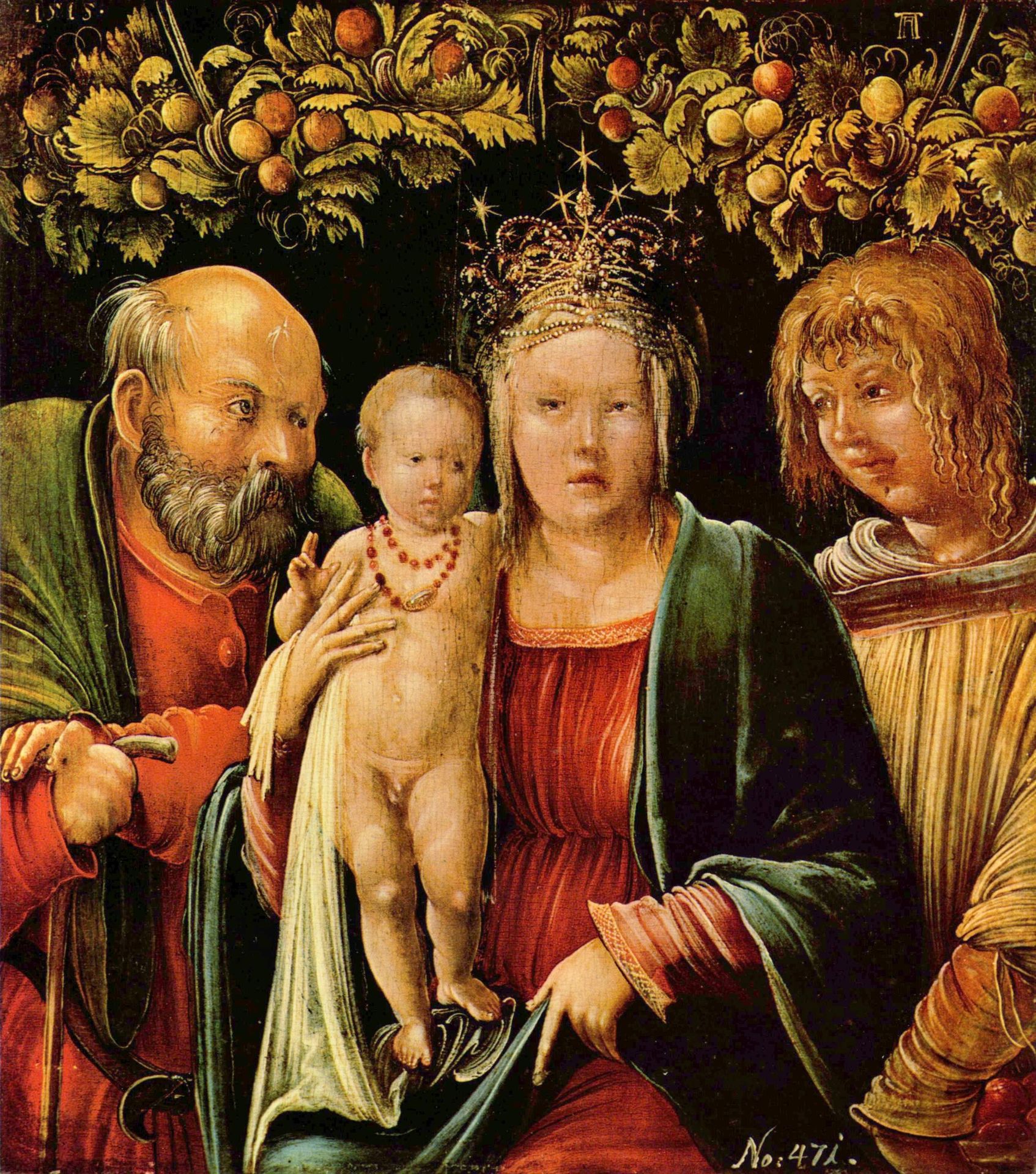
Editor: We're looking at "Holy Family with an Angel" by Albrecht Altdorfer, painted around 1515 using oil paints. It’s currently housed at the Kunsthistorisches Museum in Vienna. I'm struck by the close grouping of the figures and the somewhat flat perspective. What strikes you most about its composition? Curator: It's indeed a tightly knit group, and Altdorfer, consistent with the Northern Renaissance, demonstrates a keen eye for detail, wouldn't you agree? The intricate folds in their clothing and the precise rendering of their facial features point to a dedication to meticulous craftsmanship, yet do these details fully succeed at creating spatial depth or a truly convincing sense of volume? Note how the forms tend to flatten against the dark background, particularly the areas of rich color saturation and line. Editor: I see that now! The lack of strong chiaroscuro flattens everything. Does that push the focus to the subjects themselves and their expressions? Curator: Possibly, although the rendering of the faces could hardly be called expressive. Notice how the composition utilizes symmetry; observe the distribution of figures and colors. Can you decode any system of structural organization that provides some logic to the artwork? How are the primary colors balanced? Editor: Hmm. I guess I hadn't thought of it that way. I was stuck on the direct representation and subject! It's like the artist uses this symmetry to direct us... like mathematical, formal! Curator: Precisely. Formal analysis compels us to move beyond initial impressions and uncover these underlying formal structures. That sort of precision reveals the essence of the image’s design, rather than dwelling merely on its narrative content. Editor: I appreciate seeing it that way. Focusing on structure offers a new way to think about this piece, moving beyond just subject matter!
Holy Family with an Angel 1515


Artwork details
- Medium
- oil-paint
- Dimensions
- 22.5 x 20.5 cm
- Location
- Kunsthistorisches Museum, Vienna, Austria
- Copyright
- Public domain
Tags
portrait
oil-paint
figuration
11_renaissance
oil painting
history-painting
northern-renaissance
angel
christ
Comments
No comments
About this artwork
Editor: We're looking at "Holy Family with an Angel" by Albrecht Altdorfer, painted around 1515 using oil paints. It’s currently housed at the Kunsthistorisches Museum in Vienna. I'm struck by the close grouping of the figures and the somewhat flat perspective. What strikes you most about its composition? Curator: It's indeed a tightly knit group, and Altdorfer, consistent with the Northern Renaissance, demonstrates a keen eye for detail, wouldn't you agree? The intricate folds in their clothing and the precise rendering of their facial features point to a dedication to meticulous craftsmanship, yet do these details fully succeed at creating spatial depth or a truly convincing sense of volume? Note how the forms tend to flatten against the dark background, particularly the areas of rich color saturation and line. Editor: I see that now! The lack of strong chiaroscuro flattens everything. Does that push the focus to the subjects themselves and their expressions? Curator: Possibly, although the rendering of the faces could hardly be called expressive. Notice how the composition utilizes symmetry; observe the distribution of figures and colors. Can you decode any system of structural organization that provides some logic to the artwork? How are the primary colors balanced? Editor: Hmm. I guess I hadn't thought of it that way. I was stuck on the direct representation and subject! It's like the artist uses this symmetry to direct us... like mathematical, formal! Curator: Precisely. Formal analysis compels us to move beyond initial impressions and uncover these underlying formal structures. That sort of precision reveals the essence of the image’s design, rather than dwelling merely on its narrative content. Editor: I appreciate seeing it that way. Focusing on structure offers a new way to think about this piece, moving beyond just subject matter!
Comments
No comments