drawing, print, etching
#
drawing
# print
#
etching
#
realism
Dimensions: height 236 mm, width 321 mm
Copyright: Rijks Museum: Open Domain
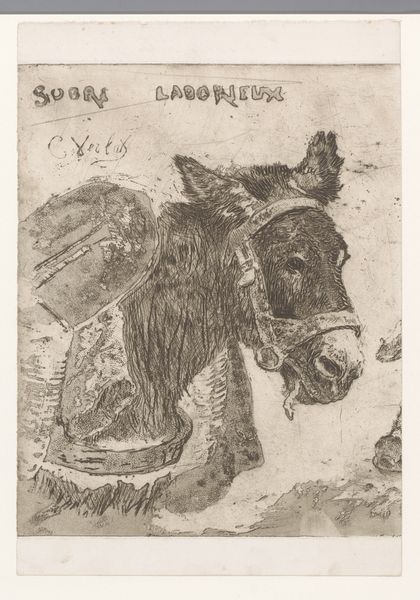
Curator: "Ezel en zwijn," or "Donkey and Pig," an etching by Charles Verlat, dating from after 1880. What jumps out at you? Editor: It’s moody, definitely has a fable-like quality to it. The contrast between the dark, sharply rendered donkey and the softer, almost hazy pig is striking. They are presented as such distinct characters. Curator: Exactly. The animals stand as archetypes. Note the inscription. Above the donkey, we see "Sobre et Laborieux," and above the pig, "Glouton et Paresseux"—temperate and industrious versus gluttonous and lazy. Editor: Yes, you're absolutely right! The writing reinforces the stereotypes immediately. Did people just assume these qualities, or was Verlat critiquing this kind of simplistic labeling? Curator: Likely, both. It’s a classic trope that’s deeply ingrained in Western cultural narratives—the diligent beast of burden contrasted with the pleasure-seeking swine. The imagery echoes Aesop, La Fontaine, really all those fabulist traditions where animals embody human virtues and vices. Editor: It’s quite an unkind depiction of the pig. And I wonder, does ascribing “laborious” as the donkey’s primary trait ignore its own complexities or needs? It is not shown enjoying labor. Curator: Perhaps it reveals a commentary on societal expectations and assigned roles. It feels like Verlat is prompting us to consider how these types cast long shadows, influencing how we perceive both animals and ourselves. Think about it: how often do we fall back on these ingrained binary oppositions? Editor: It's an uncomfortable truth, for sure. This seemingly simple image becomes quite loaded with that in mind. There is nothing whimsical about their presentation here; both seem exhausted by their attributed states. Curator: Well put. Ultimately, "Donkey and Pig" isn’t merely an animal study; it’s an examination of the moral constructs we project onto the world. Editor: It certainly provides fertile ground for self-reflection, then. I'll leave today thinking a bit more carefully about where my inherent biases might originate.
Comments
No comments
Be the first to comment and join the conversation on the ultimate creative platform.
 Collect
 React
React Comment
More like this