About this artwork
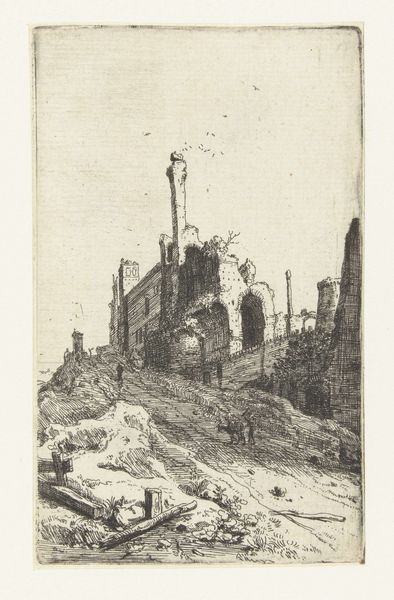
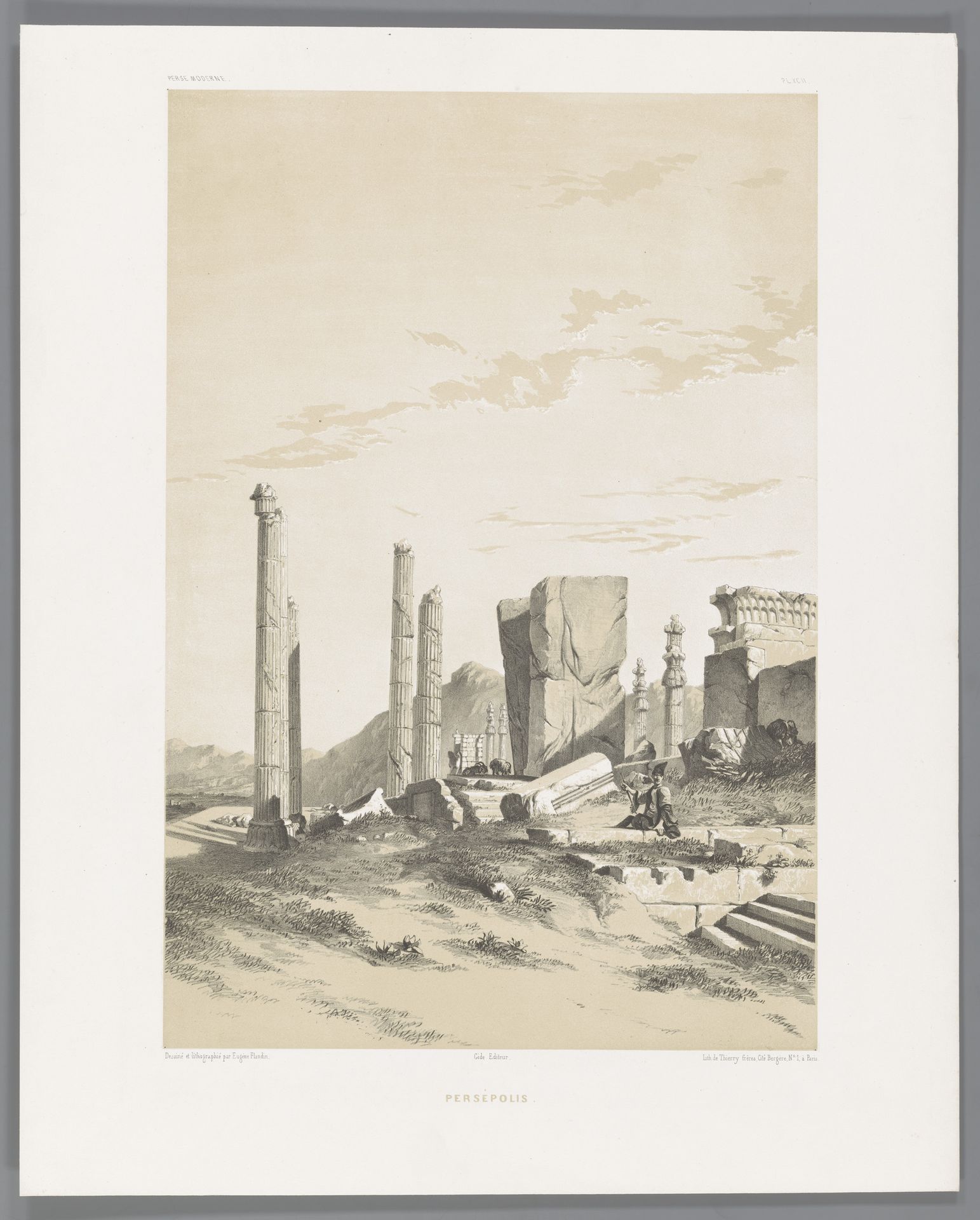
Editor: This is Eugène Flandin's "Ruïne van Persepolis," created between 1843 and 1854 using ink and watercolor on paper. There's such a striking stillness and sense of faded grandeur about it, even in its monochrome palette. What strikes you most about this drawing? Curator: I think what’s fascinating is how Flandin's work participates in the visual language of Orientalism, particularly the European gaze upon the Middle East as a site of both exoticism and decaying empires. How does this image, created during a period of intense colonial interest in Persia, shape our understanding of cultural exchange and power dynamics? Do you notice how the composition emphasizes the ruinous state, almost inviting a sense of European superiority through its depiction of a 'lost' civilization? Editor: That's a perspective I hadn't fully considered. I was focused on the artistic skill, but now I see how it can be interpreted as a statement on cultural dominance. So, it’s not just a depiction of ruins, but a commentary on the perceived decline of a culture. Curator: Precisely. It prompts us to question the intentions and the social context of such representations. Who benefits from portraying a civilization in ruins, and what narrative does that serve? Consider also the absence of contemporary Persian voices or perspectives. Whose history are we really seeing here? Editor: I guess I had naively appreciated its aesthetic qualities without considering its political undertones. I now realize it's crucial to view it as a product of its time, shaped by colonialism and unequal power relations. Curator: Exactly. It is a reminder that art is never neutral; it always carries the weight of history and societal power structures. Thinking critically about those forces allows us to engage more deeply with these artworks.

Artwork details
- Medium
- drawing, paper, ink
- Dimensions
- height 557 mm, width 448 mm
- Location
- Rijksmuseum
- Copyright
- Rijks Museum: Open Domain
Tags
Comments
Share your thoughts
About this artwork
Editor: This is Eugène Flandin's "Ruïne van Persepolis," created between 1843 and 1854 using ink and watercolor on paper. There's such a striking stillness and sense of faded grandeur about it, even in its monochrome palette. What strikes you most about this drawing? Curator: I think what’s fascinating is how Flandin's work participates in the visual language of Orientalism, particularly the European gaze upon the Middle East as a site of both exoticism and decaying empires. How does this image, created during a period of intense colonial interest in Persia, shape our understanding of cultural exchange and power dynamics? Do you notice how the composition emphasizes the ruinous state, almost inviting a sense of European superiority through its depiction of a 'lost' civilization? Editor: That's a perspective I hadn't fully considered. I was focused on the artistic skill, but now I see how it can be interpreted as a statement on cultural dominance. So, it’s not just a depiction of ruins, but a commentary on the perceived decline of a culture. Curator: Precisely. It prompts us to question the intentions and the social context of such representations. Who benefits from portraying a civilization in ruins, and what narrative does that serve? Consider also the absence of contemporary Persian voices or perspectives. Whose history are we really seeing here? Editor: I guess I had naively appreciated its aesthetic qualities without considering its political undertones. I now realize it's crucial to view it as a product of its time, shaped by colonialism and unequal power relations. Curator: Exactly. It is a reminder that art is never neutral; it always carries the weight of history and societal power structures. Thinking critically about those forces allows us to engage more deeply with these artworks.
Comments
Share your thoughts