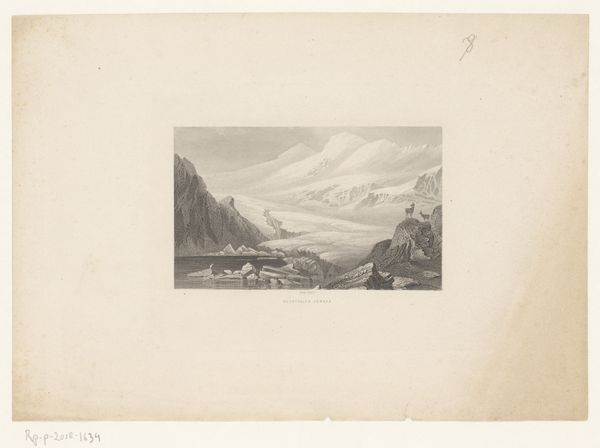
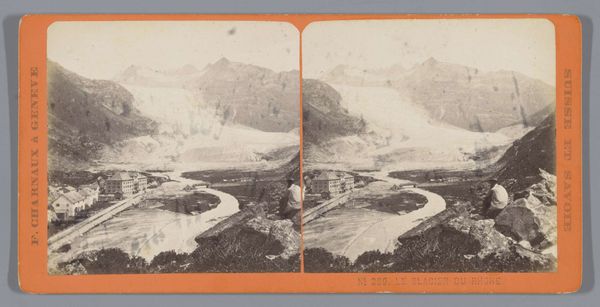
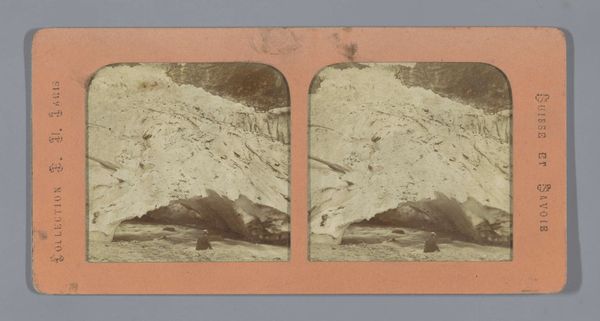
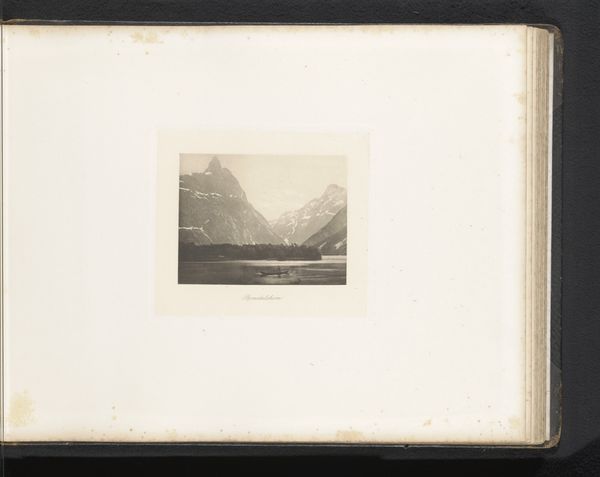
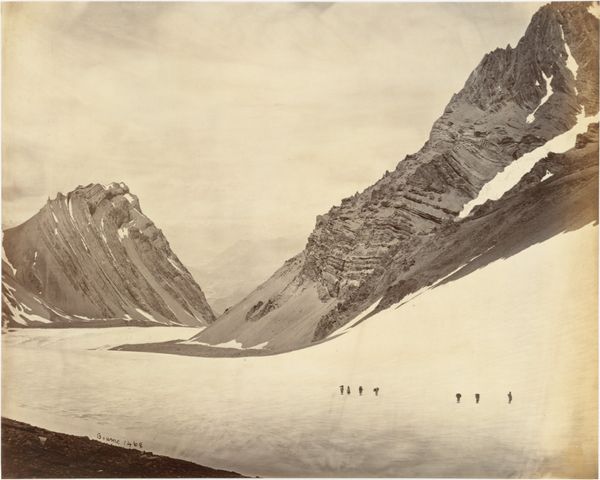
Gezicht op de Col Saint Théodule en de Petit Mont Cervin (Klein Matterhorn) in de Alpen, met op de voorgrond een bergbeklimmer c. 1871
0:00
0:00

Dimensions: height 55 mm, width 89 mm
Copyright: Rijks Museum: Open Domain
Curator: Before us is a gelatin-silver print by Florentin Charnaux, taken around 1871. It's titled "View of the Col Saint-Théodule and the Petit Mont Cervin in the Alps, with a Mountaineer in the Foreground." Editor: My first impression is the scale of this! The monochrome exaggerates the contrast between the crisp detail of the snow and the softened peak behind it. Even the small figure feels stark, almost imposed on this sublime backdrop. Curator: Absolutely. That figure is crucial, drawing on Romanticism’s frequent theme of humanity dwarfed by nature's grandeur. Consider the Alpine setting as a symbol: in the 19th century, it represented the sublime, untamed, and spiritual experience that transcended everyday life. Climbing such peaks suggested a symbolic ascent towards enlightenment. Editor: I'm struck by the near-absence of any horizon line. Instead, we have the stark whiteness reflecting ambient light. This flattening effect actually increases the picture's dramatic power, drawing the eye upwards and suggesting boundless verticality. Curator: Exactly, there's an interesting play with light and shadow that gives almost a dreamlike feel. Mountaineering at the time also spoke to social change, progress, the ambition and skill that pushed the boundaries of what humans believed they could achieve, not only physically but spiritually. That solitary climber represents more than a person on a mountain; they represent an evolving cultural relationship to nature. Editor: I'd push back a bit, though, and suggest that the dreaminess stems just as much from the photograph’s tonal range—very fine gradients give the snowfields an unreal softness. Notice, too, how Charnaux positions the climber using a central-horizontal composition; even the stick helps bisect the photo giving stability despite the overwhelming terrain. The image, as a formal object, is highly controlled. Curator: A compelling point. I see now the photograph working both to depict objective grandeur and reflecting subtle shifts in society's attitude towards both faith and progress. Editor: And I appreciate how you contextualized its historical relevance and its link to our enduring human need to create meaning in the natural world.
Comments
No comments
Be the first to comment and join the conversation on the ultimate creative platform.
 Collect
 React
React Comment
More like this