About this artwork
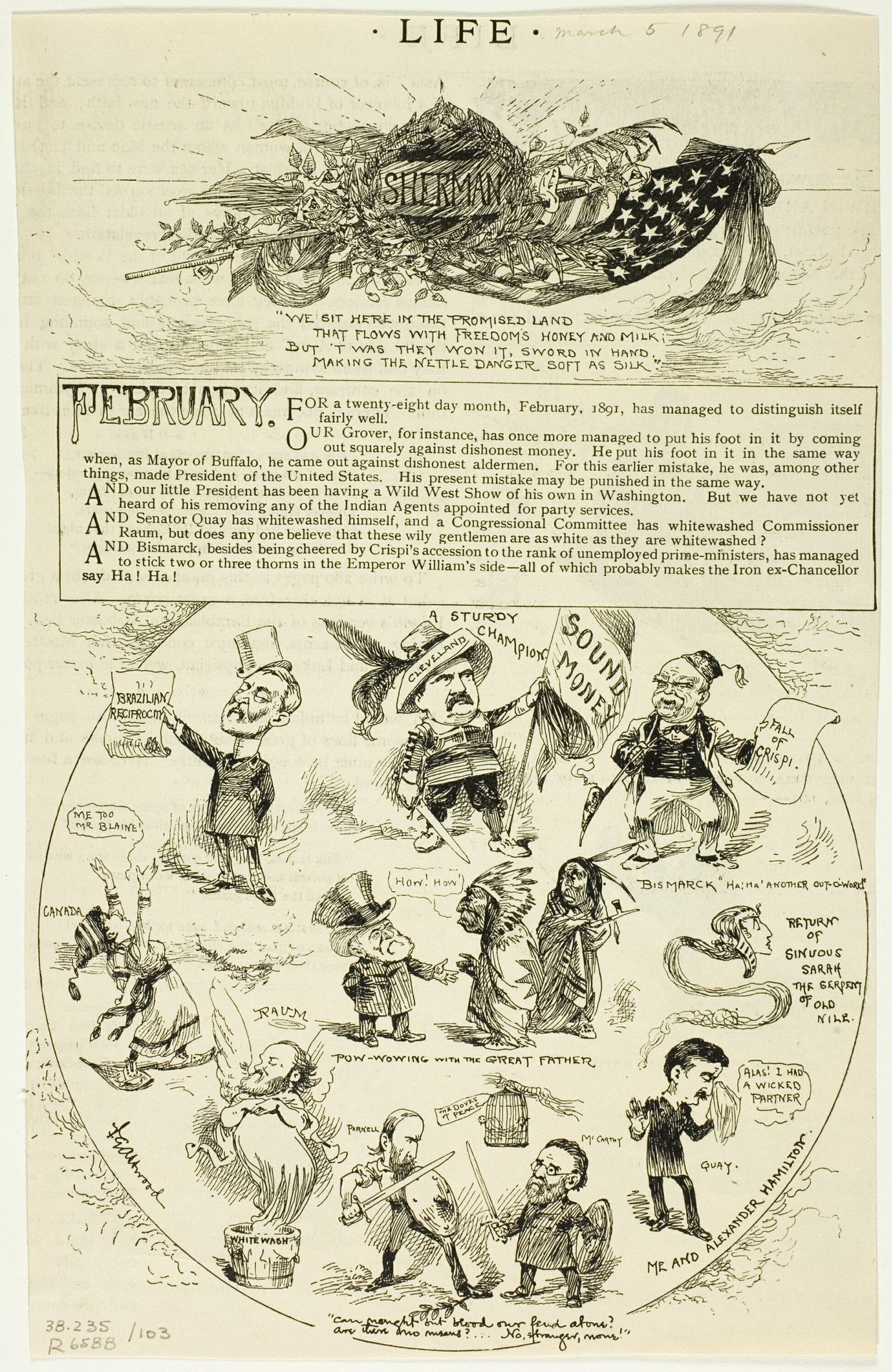
F. G. Attwood created this artwork, Sherman, a black ink drawing, in 1891. The composition is dominated by a circular arrangement of caricatures, immediately suggesting a cyclical, perhaps satirical, view of political figures. The monochromatic palette heightens the graphic quality, emphasizing the stark contrasts and sharp lines that define each character. The organization within the circle evokes a sense of hierarchy and interconnectedness. The figures, rendered with exaggerated features, communicate a critical commentary on the political landscape of the time. Attwood employs a semiotic system through visual cues to decode each figure's role and status. The structure challenges fixed meanings, using familiar imagery to undermine established political values. The cyclical arrangement, reminiscent of a clock face, suggests a repeating pattern of political behavior. Ultimately, Attwood's work functions as a commentary on power, representation, and the perpetual re-interpretation of political narratives.
Sherman c. 1891


Artwork details
- Medium
- drawing, lithograph, print, ink, pen
- Dimensions
- 224 × 143 mm
- Location
- The Art Institute of Chicago
- Copyright
- Public Domain
Tags
drawing
lithograph
pen illustration
caricature
ink
comic
pen
Comments
No comments
About this artwork
F. G. Attwood created this artwork, Sherman, a black ink drawing, in 1891. The composition is dominated by a circular arrangement of caricatures, immediately suggesting a cyclical, perhaps satirical, view of political figures. The monochromatic palette heightens the graphic quality, emphasizing the stark contrasts and sharp lines that define each character. The organization within the circle evokes a sense of hierarchy and interconnectedness. The figures, rendered with exaggerated features, communicate a critical commentary on the political landscape of the time. Attwood employs a semiotic system through visual cues to decode each figure's role and status. The structure challenges fixed meanings, using familiar imagery to undermine established political values. The cyclical arrangement, reminiscent of a clock face, suggests a repeating pattern of political behavior. Ultimately, Attwood's work functions as a commentary on power, representation, and the perpetual re-interpretation of political narratives.
Comments
No comments