About this artwork
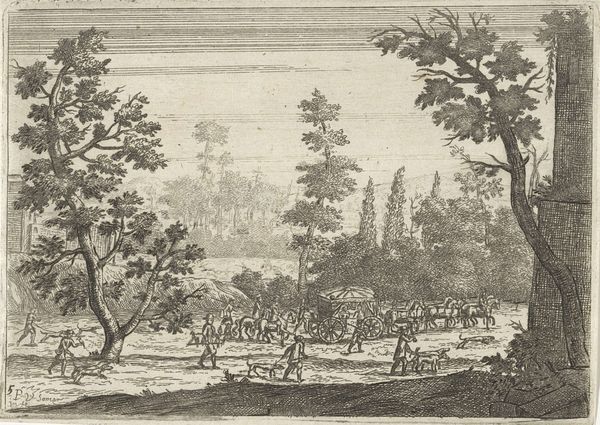
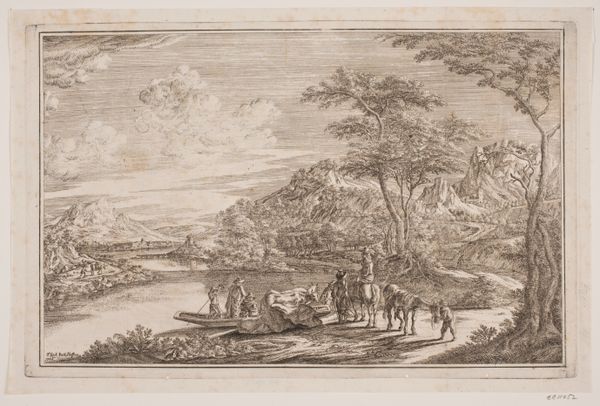
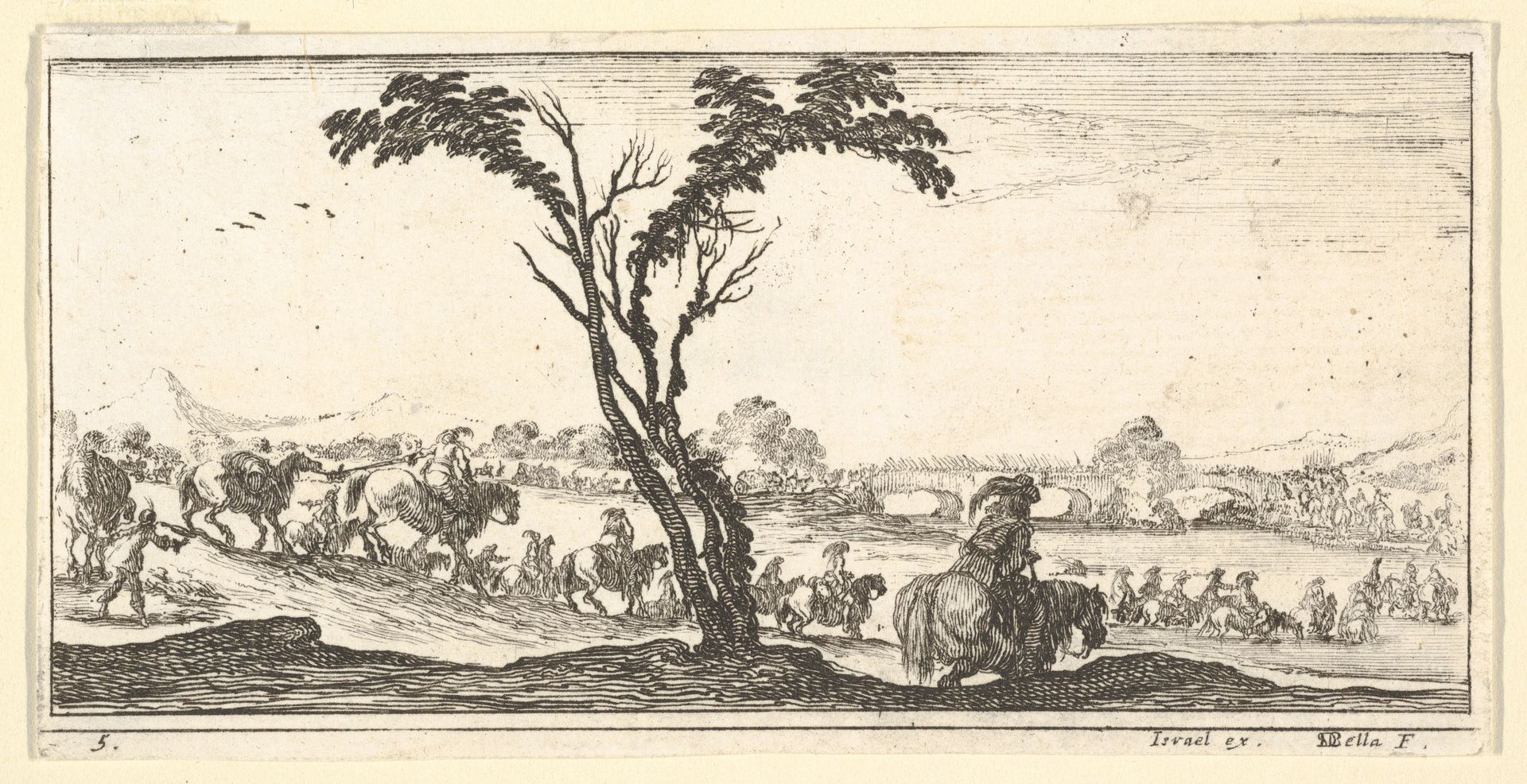
This print, Plate 5 from 'Troops, cannons, and attacks on towns' was etched by Stefano della Bella in the 17th century. Notice the composition, which divides the scene into distinct registers. The foreground presents a detailed depiction of horsemen and a prominent tree, while the background fades into a more generalized landscape featuring a bridge, distant figures and faint smoke. Della Bella masterfully uses line to define form and space, creating a sense of depth and movement. The diagonal lines of the landscape and the procession of figures draw the viewer's eye across the scene. The central tree acts as a structural anchor, its branches reaching out to frame the sky and provide a counterpoint to the linear movement of the troops. Consider how the artwork destabilizes established meanings. Is this a celebration of military might or a commentary on the chaos and displacement of war? The delicate lines and balanced composition invite contemplation.
Plate 5: a procession of horsemen crossing a river, a tree at center, from 'Troops, cannons, and attacks on towns' (Dessins de quelques conduites de troupes, canons, et ataques de villes) 1635 - 1645


Artwork details
- Medium
- drawing, print, etching
- Dimensions
- Sheet: 2 1/2 x 4 15/16 in. (6.3 x 12.6 cm)
- Location
- Metropolitan Museum of Art, New York, NY
- Copyright
- Public Domain
Tags
drawing
baroque
etching
landscape
history-painting
Comments
No comments
About this artwork
This print, Plate 5 from 'Troops, cannons, and attacks on towns' was etched by Stefano della Bella in the 17th century. Notice the composition, which divides the scene into distinct registers. The foreground presents a detailed depiction of horsemen and a prominent tree, while the background fades into a more generalized landscape featuring a bridge, distant figures and faint smoke. Della Bella masterfully uses line to define form and space, creating a sense of depth and movement. The diagonal lines of the landscape and the procession of figures draw the viewer's eye across the scene. The central tree acts as a structural anchor, its branches reaching out to frame the sky and provide a counterpoint to the linear movement of the troops. Consider how the artwork destabilizes established meanings. Is this a celebration of military might or a commentary on the chaos and displacement of war? The delicate lines and balanced composition invite contemplation.
Comments
No comments