About this artwork
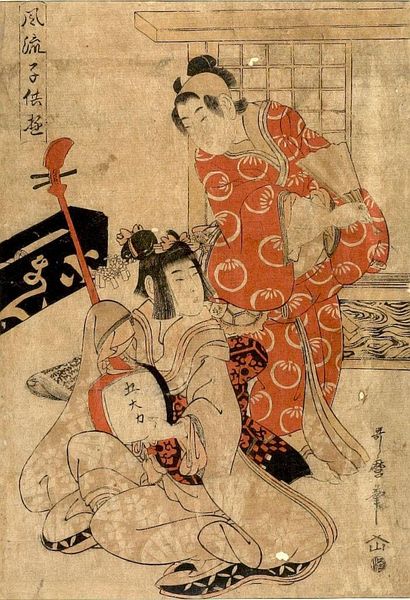
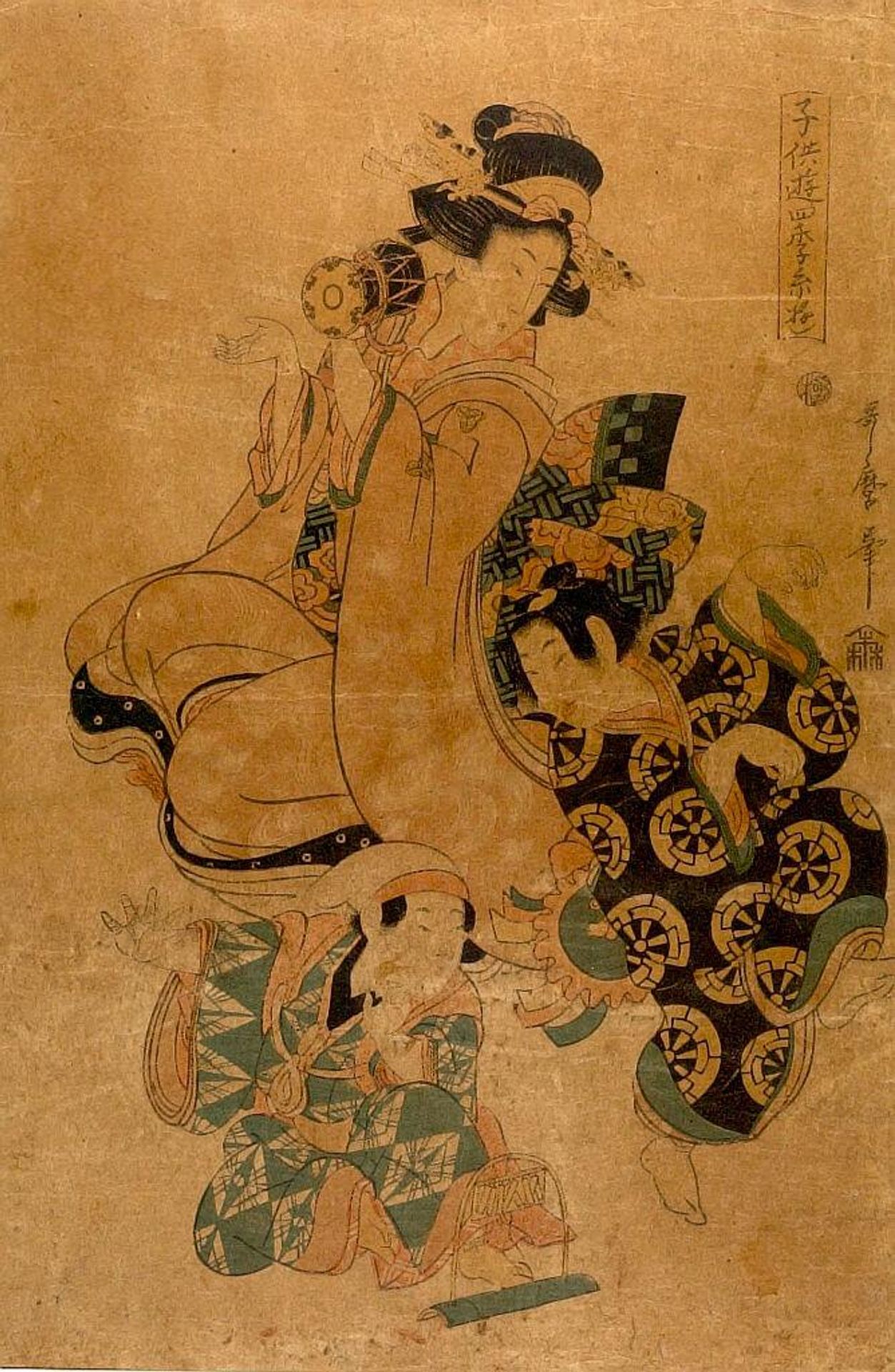
Curator: This is a print by Kitagawa Utamaro II, known as "Woman Playing Hand-Drum (Tsuzumi) for Two Dancing Children," currently held at the Harvard Art Museums. The dimensions are roughly 39 by 27 centimeters. Editor: It has a delicate, almost fleeting quality. The figures seem to float on this warm ground, brought to life by their patterned clothes. Curator: Utamaro’s Ukiyo-e prints often captured scenes of everyday life, elevating them to a beautiful transience. Here, a woman provides the music, while the children dance. Consider the drum and the labor required to produce these prints. Editor: And the cultural weight of performance. The drum, the robes, the dance itself—it's all a display of cultural memory. Curator: Indeed. Woodblock prints were crucial for disseminating cultural practices in Japan and it allowed popular culture and the world of the elite to mingle. Editor: I like that it points to how our cultural habits become woven into our very being. I’ll be thinking about it.
Woman Playing Hand-Drum (Tsuzumi) for Two Dancing Children
c. 19th century

Artwork details
- Dimensions
- Paper: H. 39.2 x W. 26.7 cm (15 7/16 x 10 1/2 in.)
- Location
- Harvard Art Museums
- Copyright
- CC0 1.0
Comments
Share your thoughts
About this artwork
Curator: This is a print by Kitagawa Utamaro II, known as "Woman Playing Hand-Drum (Tsuzumi) for Two Dancing Children," currently held at the Harvard Art Museums. The dimensions are roughly 39 by 27 centimeters. Editor: It has a delicate, almost fleeting quality. The figures seem to float on this warm ground, brought to life by their patterned clothes. Curator: Utamaro’s Ukiyo-e prints often captured scenes of everyday life, elevating them to a beautiful transience. Here, a woman provides the music, while the children dance. Consider the drum and the labor required to produce these prints. Editor: And the cultural weight of performance. The drum, the robes, the dance itself—it's all a display of cultural memory. Curator: Indeed. Woodblock prints were crucial for disseminating cultural practices in Japan and it allowed popular culture and the world of the elite to mingle. Editor: I like that it points to how our cultural habits become woven into our very being. I’ll be thinking about it.
Comments
Share your thoughts