About this artwork
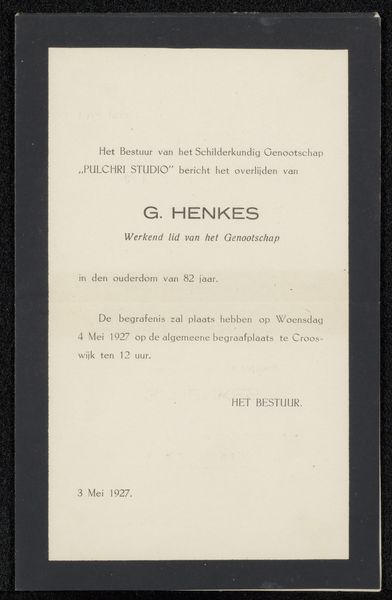
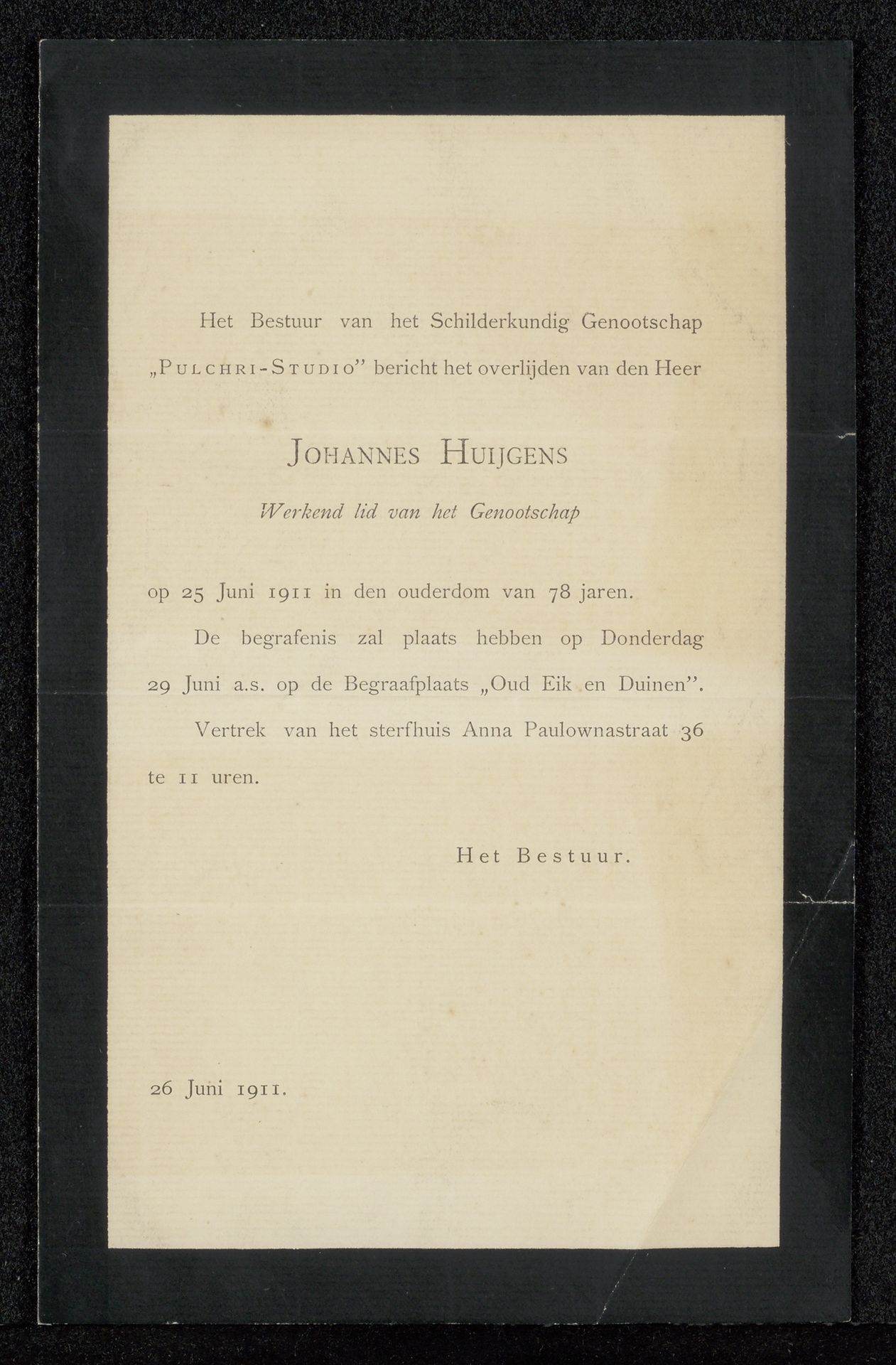
Editor: This printed announcement, “Overlijdensbericht aan Philip Zilcken,” dating from after 1911, commemorates the death of Johannes Huijgens. Its restrained typography on paper conveys a sense of formal respect. How can we interpret the significance of this seemingly simple death announcement in the context of art history? Curator: It’s fascinating to consider how institutions frame the narrative of an artist's life, even in death. Pulchri Studio, a prestigious artists' society, publicly acknowledges Huijgens’ passing. Do you think this announcement primarily served to inform, or did it also play a role in constructing Huijgens’ legacy within the art world? Editor: I see your point. Beyond its informational purpose, it probably served as a public validation of Huijgens' contribution. It signifies that he was valued by his peers and the artistic establishment. Do you think such announcements were common? Curator: Yes, particularly within close-knit artistic circles. Announcements like these subtly reinforce the importance of the society itself, acting as a kind of self-promotion. In the Netherlands, artist societies wielded significant power in shaping careers and influencing public taste. The tone here speaks to an attempt at a more accessible way of circulating what had mostly happened in word of mouth previously. Editor: That's a really interesting take. So, even in something as seemingly straightforward as a death announcement, the power dynamics and institutional frameworks of the art world are at play. I hadn't thought about it that way before. Curator: Exactly. These subtle acts contribute to how we understand artistic value and the legacies artists leave behind. It makes one think how an obituary can impact history itself. Editor: It's like, we are reading a primary source in constructing that history ourselves. Thanks, I’ve gained a fresh view on such objects. Curator: Glad to share my thoughts. It’s always fruitful to see seemingly mundane artifacts reflecting larger societal currents and institutional maneuvers.

Artwork details
- Medium
- drawing, print, textile, paper, typography, pen
- Location
- Rijksmuseum
- Copyright
- Rijks Museum: Open Domain
Tags
Comments
Share your thoughts
About this artwork
Editor: This printed announcement, “Overlijdensbericht aan Philip Zilcken,” dating from after 1911, commemorates the death of Johannes Huijgens. Its restrained typography on paper conveys a sense of formal respect. How can we interpret the significance of this seemingly simple death announcement in the context of art history? Curator: It’s fascinating to consider how institutions frame the narrative of an artist's life, even in death. Pulchri Studio, a prestigious artists' society, publicly acknowledges Huijgens’ passing. Do you think this announcement primarily served to inform, or did it also play a role in constructing Huijgens’ legacy within the art world? Editor: I see your point. Beyond its informational purpose, it probably served as a public validation of Huijgens' contribution. It signifies that he was valued by his peers and the artistic establishment. Do you think such announcements were common? Curator: Yes, particularly within close-knit artistic circles. Announcements like these subtly reinforce the importance of the society itself, acting as a kind of self-promotion. In the Netherlands, artist societies wielded significant power in shaping careers and influencing public taste. The tone here speaks to an attempt at a more accessible way of circulating what had mostly happened in word of mouth previously. Editor: That's a really interesting take. So, even in something as seemingly straightforward as a death announcement, the power dynamics and institutional frameworks of the art world are at play. I hadn't thought about it that way before. Curator: Exactly. These subtle acts contribute to how we understand artistic value and the legacies artists leave behind. It makes one think how an obituary can impact history itself. Editor: It's like, we are reading a primary source in constructing that history ourselves. Thanks, I’ve gained a fresh view on such objects. Curator: Glad to share my thoughts. It’s always fruitful to see seemingly mundane artifacts reflecting larger societal currents and institutional maneuvers.
Comments
Share your thoughts