About this artwork
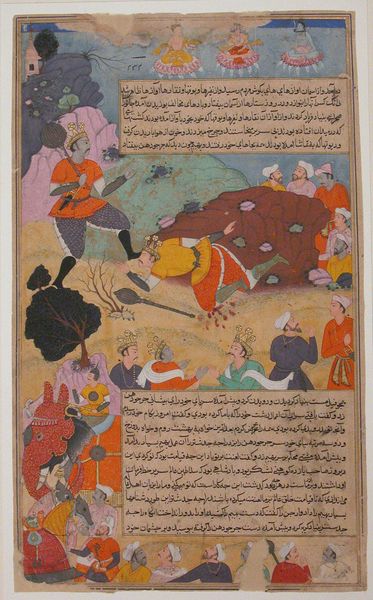
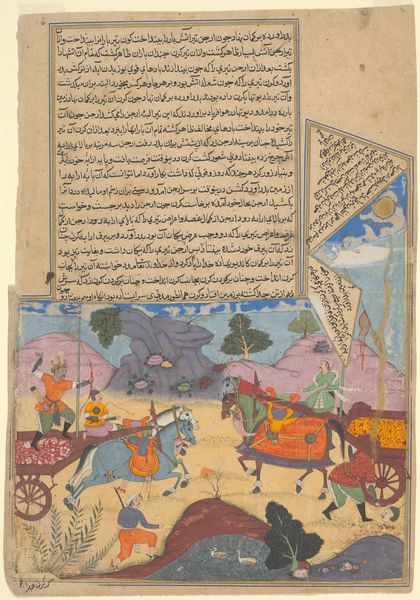
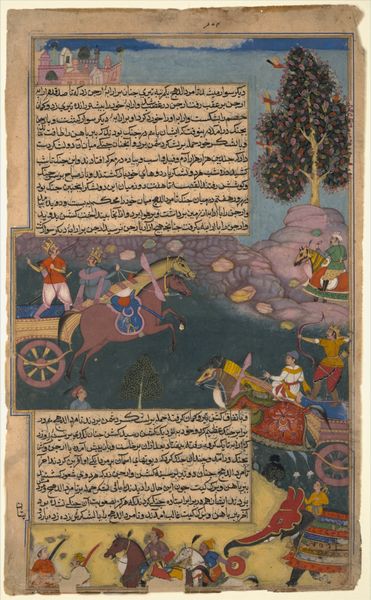
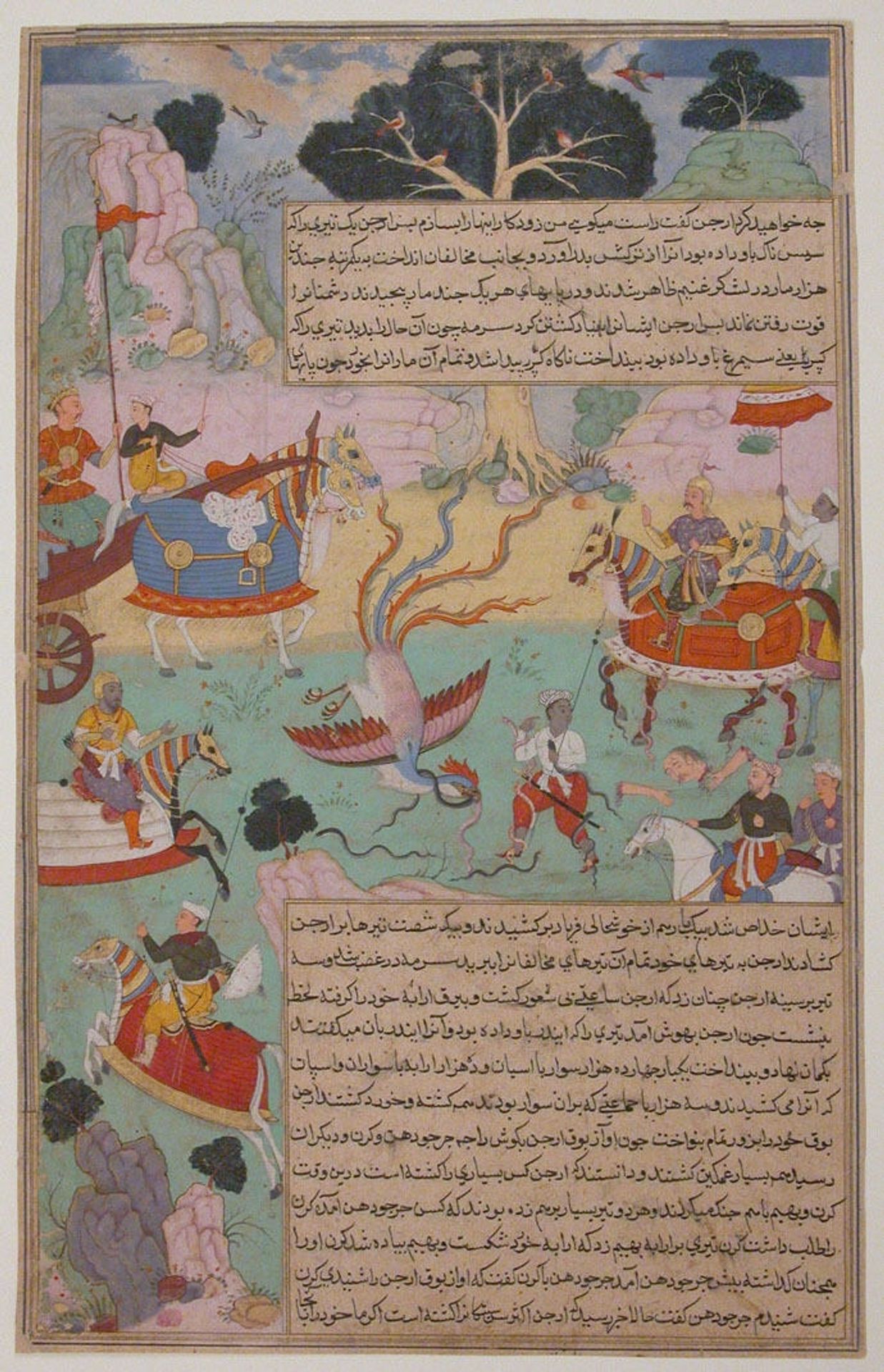
This folio, "Fighting Arjuna, Susarma Unleashes the Suparna Weapon which Invokes Garuda," was made by 'Abd al-Rahim, a court artist in Mughal India. It's a painting in opaque watercolor with gold on paper, a technique rooted in Persianate traditions of illumination and manuscript production. Look closely, and you'll see how the artist has meticulously depicted a scene from the Razmnama, the Persian translation of the Hindu epic, the Mahabharata. It’s an incredibly rich image, full of dynamic figures and swirling action. Notice the careful detailing in the horses’ trappings and the soldiers’ armor. The whole composition is an amazing feat of draftsmanship. This wasn’t just a matter of artistic skill; it was also a highly collaborative process. Many hands would have been involved in preparing the paper, grinding the pigments, and applying the gold leaf. This folio isn’t just an artwork; it’s a product of intense labor and a testament to the value placed on skilled craftsmanship in the Mughal court. By recognizing the labor and materials, we expand our understanding of the artwork's historical and cultural significance.
"Fighting Arjuna, Susarma Unleashes the Suparna Weapon which Invokes Garuda", Folio from a Razmnama
1591 - 1642


Artwork details
- Medium
- painting, watercolor
- Dimensions
- H. 13 11/16 in. (34.7 cm) W. 8 11/16 in. (22 cm)
- Location
- Metropolitan Museum of Art, New York, NY
- Copyright
- Public Domain
Tags
portrait
water colours
narrative-art
painting
landscape
figuration
watercolor
wall painting
islamic-art
miniature
Comments
Be the first to share your thoughts about this work.
About this artwork
This folio, "Fighting Arjuna, Susarma Unleashes the Suparna Weapon which Invokes Garuda," was made by 'Abd al-Rahim, a court artist in Mughal India. It's a painting in opaque watercolor with gold on paper, a technique rooted in Persianate traditions of illumination and manuscript production. Look closely, and you'll see how the artist has meticulously depicted a scene from the Razmnama, the Persian translation of the Hindu epic, the Mahabharata. It’s an incredibly rich image, full of dynamic figures and swirling action. Notice the careful detailing in the horses’ trappings and the soldiers’ armor. The whole composition is an amazing feat of draftsmanship. This wasn’t just a matter of artistic skill; it was also a highly collaborative process. Many hands would have been involved in preparing the paper, grinding the pigments, and applying the gold leaf. This folio isn’t just an artwork; it’s a product of intense labor and a testament to the value placed on skilled craftsmanship in the Mughal court. By recognizing the labor and materials, we expand our understanding of the artwork's historical and cultural significance.
Comments
Be the first to share your thoughts about this work.