1784
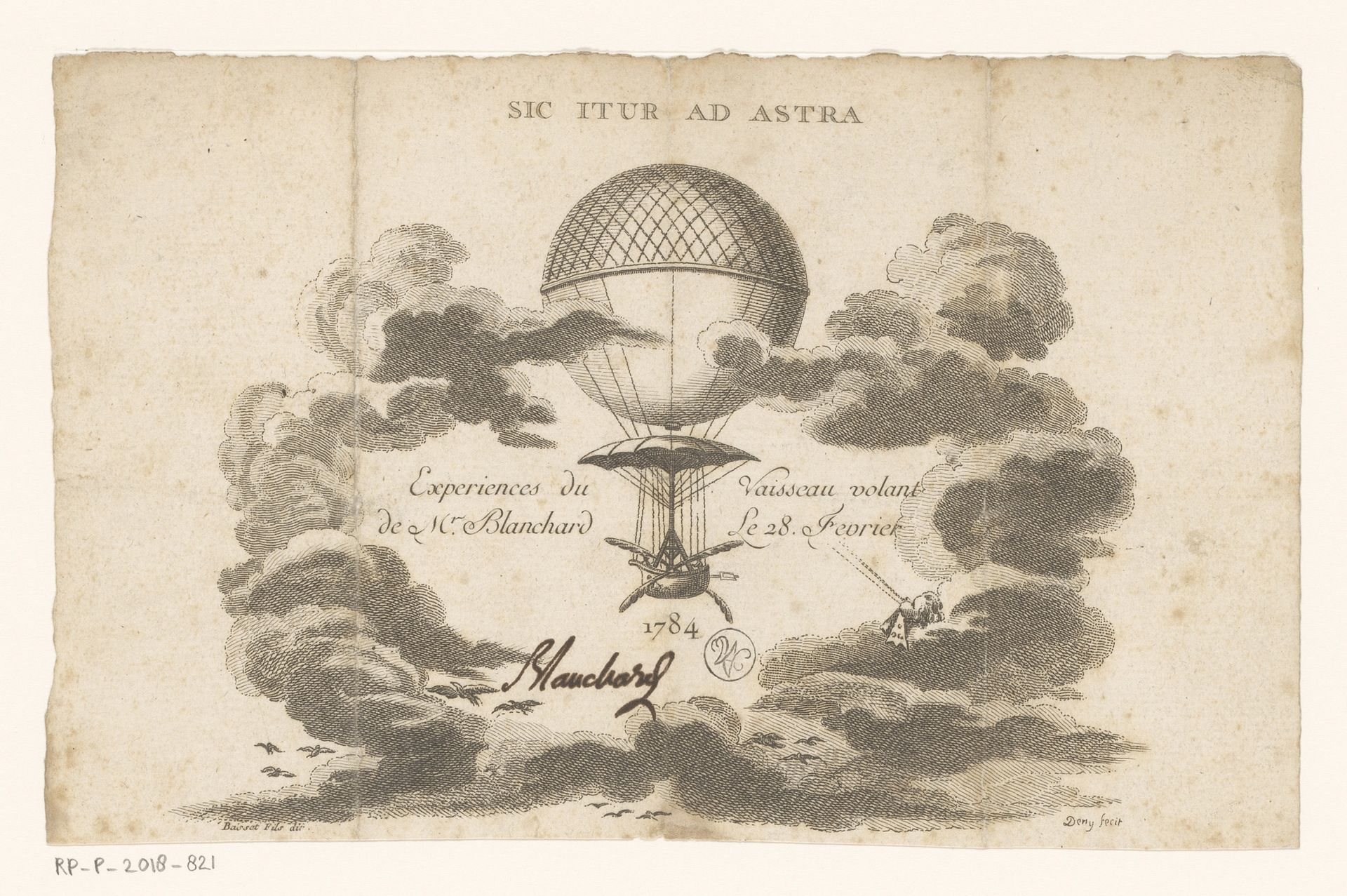
Toegangskaart tot de Expériences du Vaisseau volant van Mr. Blanchard op 28 februari 1784

Listen to curator's interpretation
Curatorial notes
Editor: This is an admission ticket, or 'Toegangskaart', for Mr. Blanchard's flying vessel experiences from February 28th, 1784. It’s a print, probably an engraving. The scene has such a dreamy, fantastical quality; the balloon soaring amongst these wispy clouds. How do you interpret this work within its historical context? Curator: What strikes me immediately is the phrase “Sic itur ad astra” – “Thus one goes to the stars.” This wasn’t simply about witnessing a spectacle; it was about humanity’s perceived potential to transcend earthly limitations. Blanchard's balloon becomes a powerful symbol of enlightenment ideals – a tangible manifestation of progress and reason breaking free from traditional hierarchies. We must ask: who had access to this experience? How might it relate to early industrial revolution and colonial ambitions? Editor: So, you’re saying the print becomes a reflection of the social aspirations of the time? Curator: Exactly! Think about it: flight was revolutionary, a symbol of upward mobility, both literally and figuratively. However, such a symbol was not equally accessible to all people. Aviation and scientific endeavor are repeatedly connected to national ambitions. What is more, such technological progress comes at a cost to colonized people and ecological environments. How are these costs overlooked when we see technological advancement as unmitigated progress? Editor: I never considered how ideas of social mobility could be tied to something like a hot air balloon ride! Curator: The image invites us to unpack these interwoven narratives. It encourages us to consider the societal values projected onto scientific advancements and to look critically at what, or who, is left out of the picture. Editor: That’s really insightful, seeing the print not just as a historical document, but as a complex cultural artifact that reveals so much about that era's hopes and blind spots. Curator: Indeed, it pushes us to ask: Whose stars are we reaching for? And at what cost?