About this artwork
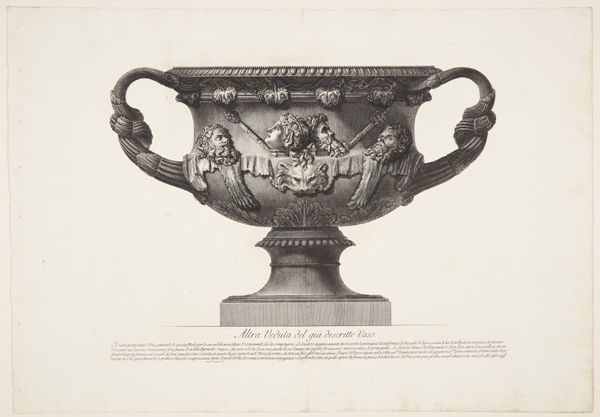
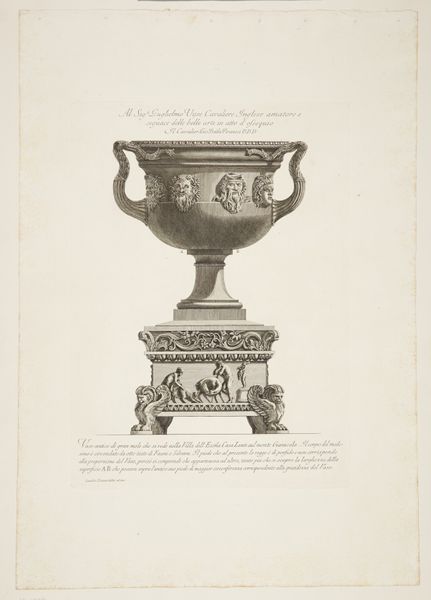
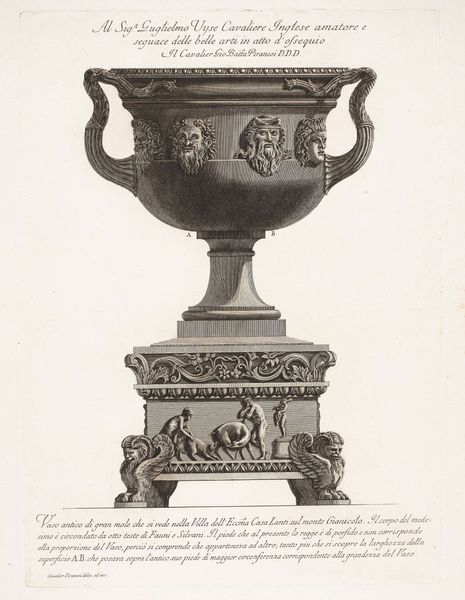
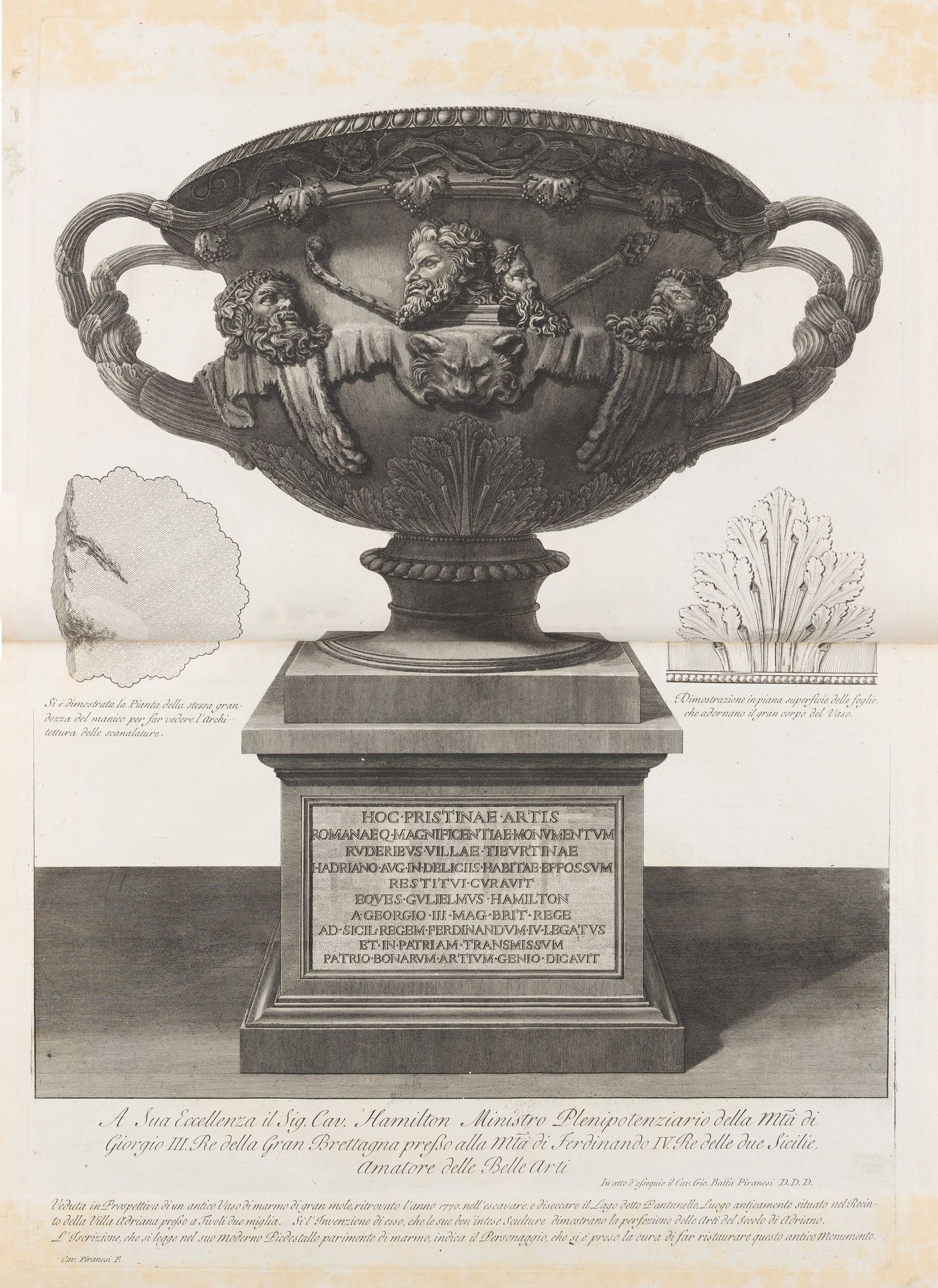
This print of the Warwick Vase was made by Giovanni Battista Piranesi, likely in the 1770s, around the same time the ancient vase itself was unearthed at Hadrian’s Villa. Piranesi’s work gives us a window into the cultural fascination with classical antiquity during the 18th century. Notice the inscription that celebrates the vase as a monument to Roman magnificence, discovered in the ruins of Hadrian’s Villa. It also names Sir William Hamilton as the one who restored and brought it to Britain. This emphasizes the vase’s journey through different hands and contexts, from an ancient artifact to a prized possession of the British elite. Piranesi’s meticulous engravings weren’t just documentation; they actively shaped perceptions of antiquity, feeding into the period's aesthetic and intellectual trends. Art historians can use sources like travelers' accounts, museum records, and auction catalogs to trace the movement and reception of such objects, revealing the complex interplay between art, power, and cultural identity.
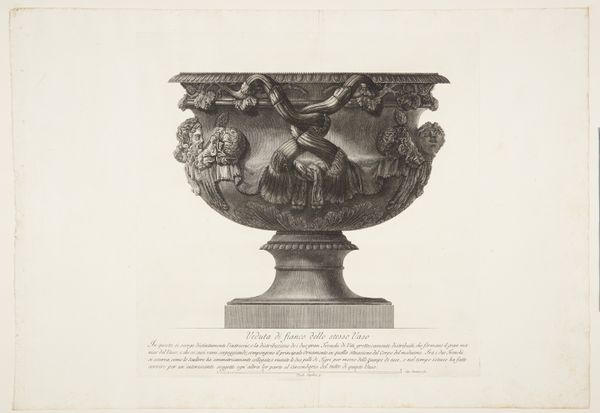
Large vase found at the Pantanello, Hadrian's Villa, Tivoli, in 1770 (The "Warwick Vase," from Vasi, candelabri, cippi, sarcofagi, tripodi, lucerne, ed ornamenti antichi disegnati ed incisi dal Cav. Gio. Batt. Piranesi, Vol. I (Vases, candelabra, grave stones, sarcophagi, tripods, lamps, and ornaments designed and etched by Cavalieri Giovanni Battista Piranesi) 1778 - 1780

Giovanni Battista Piranesi
1720 - 1778
The Metropolitan Museum of Art
Metropolitan Museum of Art, New York, NYArtwork details
- Dimensions
- Sheet: 21 5/8 x 31 1/2 in. (55 x 80 cm) Plate: 27 15/16 x 18 5/8 in. (71 x 47.3 cm) printed horizontally
- Location
- Metropolitan Museum of Art, New York, NY
- Copyright
- Public Domain
Comments
No comments
About this artwork
This print of the Warwick Vase was made by Giovanni Battista Piranesi, likely in the 1770s, around the same time the ancient vase itself was unearthed at Hadrian’s Villa. Piranesi’s work gives us a window into the cultural fascination with classical antiquity during the 18th century. Notice the inscription that celebrates the vase as a monument to Roman magnificence, discovered in the ruins of Hadrian’s Villa. It also names Sir William Hamilton as the one who restored and brought it to Britain. This emphasizes the vase’s journey through different hands and contexts, from an ancient artifact to a prized possession of the British elite. Piranesi’s meticulous engravings weren’t just documentation; they actively shaped perceptions of antiquity, feeding into the period's aesthetic and intellectual trends. Art historians can use sources like travelers' accounts, museum records, and auction catalogs to trace the movement and reception of such objects, revealing the complex interplay between art, power, and cultural identity.
Comments
No comments