About this artwork
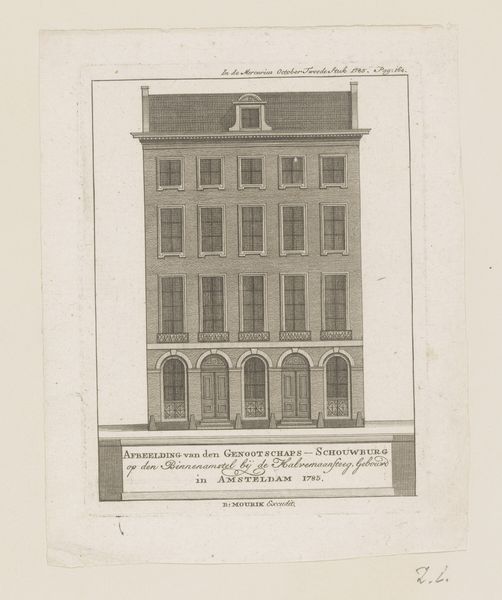
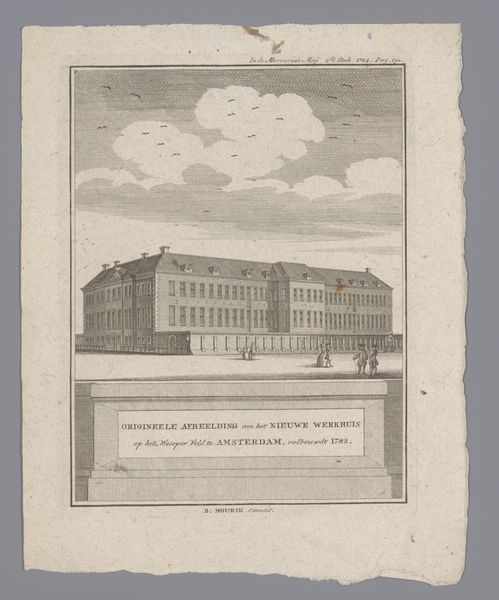
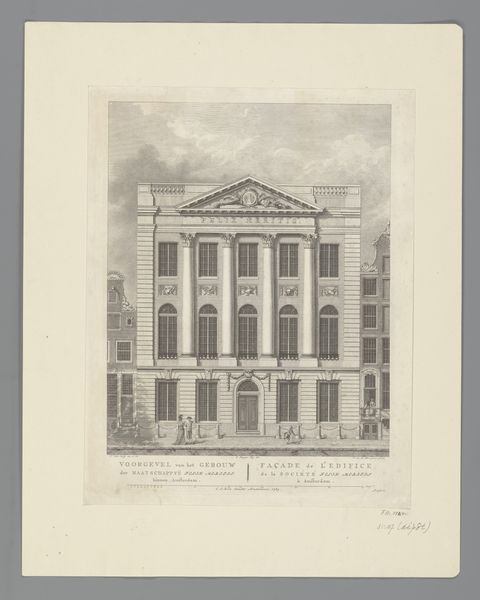
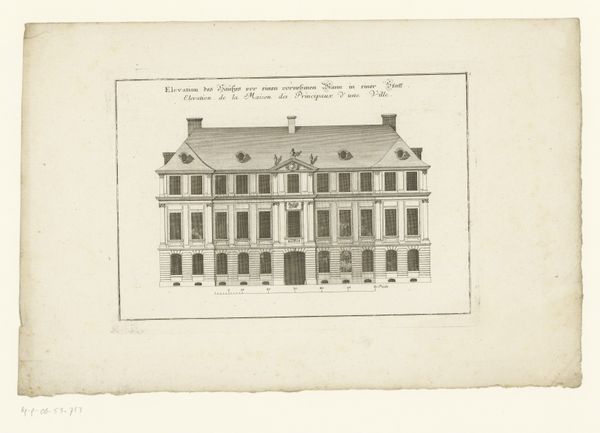
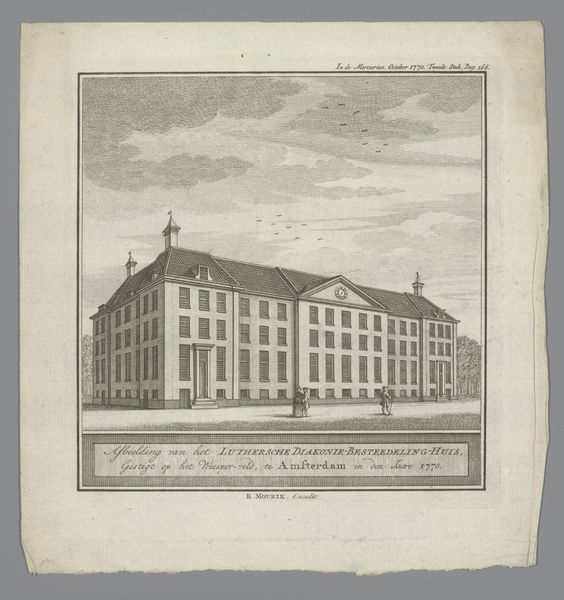
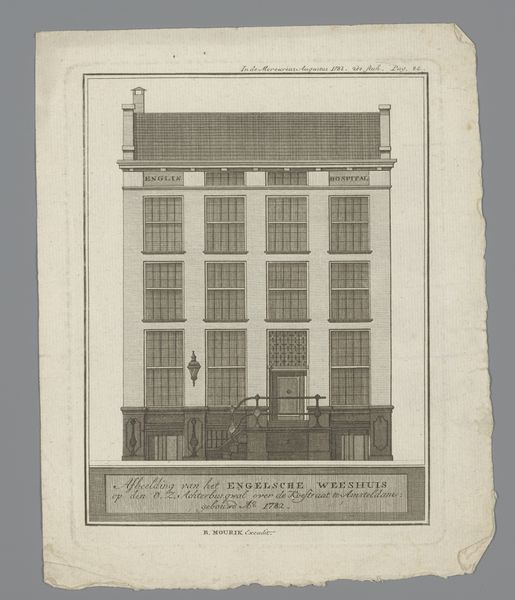
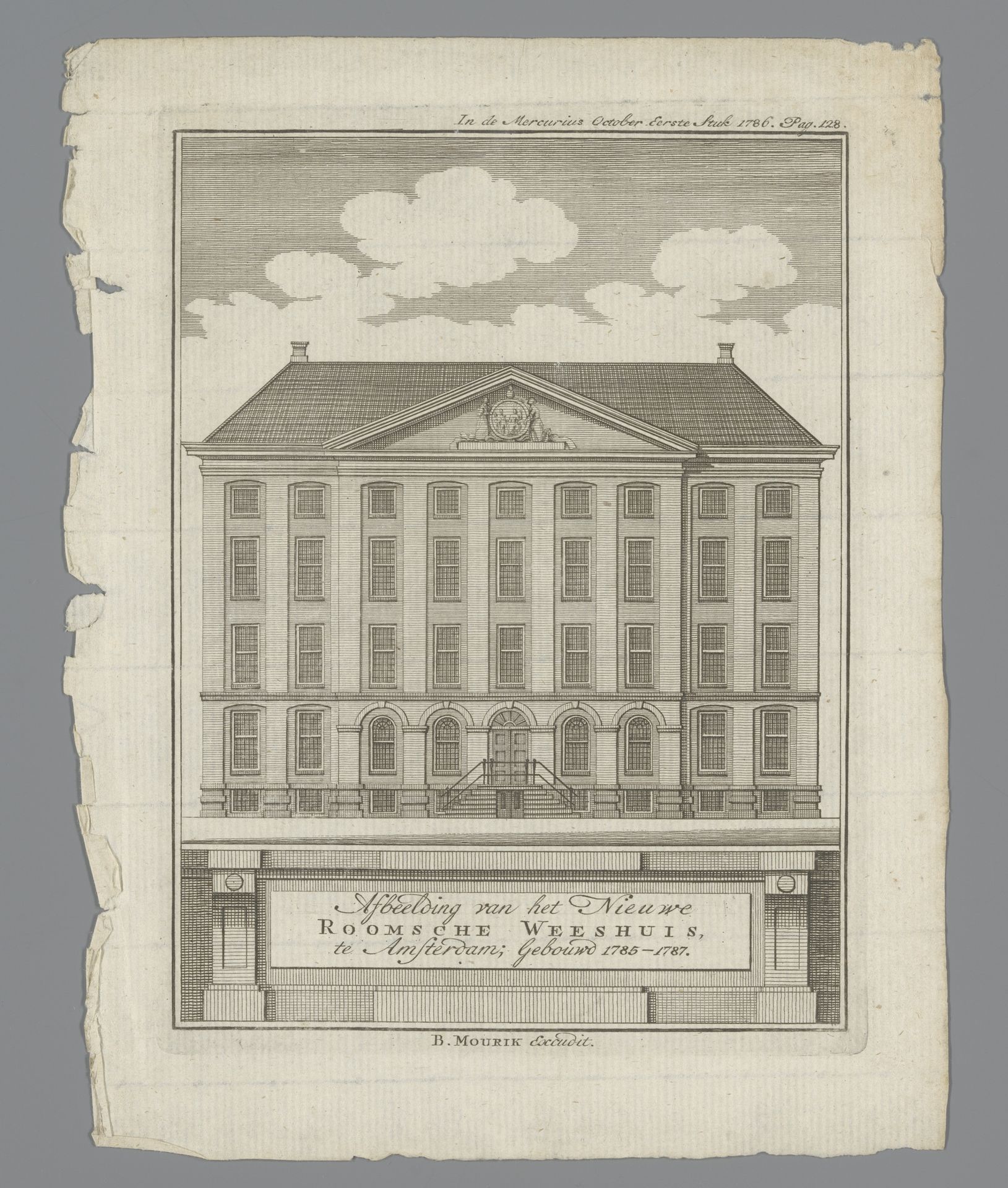
Curator: Before us, we have an etching from 1786, "Gezicht op het Maagdenhuis te Amsterdam," currently held at the Rijksmuseum. The piece is attributed to an anonymous artist. What are your initial impressions? Editor: It feels almost... clinical? All clean lines and right angles. Makes you think of architectural drawings rather than art meant to stir something inside you. There's something serene but also strangely detached about it. Curator: Indeed. The precision is paramount here. Observe how the artist employs line to define the building’s structure. The composition relies heavily on symmetry, emphasizing order and rationality, hallmarks of the Neoclassical movement it's connected to. Note also the text underneath, almost like a caption adding another layer to its intended formal use. Editor: You’re right, the symmetry is almost oppressive, isn't it? Even the clouds seem neatly arranged above the building, trying to mirror it, a true demonstration of trying to subdue even the organic, to the desire for rational composition! But you almost miss that the piece is about an orphanage, “Roomsche Weeshuis,” as it says. You would think there was so much life brimming there but the work makes it feel rigid, closed. Is there any relationship with the golden age? Curator: Its connection with the Dutch Golden Age resides more subtly, in the continuation of meticulous detailing and cityscape traditions but within a new, intellectually driven aesthetic. Notice, for instance, the meticulous representation, but without the emotive, painterly touch typical of earlier cityscapes. Editor: I suppose. So it’s a turning point... the death of one aesthetic and the cold birth of another. Even on paper you can almost hear a change in its pace and sense of space. Well, thanks to our little analysis I perceive it now as an elegy, both grand and deeply impersonal. Curator: An insightful synthesis, blending structure with sentiment, offering a wider view that this architectural artwork invites us to view with contemplation and insight.

Artwork details
- Medium
- print, etching, paper, architecture
- Dimensions
- height 180 mm, width 134 mm
- Location
- Rijksmuseum
- Copyright
- Rijks Museum: Open Domain
Tags
neoclacissism
dutch-golden-age
etching
paper
geometric
line
cityscape
architecture
Comments
Be the first to share your thoughts about this work.
About this artwork
Curator: Before us, we have an etching from 1786, "Gezicht op het Maagdenhuis te Amsterdam," currently held at the Rijksmuseum. The piece is attributed to an anonymous artist. What are your initial impressions? Editor: It feels almost... clinical? All clean lines and right angles. Makes you think of architectural drawings rather than art meant to stir something inside you. There's something serene but also strangely detached about it. Curator: Indeed. The precision is paramount here. Observe how the artist employs line to define the building’s structure. The composition relies heavily on symmetry, emphasizing order and rationality, hallmarks of the Neoclassical movement it's connected to. Note also the text underneath, almost like a caption adding another layer to its intended formal use. Editor: You’re right, the symmetry is almost oppressive, isn't it? Even the clouds seem neatly arranged above the building, trying to mirror it, a true demonstration of trying to subdue even the organic, to the desire for rational composition! But you almost miss that the piece is about an orphanage, “Roomsche Weeshuis,” as it says. You would think there was so much life brimming there but the work makes it feel rigid, closed. Is there any relationship with the golden age? Curator: Its connection with the Dutch Golden Age resides more subtly, in the continuation of meticulous detailing and cityscape traditions but within a new, intellectually driven aesthetic. Notice, for instance, the meticulous representation, but without the emotive, painterly touch typical of earlier cityscapes. Editor: I suppose. So it’s a turning point... the death of one aesthetic and the cold birth of another. Even on paper you can almost hear a change in its pace and sense of space. Well, thanks to our little analysis I perceive it now as an elegy, both grand and deeply impersonal. Curator: An insightful synthesis, blending structure with sentiment, offering a wider view that this architectural artwork invites us to view with contemplation and insight.
Comments
Be the first to share your thoughts about this work.