About this artwork
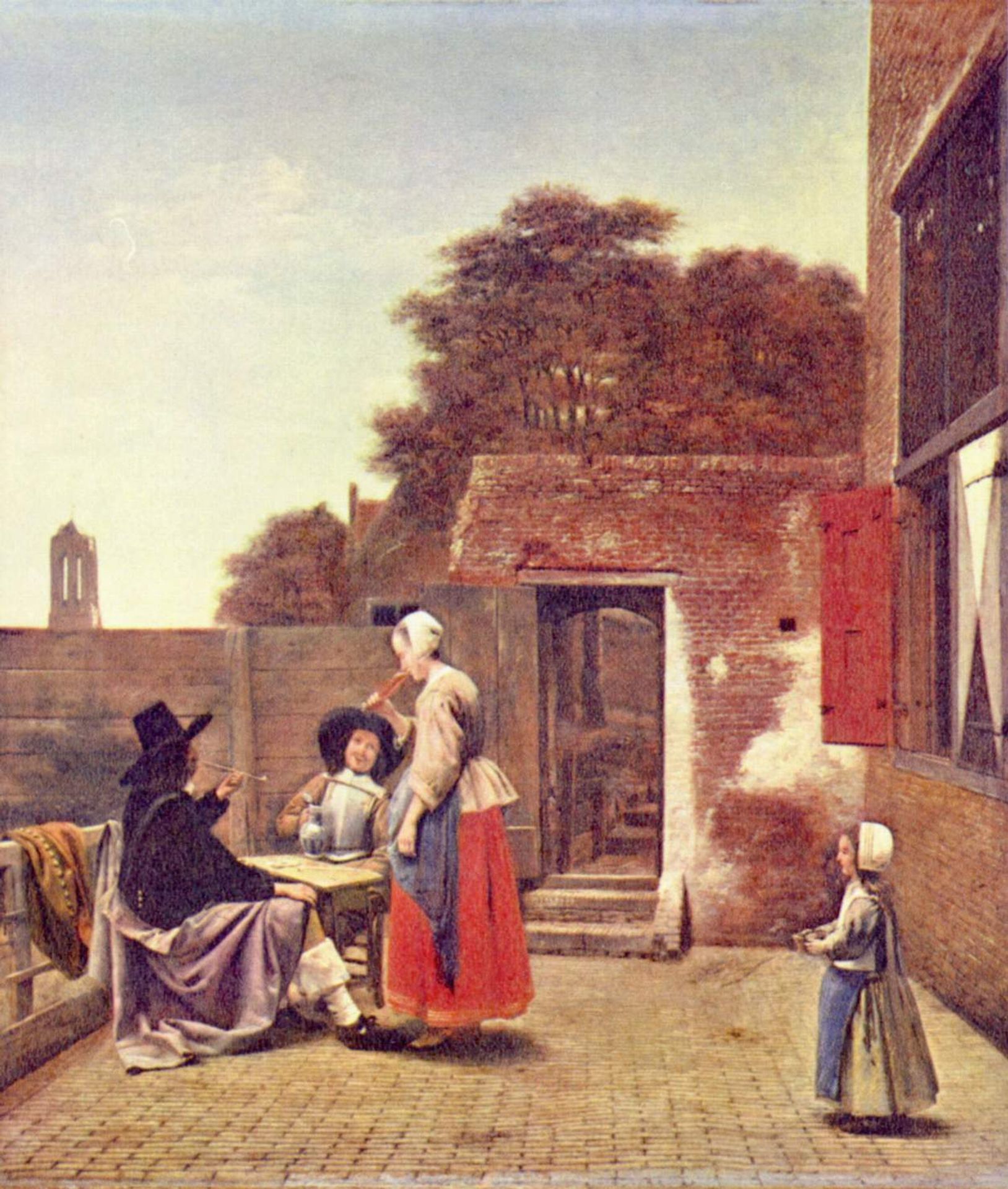
Pieter de Hooch's "A Dutch Courtyard," painted in oil on canvas, invites us into a world meticulously constructed with light and shadow. The orthogonal lines of the brick courtyard create a sense of depth, guiding the eye through the scene. De Hooch's mastery lies in his use of light to define form and space. Observe how the gentle illumination rakes across the brickwork, casting soft shadows that articulate the texture and volume of the architecture. This play of light not only enhances the realism of the scene but also imbues it with a sense of tranquility and order. De Hooch subtly destabilizes traditional notions of domestic harmony by embedding coded meaning. The figures are deliberately positioned, and their interactions are staged, not spontaneous. By carefully orchestrating every visual element, de Hooch transforms the courtyard into a space of curated existence. This manipulation encourages viewers to reflect on the nature of domestic life as not merely an unvarnished reality but a construction carefully maintained and performed.
A Dutch Courtyard
1658

Pieter de Hooch
1629 - 1684
National Gallery of Art, Washington DC
National Gallery of Art, Washington, DC, USArtwork details
- Medium
- oil-paint, architecture
- Dimensions
- 60 x 69.5 cm
- Location
- National Gallery of Art, Washington, DC, US
- Copyright
- Public domain
Tags
Comments
Share your thoughts
About this artwork
Pieter de Hooch's "A Dutch Courtyard," painted in oil on canvas, invites us into a world meticulously constructed with light and shadow. The orthogonal lines of the brick courtyard create a sense of depth, guiding the eye through the scene. De Hooch's mastery lies in his use of light to define form and space. Observe how the gentle illumination rakes across the brickwork, casting soft shadows that articulate the texture and volume of the architecture. This play of light not only enhances the realism of the scene but also imbues it with a sense of tranquility and order. De Hooch subtly destabilizes traditional notions of domestic harmony by embedding coded meaning. The figures are deliberately positioned, and their interactions are staged, not spontaneous. By carefully orchestrating every visual element, de Hooch transforms the courtyard into a space of curated existence. This manipulation encourages viewers to reflect on the nature of domestic life as not merely an unvarnished reality but a construction carefully maintained and performed.
Comments
Share your thoughts