Copyright: Public Domain: Artvee
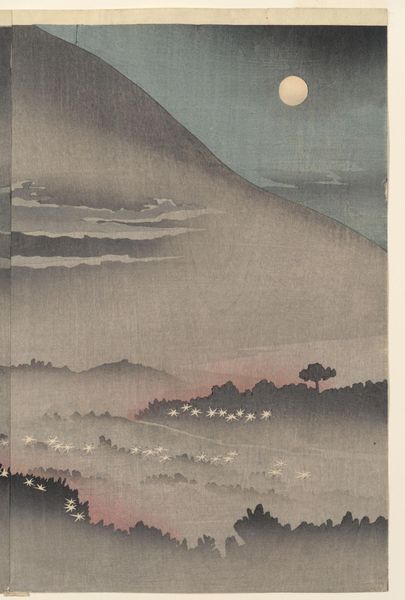
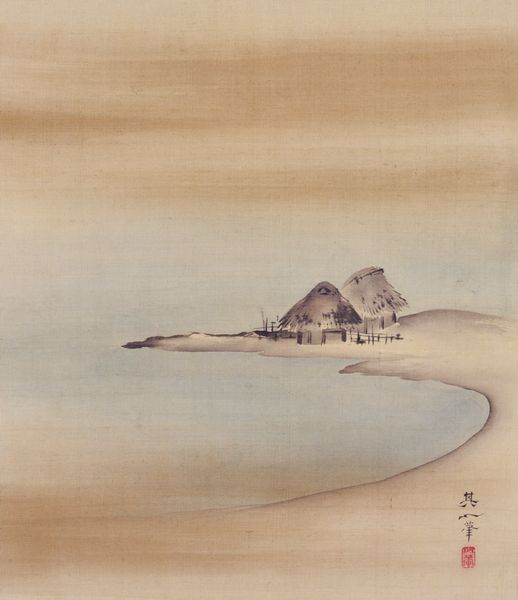
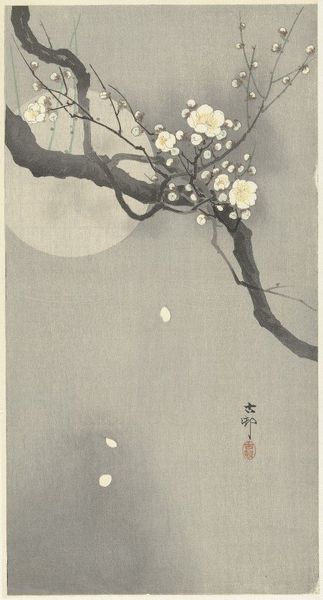
Curator: Looking at Kamisaka Sekka's "Autumn Flowers" from 1909 to 1910, created with watercolors, I'm immediately struck by its ethereal quality. The silver disc of the moon looms large behind delicate blossoms and what appears to be a humble rooftop. Editor: There's a beautiful tension in this work. On the one hand, you have this delicate scene, conjured up with watercolors and presented in a muted palette, then punctuated by this roofscape which dominates the lower portion of the piece. I’m wondering, what can we say about the construction? Look at the overlapping reeds which cover its structure. How does its materiality connect to the land and the labor required for its construction? Curator: Good eye! Sekka's mastery is evident not only in the delicate rendering of nature, typical of much Asian art, but also how he situated this image. I understand Sekka's intention was to elevate traditional Japanese design while incorporating modern elements. We see him exploring that relationship between tradition and the burgeoning industrialization in Japan through the way he is referencing popular printmaking culture while also focusing on traditional architectural scenes. Editor: I wonder about its consumption, too. This wasn’t created in a vacuum, was it? What role did art patrons or exhibitions play in shaping Sekka's practice and the reception of works like "Autumn Flowers" by the broader public? It’s lovely to think of them experiencing these natural moments filtered through this type of lens. Curator: Indeed, Sekka played a vital role in the cultural landscape, seeking to redefine design and its relationship with society. His work was intentionally accessible to a broader audience. Editor: Considering how watercolor behaves as a material, there’s a direct link to nature because of its reliance on water and a physical place for inspiration. These materials shape our understanding. For me, I find “Autumn Flowers” makes you consider those relationships. Curator: For me, the painting is a lovely window into understanding how Japanese art was navigating societal change. Editor: And for me, it is seeing the beautiful dialogue that develops as simple materials give way to such artistic accomplishment.
Comments
No comments
Be the first to comment and join the conversation on the ultimate creative platform.
 Collect
 React
React Comment
More like this