drawing, pencil
#
portrait
#
drawing
#
cubism
#
pencil sketch
#
figuration
#
roman-mythology
#
coloured pencil
#
geometric
#
pencil
#
mythology
#
history-painting
#
nude
Dimensions: 21.3 x 27 cm
Copyright: Public domain US
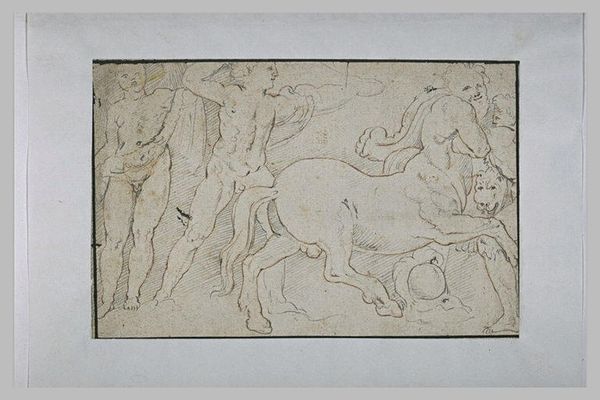
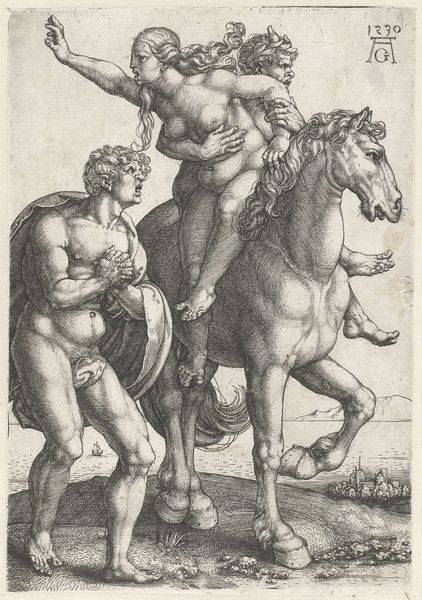
Curator: Here we have Pablo Picasso's "Abduction (Nessus and Deianeira)," a pencil and colored pencil drawing from 1920, tackling a pivotal scene from Greco-Roman mythology. Editor: My initial impression is of chaotic energy contained within these frantically scribbled lines. The centaur's form seems to emerge from the page, almost violently so. Curator: Indeed, Picasso returned frequently to classical themes during and after World War I, engaging with established narratives even as his Cubist innovations reshaped modern art. This work, with its dramatic subject matter, speaks to anxieties about power and violence in the postwar era. Editor: The way Picasso fragments and then reassembles the human and animal forms is really striking. It disrupts the conventional, idealized representation of the nude, injecting a raw and almost brutal honesty. I'm seeing geometric forms vying with naturalistic depictions, creating a push and pull. Curator: Precisely. The subject matter itself – Nessus's abduction of Deianeira, which ultimately leads to Heracles's demise – carried a weighty symbolic resonance in the 1920s, resonating with post-war societal trauma and political turmoil. The figure of the centaur becomes this symbol of uncontrolled impulse. Editor: I’m interested in how the frenetic energy emphasizes the violence of the scene, a swirling mass of lines that traps the viewer. The limited color palette – really, just monochrome with subtle tinges – throws the form into even sharper focus. Curator: Think about the historical context too. The Picasso's return to figuration might be viewed as a move towards reconciliation with the more conservative forces present in Europe post-war. This piece could be a re-engagement with history after the rupture of avant-garde experimentations. Editor: And the rough, sketch-like quality… Is it an unfinished work? Or perhaps the immediacy reinforces the uncontrolled action of the scene itself? It seems to lack closure. Curator: That question of closure might just be the point. It encapsulates an enduring unease with the lasting echoes of history, both personal and political. Editor: Absolutely. Looking closer, this raw application offers a remarkable study of form, action and tension through this medium. Curator: By framing a classical narrative through a distinctly modern lens, Picasso compels us to confront uncomfortable aspects of the past and of ourselves. Editor: Indeed. This frantic rendition pushes against conventional forms and invites reflection on what these mythical narratives still represent in today’s society.
Comments
No comments
Be the first to comment and join the conversation on the ultimate creative platform.
 Collect
 React
React Comment
More like this