About this artwork
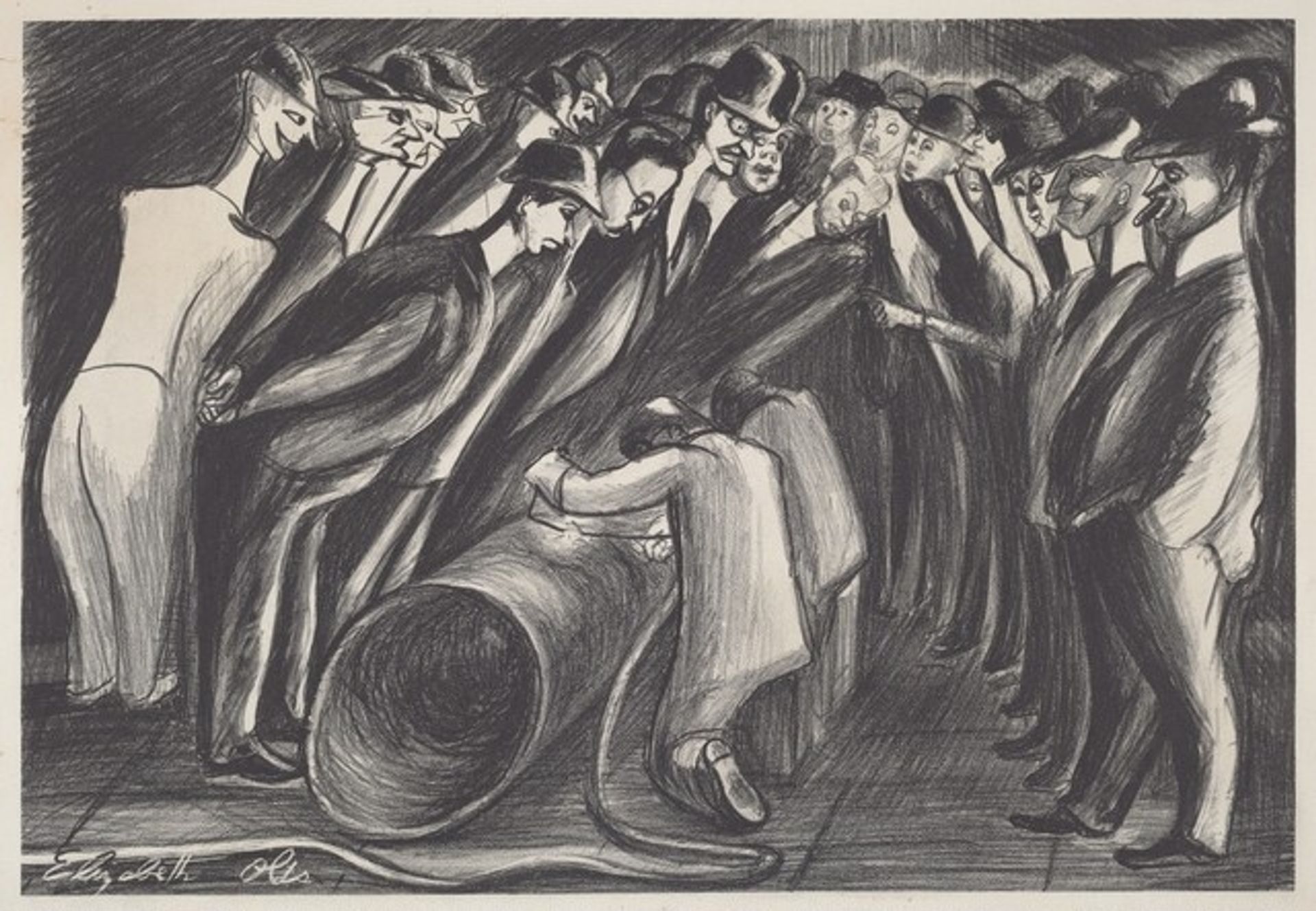
Editor: Here we have Elizabeth Olds' "Sidewalk Engineers," created in 1936. What's your first take? Curator: The material execution here, a rather somber print dominated by sharp lines and caricatured figures, sets an almost accusatory tone. The density of the crowd really makes it. Editor: That's an interesting reaction. To me, it evokes a strong sense of anxiety, maybe even desperation, which contrasts sharply with their curious facial expressions. Look at the person curled inside that pipe. Curator: It speaks volumes, doesn't it? Olds’ skillful use of pencil in the print-making process amplifies the roughness and immediacy of the scene. This speaks to a Depression-era concern: How is value assigned, produced, and maintained? Is labour seen or unseen? Editor: The pipe could represent confinement, maybe a sense of being trapped by economic circumstances during the Depression. Does this symbolism connect with common anxieties experienced during this historical moment? Curator: Precisely! Consider that Olds was very invested in accessible art practices; she wanted to use her skill as a labour. You could consider it her form of cultural organizing, using the language of modernism with some social realism thrown in. Editor: Right, her social consciousness is evident. I see some real darkness. How the figures stand around staring, pointing... It reminds me of a pack of vultures observing something on its last legs. I see layers of cultural criticism here, which really hold up to scrutiny nearly a century later. Curator: Yes, her prints were meant to engage. To foster critical awareness of one’s environment and material conditions. And frankly, as a print, it probably helped more hands see her perspective. Editor: Ultimately, Olds' choices resulted in a lasting statement about labor, economic hardship, and the human response to adversity. It definitely gives you something to think about. Curator: Indeed. It really lays bare how our material existence and the very labor that upholds it often goes unseen, even scoffed at.


Artwork details
- Medium
- drawing, print, pencil
- Dimensions
- image: 227 x 330 mm sheet: 288 x 404 mm
- Copyright
- National Gallery of Art: CC0 1.0
Tags
Comments
Share your thoughts
About this artwork
Editor: Here we have Elizabeth Olds' "Sidewalk Engineers," created in 1936. What's your first take? Curator: The material execution here, a rather somber print dominated by sharp lines and caricatured figures, sets an almost accusatory tone. The density of the crowd really makes it. Editor: That's an interesting reaction. To me, it evokes a strong sense of anxiety, maybe even desperation, which contrasts sharply with their curious facial expressions. Look at the person curled inside that pipe. Curator: It speaks volumes, doesn't it? Olds’ skillful use of pencil in the print-making process amplifies the roughness and immediacy of the scene. This speaks to a Depression-era concern: How is value assigned, produced, and maintained? Is labour seen or unseen? Editor: The pipe could represent confinement, maybe a sense of being trapped by economic circumstances during the Depression. Does this symbolism connect with common anxieties experienced during this historical moment? Curator: Precisely! Consider that Olds was very invested in accessible art practices; she wanted to use her skill as a labour. You could consider it her form of cultural organizing, using the language of modernism with some social realism thrown in. Editor: Right, her social consciousness is evident. I see some real darkness. How the figures stand around staring, pointing... It reminds me of a pack of vultures observing something on its last legs. I see layers of cultural criticism here, which really hold up to scrutiny nearly a century later. Curator: Yes, her prints were meant to engage. To foster critical awareness of one’s environment and material conditions. And frankly, as a print, it probably helped more hands see her perspective. Editor: Ultimately, Olds' choices resulted in a lasting statement about labor, economic hardship, and the human response to adversity. It definitely gives you something to think about. Curator: Indeed. It really lays bare how our material existence and the very labor that upholds it often goes unseen, even scoffed at.
Comments
Share your thoughts