About this artwork
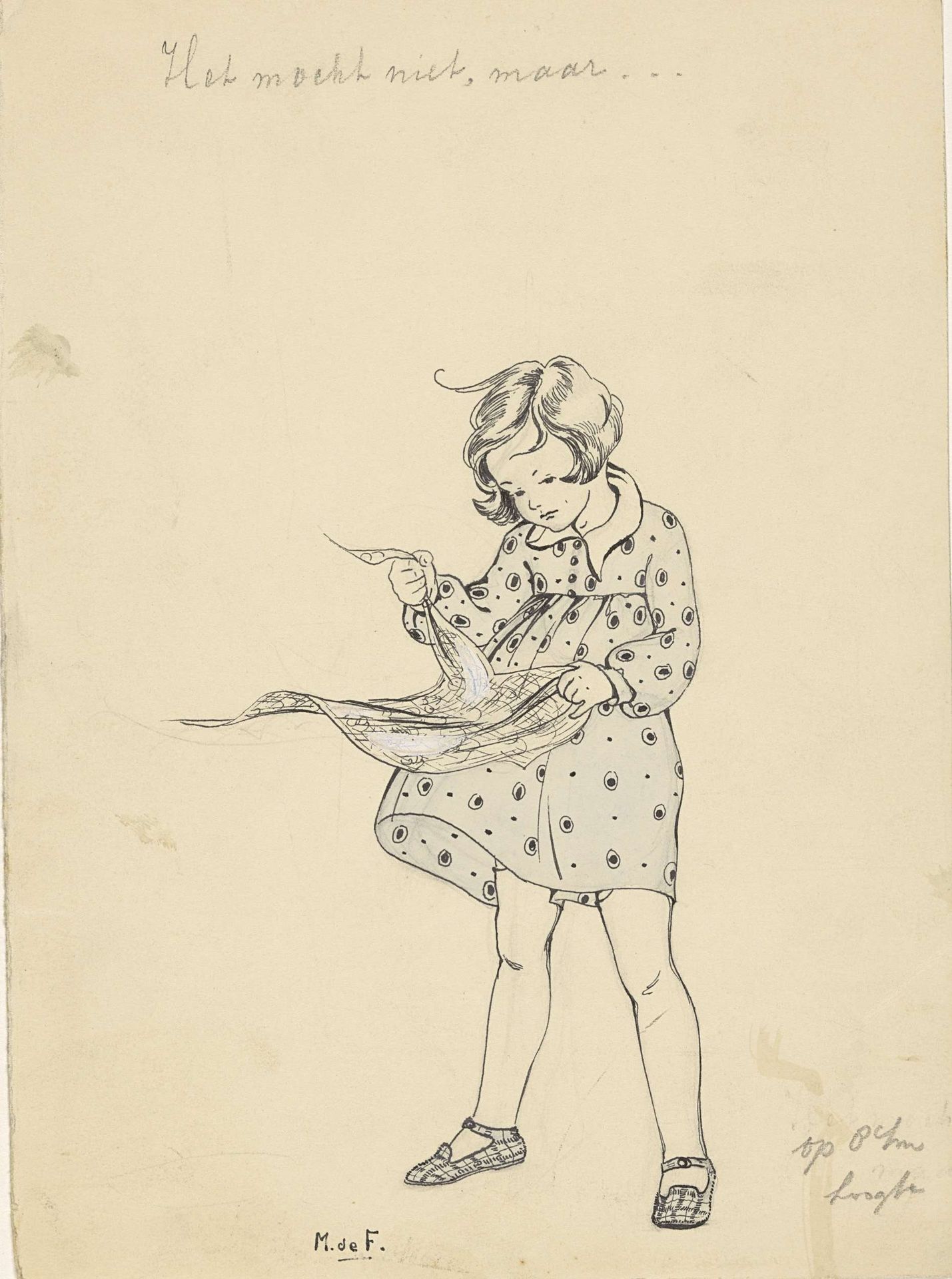
Miep de Feijter made this drawing, *Meisje met een doek*, with ink on paper. It's all about the line. Look at how she varies the pressure, sometimes scratchy and light, sometimes bolder, to give weight and form to this young girl and the cloth she’s holding. It reminds me of how, in my own work, a simple line can be surprisingly expressive. I love how the patterns on her dress create a kind of visual rhythm, playing off the textures and folds in the cloth. And, the title inscribed above, "Het mocht niet, maar..." suggesting some kind of rule being bent or broken, maybe a little rebellion. It's there in her posture, in the way she handles this mysterious cloth. This piece reminds me a little of the work of Balthus, with its focus on the quiet, interior world of children. Art’s like a visual conversation, echoing through time, always exploring these questions of seeing and feeling. There’s no one right way to understand it, it's all about embracing those ambiguities.

Artwork details
- Dimensions
- height 250 mm, width 182 mm
- Copyright
- Rijks Museum: Open Domain
Tags
imaginative character sketch
light pencil work
quirky sketch
pen sketch
personal sketchbook
ink drawing experimentation
pen-ink sketch
sketchbook drawing
sketchbook art
fantasy sketch
Comments
No comments
About this artwork
Miep de Feijter made this drawing, *Meisje met een doek*, with ink on paper. It's all about the line. Look at how she varies the pressure, sometimes scratchy and light, sometimes bolder, to give weight and form to this young girl and the cloth she’s holding. It reminds me of how, in my own work, a simple line can be surprisingly expressive. I love how the patterns on her dress create a kind of visual rhythm, playing off the textures and folds in the cloth. And, the title inscribed above, "Het mocht niet, maar..." suggesting some kind of rule being bent or broken, maybe a little rebellion. It's there in her posture, in the way she handles this mysterious cloth. This piece reminds me a little of the work of Balthus, with its focus on the quiet, interior world of children. Art’s like a visual conversation, echoing through time, always exploring these questions of seeing and feeling. There’s no one right way to understand it, it's all about embracing those ambiguities.
Comments
No comments