About this artwork
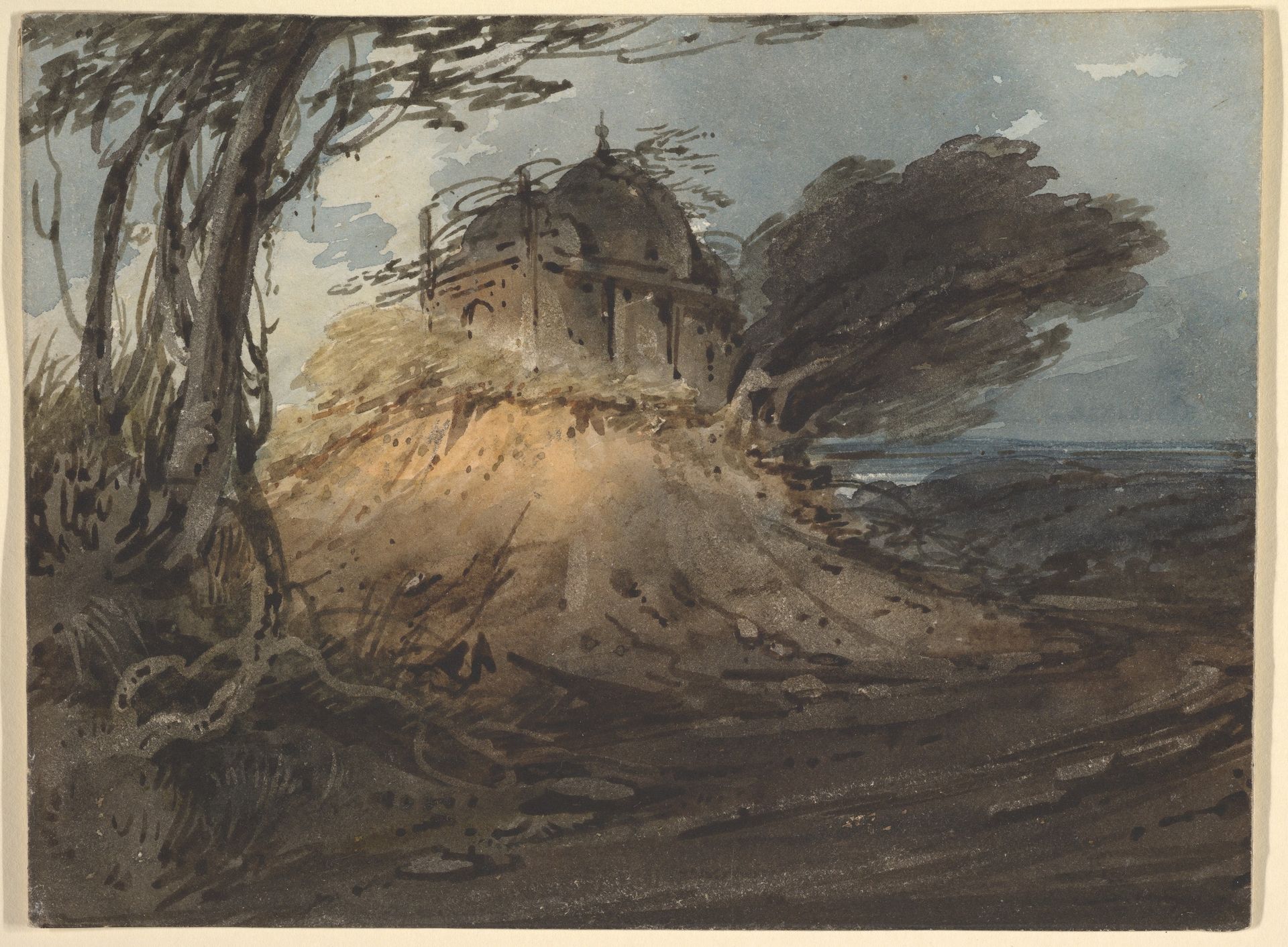
George Chinnery made this watercolor drawing of an Indian temple sometime in the first half of the 19th century. It shows a domed structure perched atop a hill, flanked by trees. Chinnery was one of the first British artists to live and work in India and China. He made a career painting portraits of British officials and wealthy merchants, as well as landscapes featuring local people and architecture. Here, the artist seems to be exploring the picturesque aesthetic then popular in Britain. It idealized nature and the past, and encouraged artists to sketch ruins and other romantic subjects. Paintings like this reflect the social and economic realities of British colonialism in India. As a cultural artifact, Chinnery's temple speaks to the way the British constructed a vision of India for audiences back home. To better understand that vision, we need to look at travel accounts, literature, and other images that shaped British perceptions of India at the time.
Indian Temple
1808 - 1812


Artwork details
- Medium
- drawing, painting, watercolor
- Dimensions
- sheet: 4 15/16 x 6 9/16 in. (12.5 x 16.7 cm)
- Location
- Metropolitan Museum of Art, New York, NY
- Copyright
- Public Domain
Tags
Comments
Share your thoughts
About this artwork
George Chinnery made this watercolor drawing of an Indian temple sometime in the first half of the 19th century. It shows a domed structure perched atop a hill, flanked by trees. Chinnery was one of the first British artists to live and work in India and China. He made a career painting portraits of British officials and wealthy merchants, as well as landscapes featuring local people and architecture. Here, the artist seems to be exploring the picturesque aesthetic then popular in Britain. It idealized nature and the past, and encouraged artists to sketch ruins and other romantic subjects. Paintings like this reflect the social and economic realities of British colonialism in India. As a cultural artifact, Chinnery's temple speaks to the way the British constructed a vision of India for audiences back home. To better understand that vision, we need to look at travel accounts, literature, and other images that shaped British perceptions of India at the time.
Comments
Share your thoughts