Copyright: National Gallery of Art: CC0 1.0
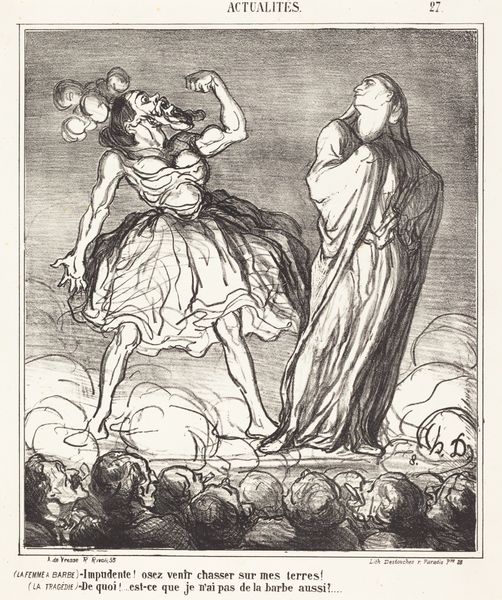
Curator: This is Honoré Daumier’s lithograph, "Les Cadeaux de Noël de 1868," or, “The Christmas Gifts of 1868.” Created during a tense period in European history, it's a powerful, unsettling image. Editor: Unsettling indeed! My first impression is of a dark, foreboding scene. The stark black and white contrasts create a sense of unease, and that figure draped with “Europe” seems burdened, almost defeated, peering into a box filled with… weaponry? Curator: Precisely. Daumier crafted this lithograph to be reproduced in a newspaper, reaching a broad audience with his political commentary. Note the directness of the lithographic crayon on the stone, which enables an easy reproduction and distribution on paper. He skillfully employed caricature to criticize the growing militarism across Europe. Editor: Absolutely. You see the symbolic figure of Europe – she is the ideal of enlightenment ideals weighted down. Daumier implicates the failure of peaceful resolutions between burgeoning nation states in an era where war increasingly became seen as an extension of politics. Are those… cannonballs alongside spiked helmets? Curator: Exactly. Those “gifts” symbolize the tools and spoils of war—artillery, ammunition. But the method of mass reproduction is just as essential to unpack as the actual depicted scene, as is how he produced many variations on this subject. Editor: Right, lithography democratized image-making; it allowed Daumier's critiques to circulate widely. Seeing this image now, I can’t help but consider how familiar these anxieties around political tension and the allure of armed conflict feel, still reproduced in papers everyday. The artwork urges critical questioning and promotes a global responsibility to move away from conflict and hostility. Curator: A fair point, but also a deliberate construction, no? The lithographic stone offered relative freedom but required specific material constraints as much as Daumier had a vision, it would have been informed by the capabilities of process in question, to produce images that were intended for newspapers. Editor: Of course. Thinking of today's images we encounter, its hard to ignore how this points at the manipulative properties inherent to media to either spread or curtail ideas of national and social identity. Curator: Exactly. Daumier prompts viewers to examine both the represented content as well as the materiality and circulation of the print itself as a manufactured article of its moment. Editor: "The Christmas Gifts of 1868"—a sobering reminder that some gifts, laden with political history, should perhaps be returned. Curator: Indeed. Daumier’s work highlights the intertwined relationship between material conditions, politics, and the enduring quest for peace, then as much as today.
Comments
No comments
Be the first to comment and join the conversation on the ultimate creative platform.
 Collect
 React
React Comment
More like this