About this artwork
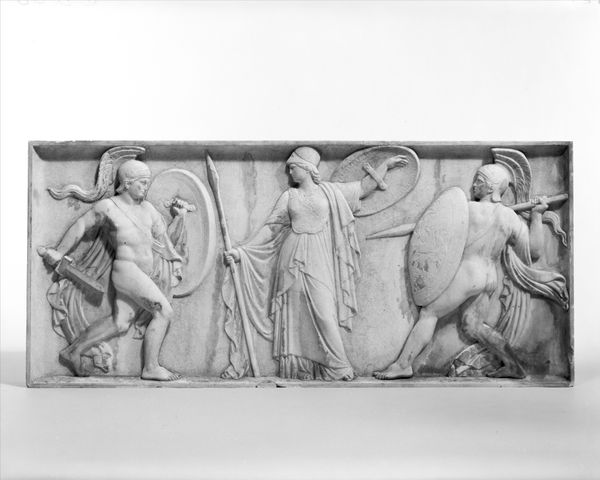
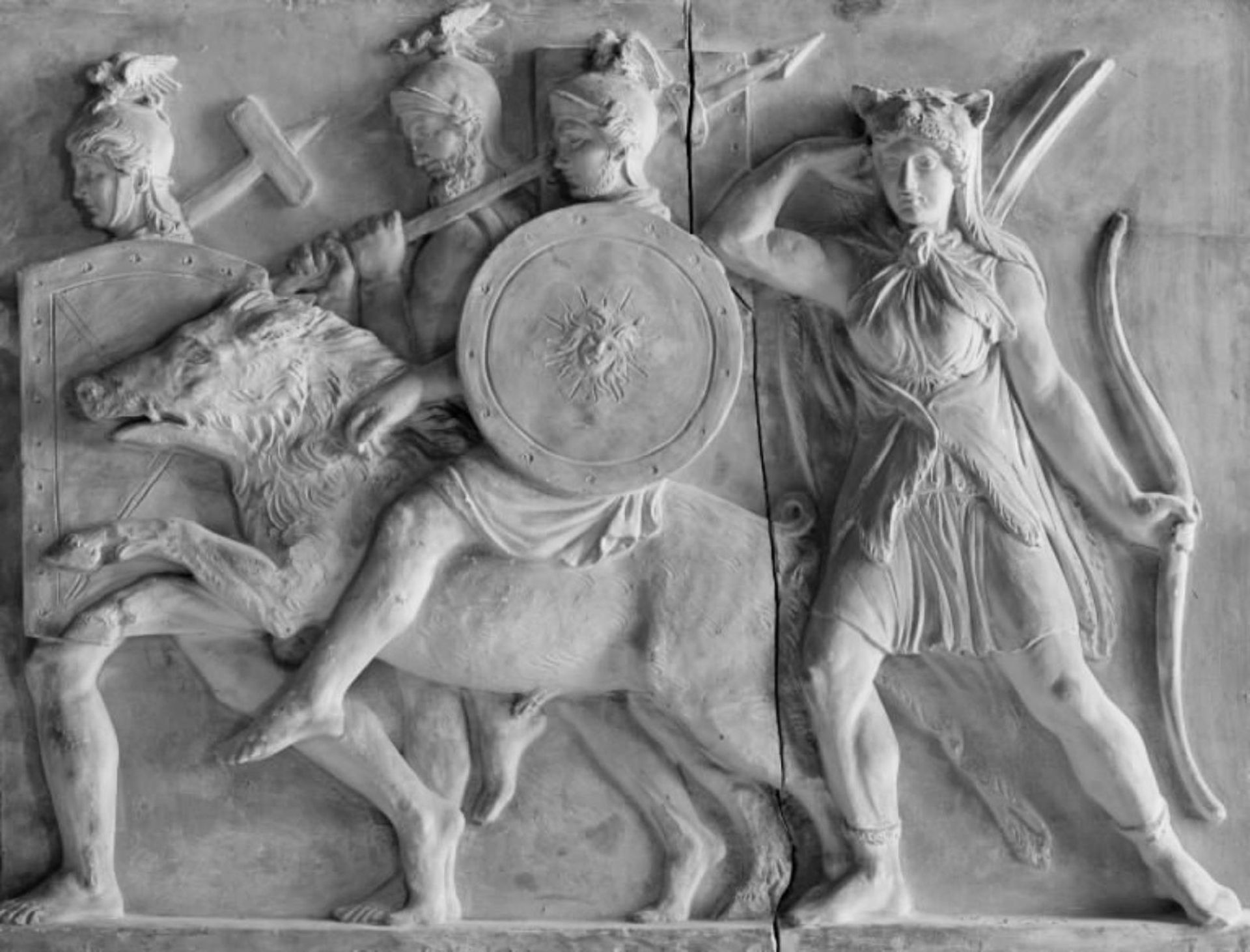
Editor: This is the "Ragnarokfrisen," or Ragnarok Frieze, sculpted in marble relief by Hermann Ernst Freund between 1826 and 1841. It's epic! I'm immediately struck by the raw power conveyed through the figures, like a moment frozen in time during an immense battle. What elements of this work stand out to you? Curator: For me, it's the materiality and labor embedded within this relief that speaks volumes. Freund chose marble, a material traditionally associated with high art and classical ideals. However, its extraction and carving are intensely physical processes. Consider the workers, the quarrymen, the sculptors—their unseen labor is fundamental to this supposedly "high art" depiction of a Norse mythological battle. How does recognizing this influence our understanding? Editor: I guess I never really considered the work that went into it; focusing more on the figures depicted... it does shift the meaning to consider them! Instead of just a romanticized depiction, you mean? Curator: Exactly! This piece, at its core, embodies social hierarchies and the distribution of labor. Note how the figures' bodies are idealized, even god-like. It disguises the extensive, and potentially exploitative, human effort that went into creating the very material they're made from. It asks us: Whose story is truly being told here? Are we glorifying the gods or the forgotten workers who literally gave shape to them? Editor: That's really eye-opening. I'd always thought of classical sculpture as timeless and...almost disembodied, but now I can't help but think about the extraction, the tools, the sheer muscle power involved. Curator: Precisely. By centering our focus on these material conditions, we resist the traditional narrative and can examine not just the aesthetic value, but the complete social context of its creation and consumption. It connects to labor and industrialization debates of its time. Editor: Wow, I'll definitely never look at a marble sculpture the same way again! Thanks. Curator: And hopefully, I can never not keep learning with a young, eager mind! Thank you for your wonderful observations.
Ragnarokfrisen
1826 - 1841


Artwork details
- Medium
- relief, sculpture, marble
- Dimensions
- 96 cm (height) x 4290 cm (width) (Netto)
- Location
- SMK - Statens Museum for Kunst
Tags
Comments
Share your thoughts
About this artwork
Editor: This is the "Ragnarokfrisen," or Ragnarok Frieze, sculpted in marble relief by Hermann Ernst Freund between 1826 and 1841. It's epic! I'm immediately struck by the raw power conveyed through the figures, like a moment frozen in time during an immense battle. What elements of this work stand out to you? Curator: For me, it's the materiality and labor embedded within this relief that speaks volumes. Freund chose marble, a material traditionally associated with high art and classical ideals. However, its extraction and carving are intensely physical processes. Consider the workers, the quarrymen, the sculptors—their unseen labor is fundamental to this supposedly "high art" depiction of a Norse mythological battle. How does recognizing this influence our understanding? Editor: I guess I never really considered the work that went into it; focusing more on the figures depicted... it does shift the meaning to consider them! Instead of just a romanticized depiction, you mean? Curator: Exactly! This piece, at its core, embodies social hierarchies and the distribution of labor. Note how the figures' bodies are idealized, even god-like. It disguises the extensive, and potentially exploitative, human effort that went into creating the very material they're made from. It asks us: Whose story is truly being told here? Are we glorifying the gods or the forgotten workers who literally gave shape to them? Editor: That's really eye-opening. I'd always thought of classical sculpture as timeless and...almost disembodied, but now I can't help but think about the extraction, the tools, the sheer muscle power involved. Curator: Precisely. By centering our focus on these material conditions, we resist the traditional narrative and can examine not just the aesthetic value, but the complete social context of its creation and consumption. It connects to labor and industrialization debates of its time. Editor: Wow, I'll definitely never look at a marble sculpture the same way again! Thanks. Curator: And hopefully, I can never not keep learning with a young, eager mind! Thank you for your wonderful observations.
Comments
Share your thoughts