About this artwork
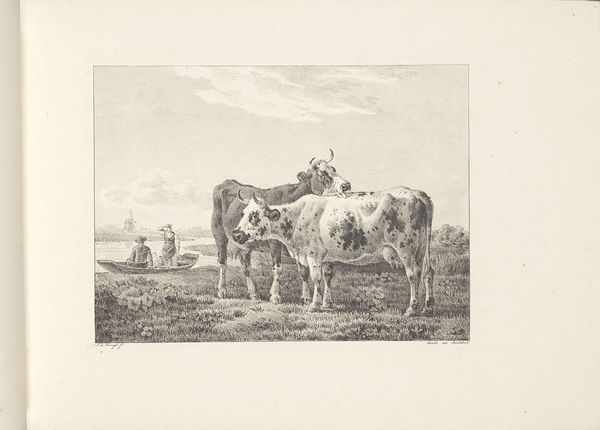
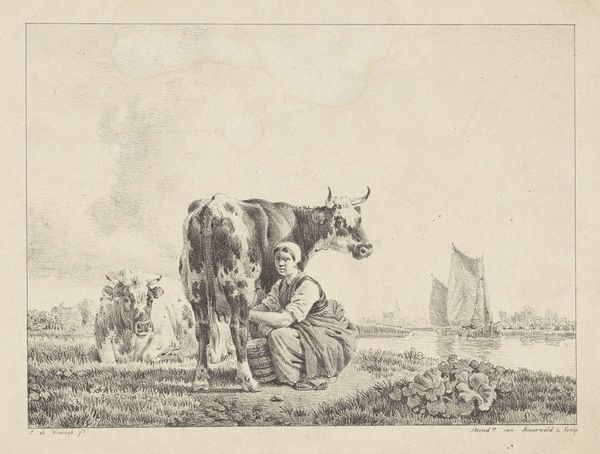
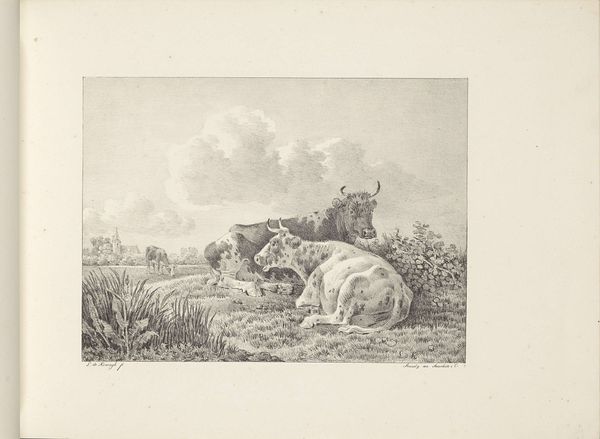
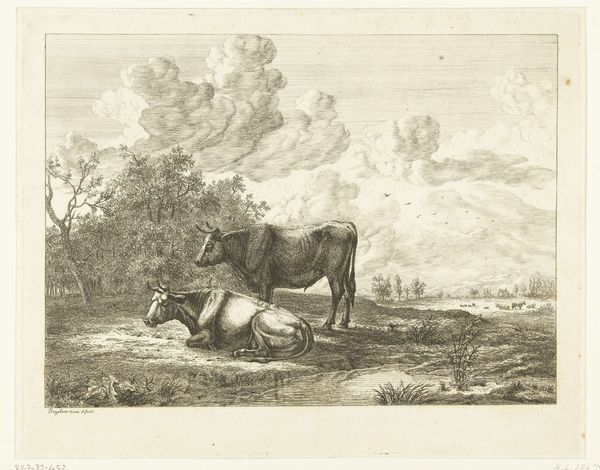
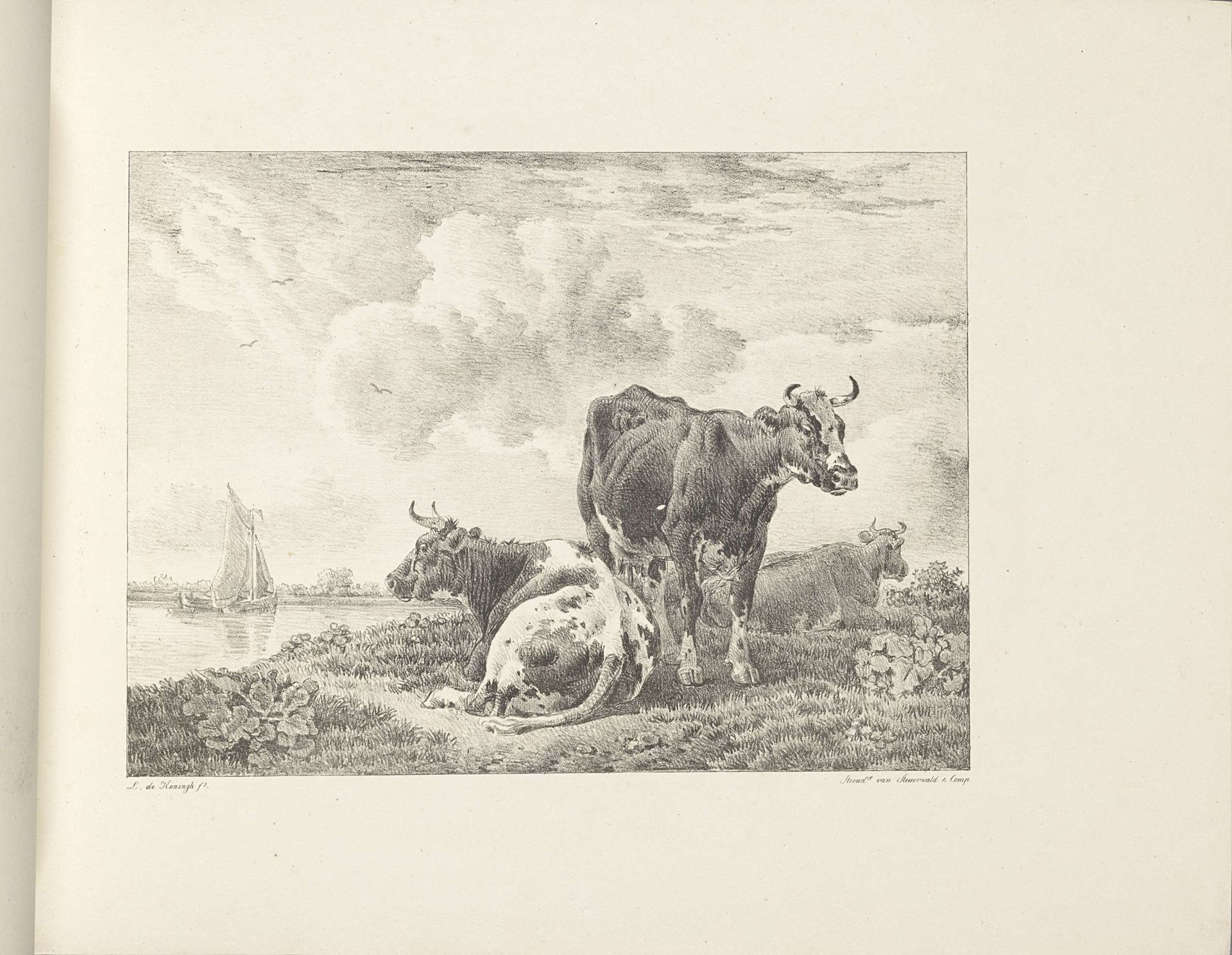
Editor: We're looking at Leendert de Koningh's "Landscape with Three Cows and a Sailboat," an etching from 1826, held at the Rijksmuseum. It feels so still, so classically composed. What do you see when you examine this print? Curator: The composition hinges on a careful orchestration of depth. Note how the foreground's textured detail—evident in the etched lines defining the foliage and the cattle's forms—yields to the gentler, more blurred treatment of the sailboat and distant shore. It's a calculated manipulation of focus. Editor: So, the artist is guiding our eye? Curator: Precisely. Consider how the positioning of the cows, especially the standing one, commands our attention. The interplay of light and shadow across its form creates a focal point, enhanced by the linear perspective that recedes towards the horizon. The atmospheric perspective makes for a soft background. The tonal contrast adds definition to foregrounded elements, creating an interplay between clarity and ambiguity. Do you perceive a certain rhythm established? Editor: I think so. It's subtle but definite, from the textures in the grass to the cows to the boat, even to the clouds. I hadn't noticed how structured it was at first. Curator: Indeed. The interplay is deliberate. Consider this, if the standing cow was absent, how drastically might the reading of the overall scene be altered? The careful placement allows the entire scene to breath, bringing the image to life. Editor: I see what you mean. The standing cow centers it. This has made me notice the careful balance the artist created and just how everything works together. Curator: Art unveils its narrative through the formal properties.
Landschap met drie koeien en een zeilboot 1826

Leendert de Koningh
1777 - 1849Location
RijksmuseumArtwork details
- Medium
- print, etching
- Dimensions
- height 325 mm, width 460 mm
- Location
- Rijksmuseum
- Copyright
- Rijks Museum: Open Domain
Tags
16_19th-century
etching
landscape
realism
Comments
No comments
About this artwork
Editor: We're looking at Leendert de Koningh's "Landscape with Three Cows and a Sailboat," an etching from 1826, held at the Rijksmuseum. It feels so still, so classically composed. What do you see when you examine this print? Curator: The composition hinges on a careful orchestration of depth. Note how the foreground's textured detail—evident in the etched lines defining the foliage and the cattle's forms—yields to the gentler, more blurred treatment of the sailboat and distant shore. It's a calculated manipulation of focus. Editor: So, the artist is guiding our eye? Curator: Precisely. Consider how the positioning of the cows, especially the standing one, commands our attention. The interplay of light and shadow across its form creates a focal point, enhanced by the linear perspective that recedes towards the horizon. The atmospheric perspective makes for a soft background. The tonal contrast adds definition to foregrounded elements, creating an interplay between clarity and ambiguity. Do you perceive a certain rhythm established? Editor: I think so. It's subtle but definite, from the textures in the grass to the cows to the boat, even to the clouds. I hadn't noticed how structured it was at first. Curator: Indeed. The interplay is deliberate. Consider this, if the standing cow was absent, how drastically might the reading of the overall scene be altered? The careful placement allows the entire scene to breath, bringing the image to life. Editor: I see what you mean. The standing cow centers it. This has made me notice the careful balance the artist created and just how everything works together. Curator: Art unveils its narrative through the formal properties.
Comments
No comments