About this artwork
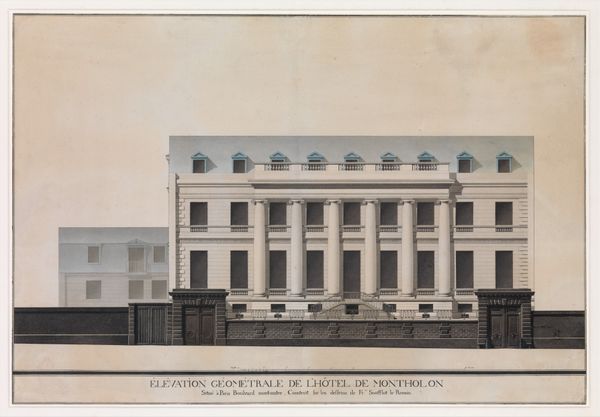
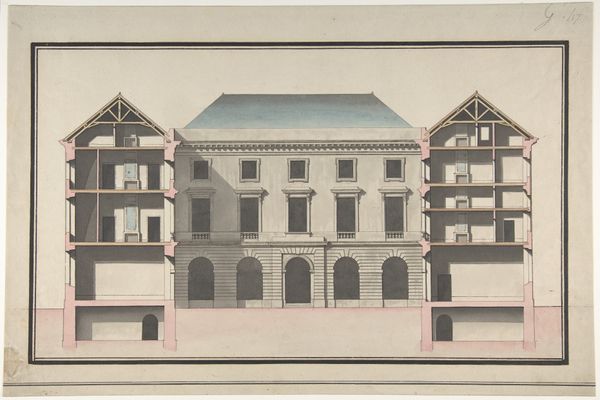
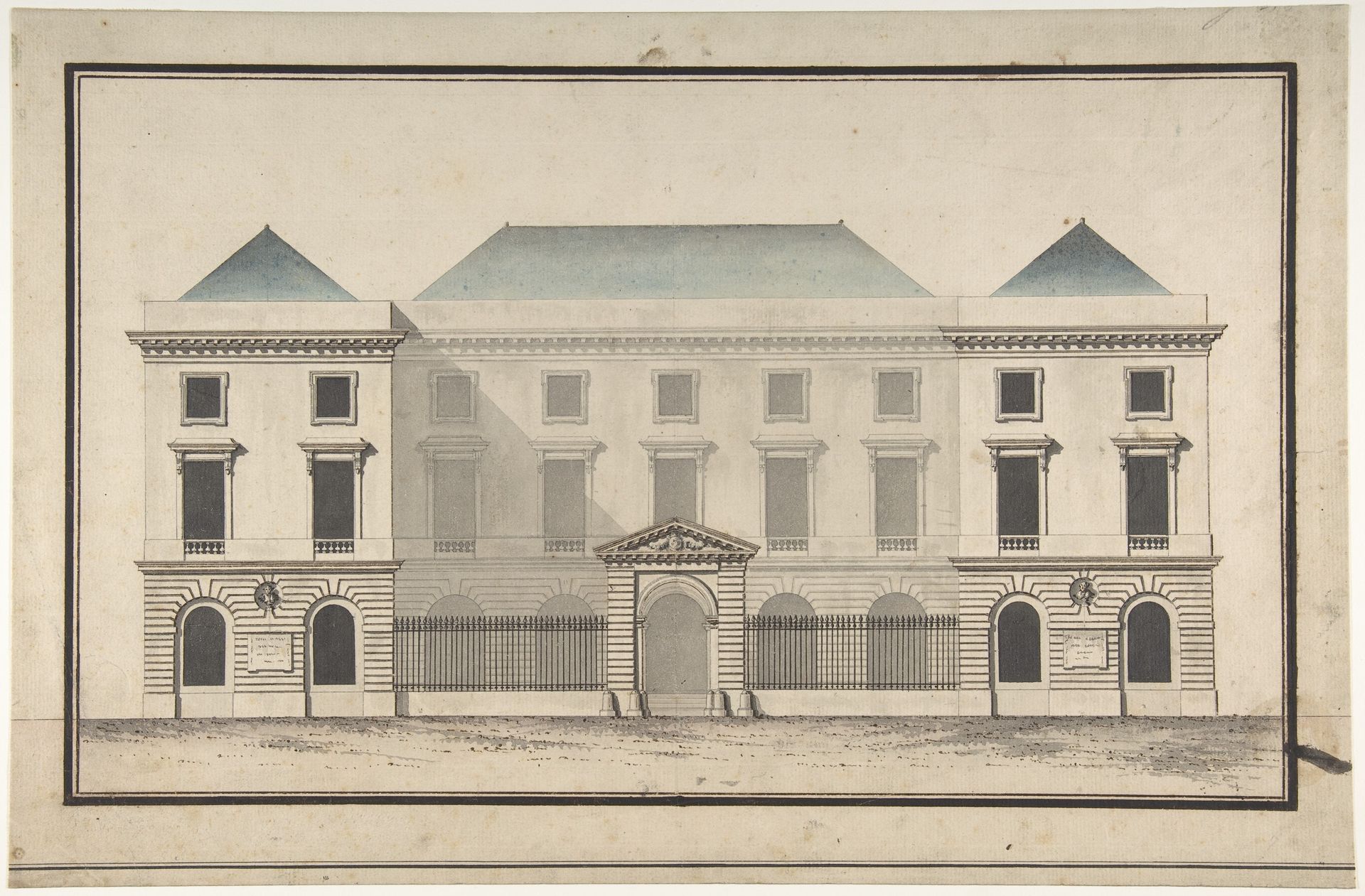
Jean François Chalgrin rendered this elevation of the Collège de France in pen, ink, and watercolor. The design showcases classical elements: symmetrical facade, arched entrance, and decorative wreaths. The wreath, a circular arrangement of leaves or flowers, has ancient roots. In classical antiquity, wreaths symbolized victory, honor, and civic virtue, often depicted in Roman triumphal arches and portraiture. Here, these wreaths signify prestige and academic excellence, aligning the Collège de France with the grandeur of classical institutions. This motif of the wreath has evolved over time, appearing in various contexts from ancient Greek pottery to modern-day emblems. It is a symbol that taps into our collective memory, evoking the enduring human aspiration for recognition and achievement. It represents a non-linear and cyclical progression. The wreath reappears, evolves, and takes on new meanings across historical contexts.
Design for the Collège de France, Paris: Elevation of Court Front Showing Entrance Screen
1767 - 1777

Jean François Chalgrin
1739 - 1811
The Metropolitan Museum of Art
Metropolitan Museum of Art, New York, NYArtwork details
- Medium
- drawing, print, paper, watercolor, ink, architecture
- Dimensions
- 12 9/16 x 19 1/8 in. (31.9 x 48.5 cm)
- Location
- Metropolitan Museum of Art, New York, NY
- Copyright
- Public Domain
Tags
Comments
Share your thoughts
About this artwork
Jean François Chalgrin rendered this elevation of the Collège de France in pen, ink, and watercolor. The design showcases classical elements: symmetrical facade, arched entrance, and decorative wreaths. The wreath, a circular arrangement of leaves or flowers, has ancient roots. In classical antiquity, wreaths symbolized victory, honor, and civic virtue, often depicted in Roman triumphal arches and portraiture. Here, these wreaths signify prestige and academic excellence, aligning the Collège de France with the grandeur of classical institutions. This motif of the wreath has evolved over time, appearing in various contexts from ancient Greek pottery to modern-day emblems. It is a symbol that taps into our collective memory, evoking the enduring human aspiration for recognition and achievement. It represents a non-linear and cyclical progression. The wreath reappears, evolves, and takes on new meanings across historical contexts.
Comments
Share your thoughts