About this artwork
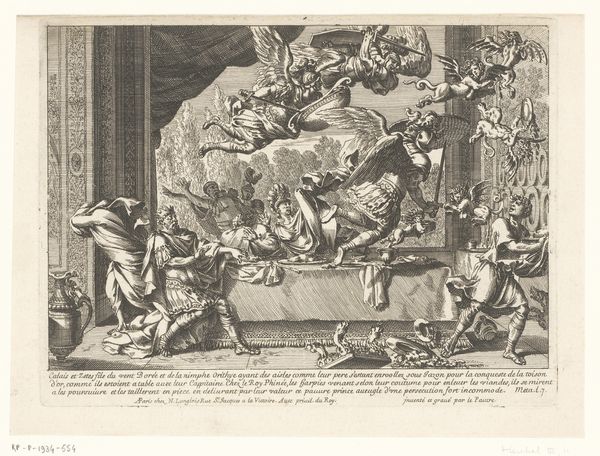
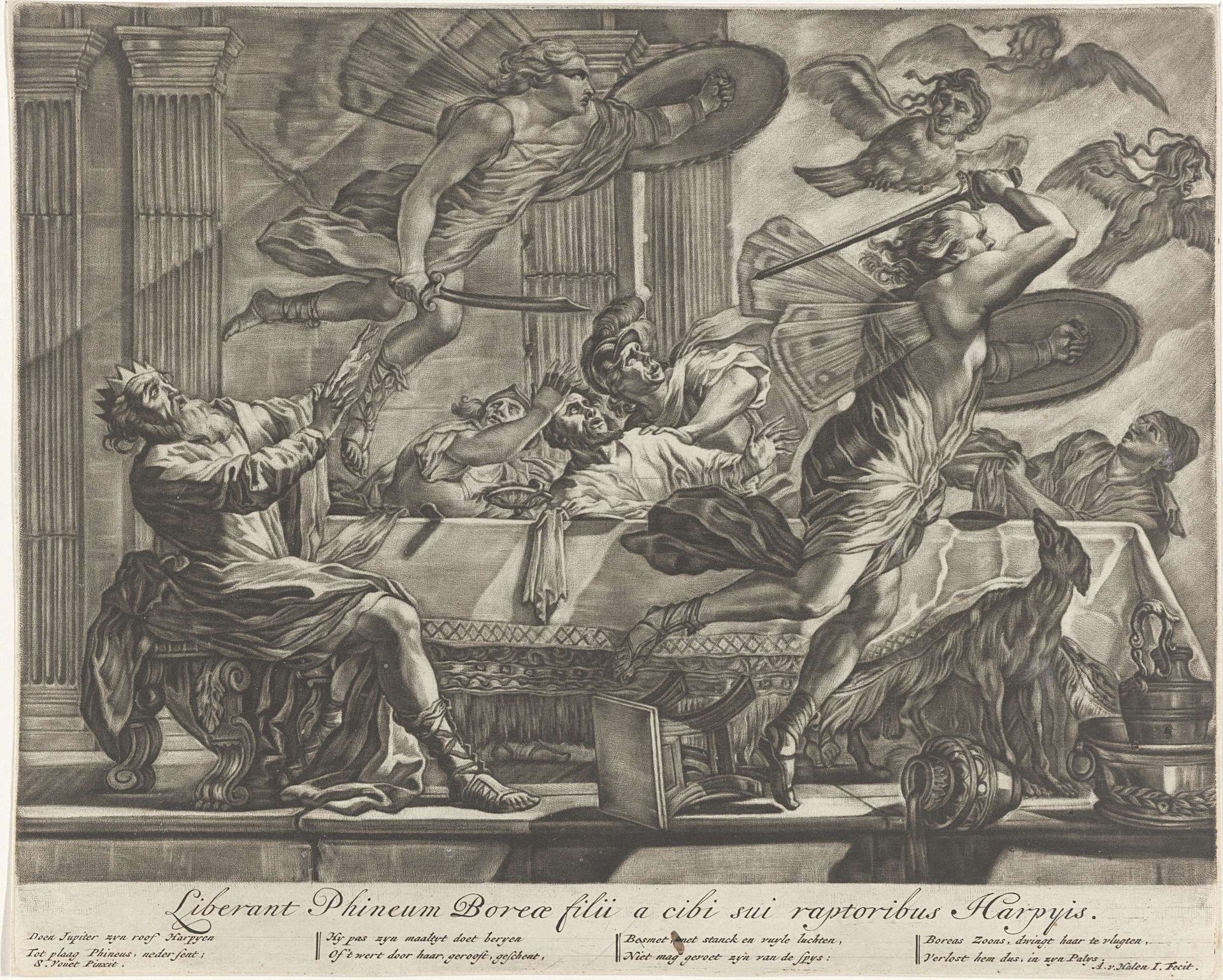
Editor: This is "Bevrijding van Phineus," or "Liberation of Phineus," an engraving by Arnoud van Halen made sometime between 1683 and 1732. It's an intense scene, pretty packed with figures, and has a distinctly Baroque feel with all the dynamic movement. I wonder what a contemporary viewer would have made of it? What catches your eye in this piece? Curator: Ah, yes, Van Halen really throws us into the thick of it, doesn't he? Immediately, I'm struck by the theatricality. Think of it as Baroque drama frozen in ink! It’s based on a story from Ovid’s Metamorphoses where Phineus is being tormented by these bird-like women, the Harpies, who keep stealing or befouling his food. And there in swoops Boreas's sons to rescue him! Can you feel the tension radiating from the image? Editor: Absolutely! The Harpies look terrifying, but what about the other figures? The faces seem exaggerated… almost like caricatures. Curator: Precisely! It's fascinating how Van Halen uses classical realism but injects these near-grotesque expressions. It’s like he is saying that underneath the polished veneer of mythology lurks the messy, uncomfortable truth of human experience. And don't overlook how he manipulates light and shadow to create depth, enhancing the overall dramatic effect. Does the Latin text at the bottom perhaps reveal something more about its intention? Editor: The text certainly frames it in its classical origins, giving the overall engraving a timeless feel and sense of intellectualism. The dynamic tension alongside these elements creates an intriguing piece! Curator: Indeed. The artwork becomes an artifact for deeper reflection. The convergence of classical and creative styles makes this a piece that resonates even centuries later.

Artwork details
- Medium
- engraving
- Dimensions
- height 235 mm, width 291 mm
- Copyright
- Rijks Museum: Open Domain
Tags
narrative-art
baroque
old engraving style
caricature
classical-realism
figuration
portrait drawing
history-painting
engraving
Comments
Be the first to share your thoughts about this work.
About this artwork
Editor: This is "Bevrijding van Phineus," or "Liberation of Phineus," an engraving by Arnoud van Halen made sometime between 1683 and 1732. It's an intense scene, pretty packed with figures, and has a distinctly Baroque feel with all the dynamic movement. I wonder what a contemporary viewer would have made of it? What catches your eye in this piece? Curator: Ah, yes, Van Halen really throws us into the thick of it, doesn't he? Immediately, I'm struck by the theatricality. Think of it as Baroque drama frozen in ink! It’s based on a story from Ovid’s Metamorphoses where Phineus is being tormented by these bird-like women, the Harpies, who keep stealing or befouling his food. And there in swoops Boreas's sons to rescue him! Can you feel the tension radiating from the image? Editor: Absolutely! The Harpies look terrifying, but what about the other figures? The faces seem exaggerated… almost like caricatures. Curator: Precisely! It's fascinating how Van Halen uses classical realism but injects these near-grotesque expressions. It’s like he is saying that underneath the polished veneer of mythology lurks the messy, uncomfortable truth of human experience. And don't overlook how he manipulates light and shadow to create depth, enhancing the overall dramatic effect. Does the Latin text at the bottom perhaps reveal something more about its intention? Editor: The text certainly frames it in its classical origins, giving the overall engraving a timeless feel and sense of intellectualism. The dynamic tension alongside these elements creates an intriguing piece! Curator: Indeed. The artwork becomes an artifact for deeper reflection. The convergence of classical and creative styles makes this a piece that resonates even centuries later.
Comments
Be the first to share your thoughts about this work.