About this artwork
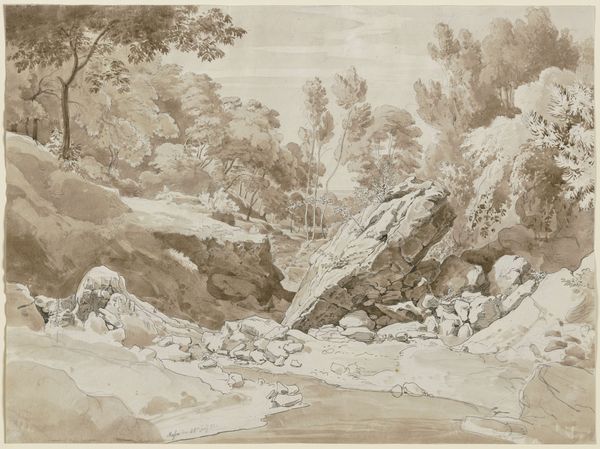
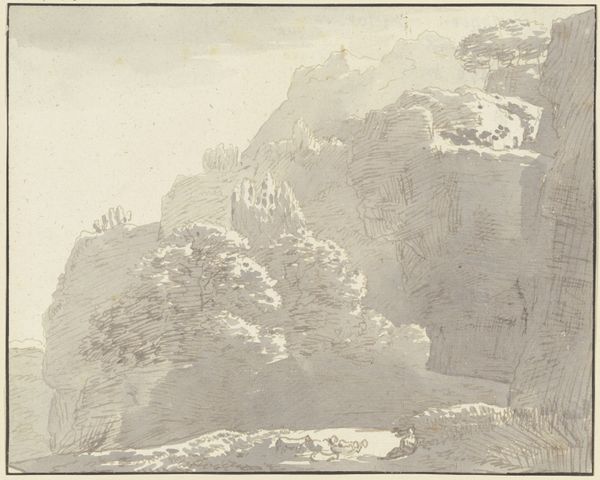
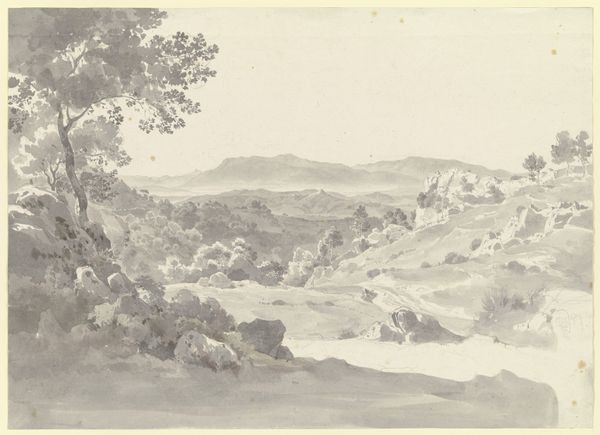
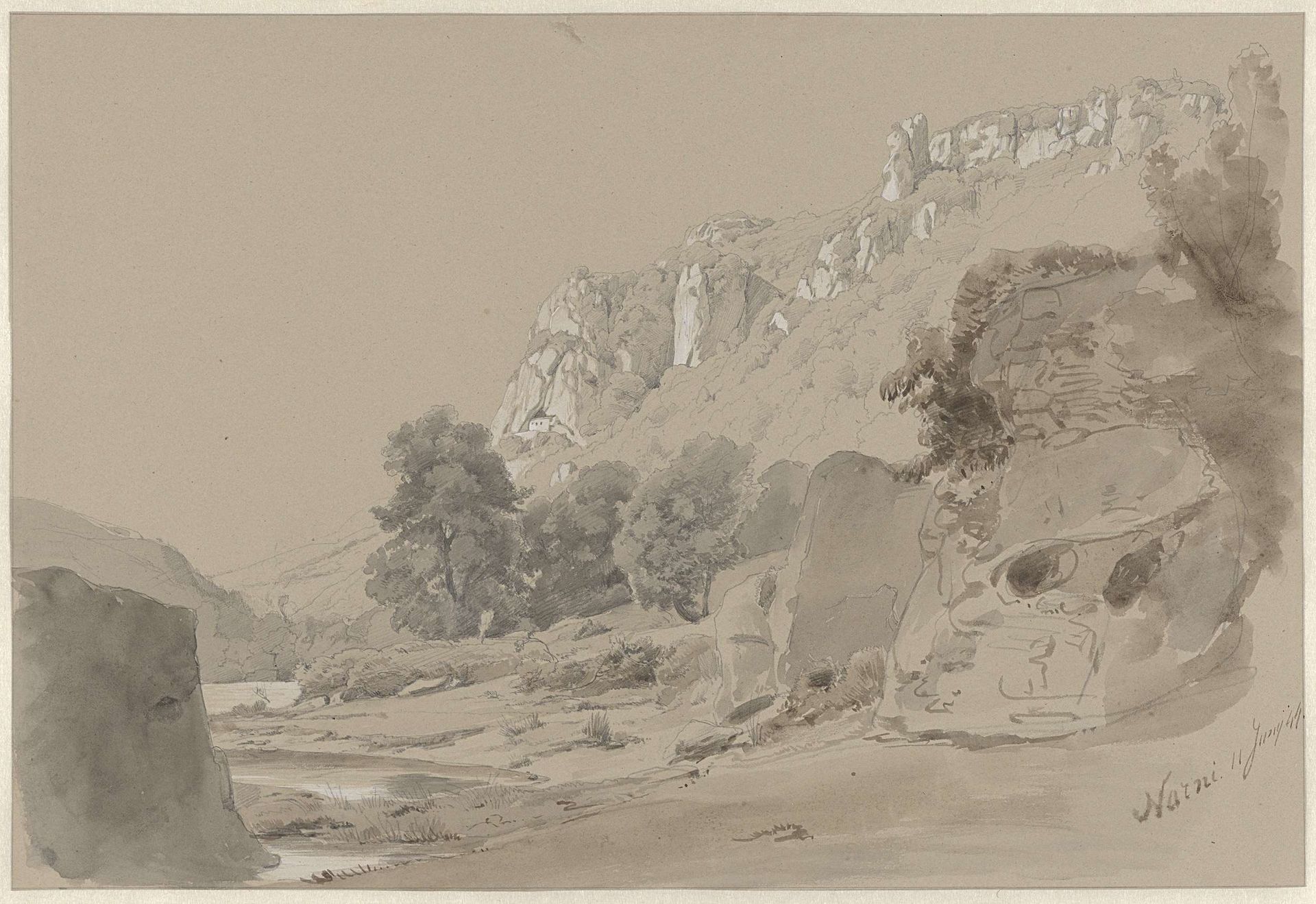
Editor: This drawing, "The Nera River near Narni" by Pierre Louis Dubourcq, from 1844, utilizes ink, charcoal and watercolor to capture this landscape. The delicate use of monochrome gives it a kind of peaceful but also almost desolate quality. How do you interpret this work within its historical context? Curator: It's interesting you find it desolate. Consider that landscapes in the Romantic era, and this definitely seems connected to those ideals, were often tied to national identity. Dubourcq, likely responding to broader European trends, presents this Italian landscape as powerful, even sublime, and invites reflection on Italy's historical and cultural significance, something deeply important for cultural identity during the rise of nationalism. What feeling does the composition itself evoke in you, independent of medium and history? Editor: I see what you mean about sublime power. The height of the crags in the background, towering over the small, seemingly quiet stream… I still can’t shake that feeling of quiet melancholy though, even if it’s intentional. Curator: Does knowing the political context – the rise of nationalist sentiment, the drive to create a unified Italian identity – perhaps alter your reading? Could that melancholy speak not only of beauty, but also of the perceived past glories, a sentiment deeply woven into nationalist art production and propaganda of that era? Editor: Definitely, that adds another layer. Thinking about it as a promotion of national identity, that subtle melancholy makes a lot of sense. Curator: Exactly. This work allows us to consider the intersections between artistic expression, political ideology, and the construction of national identity. Art isn't produced in a vacuum, and appreciating that reality is what makes studying art history such a rewarding challenge. Editor: I’ll definitely keep that interplay of beauty, melancholy, and political messaging in mind moving forward.

Artwork details
- Medium
- drawing, plein-air, ink
- Dimensions
- height 297 mm, width 439 mm
- Location
- Rijksmuseum
- Copyright
- Rijks Museum: Open Domain
Tags
drawing
plein-air
landscape
charcoal drawing
ink
pencil drawing
romanticism
watercolor
Comments

Dubourcq and his travelling companion, the painter Willem Bodeman, spent the winter in Rome. Dubourcq later wrote to a colleague ‘…for the ordinary traveller Rome is rather somber and sad, but for us it was a favourite place to be.’ The friends headed back north in the spring of 1844, making ‘a study tour’ of their journey. They stayed in Narni, a hilltop village in Umbria, for a few days in June.
About this artwork
Editor: This drawing, "The Nera River near Narni" by Pierre Louis Dubourcq, from 1844, utilizes ink, charcoal and watercolor to capture this landscape. The delicate use of monochrome gives it a kind of peaceful but also almost desolate quality. How do you interpret this work within its historical context? Curator: It's interesting you find it desolate. Consider that landscapes in the Romantic era, and this definitely seems connected to those ideals, were often tied to national identity. Dubourcq, likely responding to broader European trends, presents this Italian landscape as powerful, even sublime, and invites reflection on Italy's historical and cultural significance, something deeply important for cultural identity during the rise of nationalism. What feeling does the composition itself evoke in you, independent of medium and history? Editor: I see what you mean about sublime power. The height of the crags in the background, towering over the small, seemingly quiet stream… I still can’t shake that feeling of quiet melancholy though, even if it’s intentional. Curator: Does knowing the political context – the rise of nationalist sentiment, the drive to create a unified Italian identity – perhaps alter your reading? Could that melancholy speak not only of beauty, but also of the perceived past glories, a sentiment deeply woven into nationalist art production and propaganda of that era? Editor: Definitely, that adds another layer. Thinking about it as a promotion of national identity, that subtle melancholy makes a lot of sense. Curator: Exactly. This work allows us to consider the intersections between artistic expression, political ideology, and the construction of national identity. Art isn't produced in a vacuum, and appreciating that reality is what makes studying art history such a rewarding challenge. Editor: I’ll definitely keep that interplay of beauty, melancholy, and political messaging in mind moving forward.
Comments
Dubourcq and his travelling companion, the painter Willem Bodeman, spent the winter in Rome. Dubourcq later wrote to a colleague ‘…for the ordinary traveller Rome is rather somber and sad, but for us it was a favourite place to be.’ The friends headed back north in the spring of 1844, making ‘a study tour’ of their journey. They stayed in Narni, a hilltop village in Umbria, for a few days in June.