About this artwork
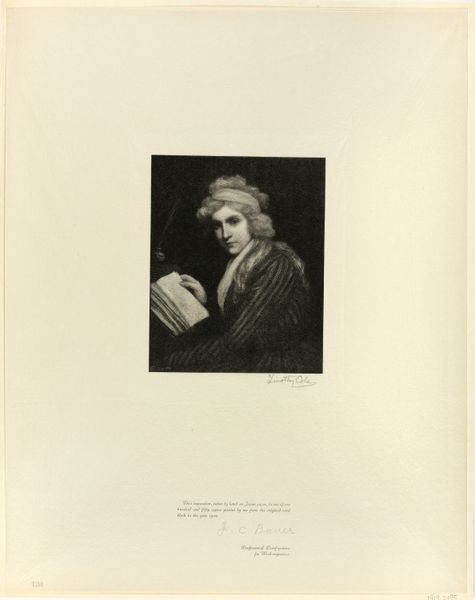
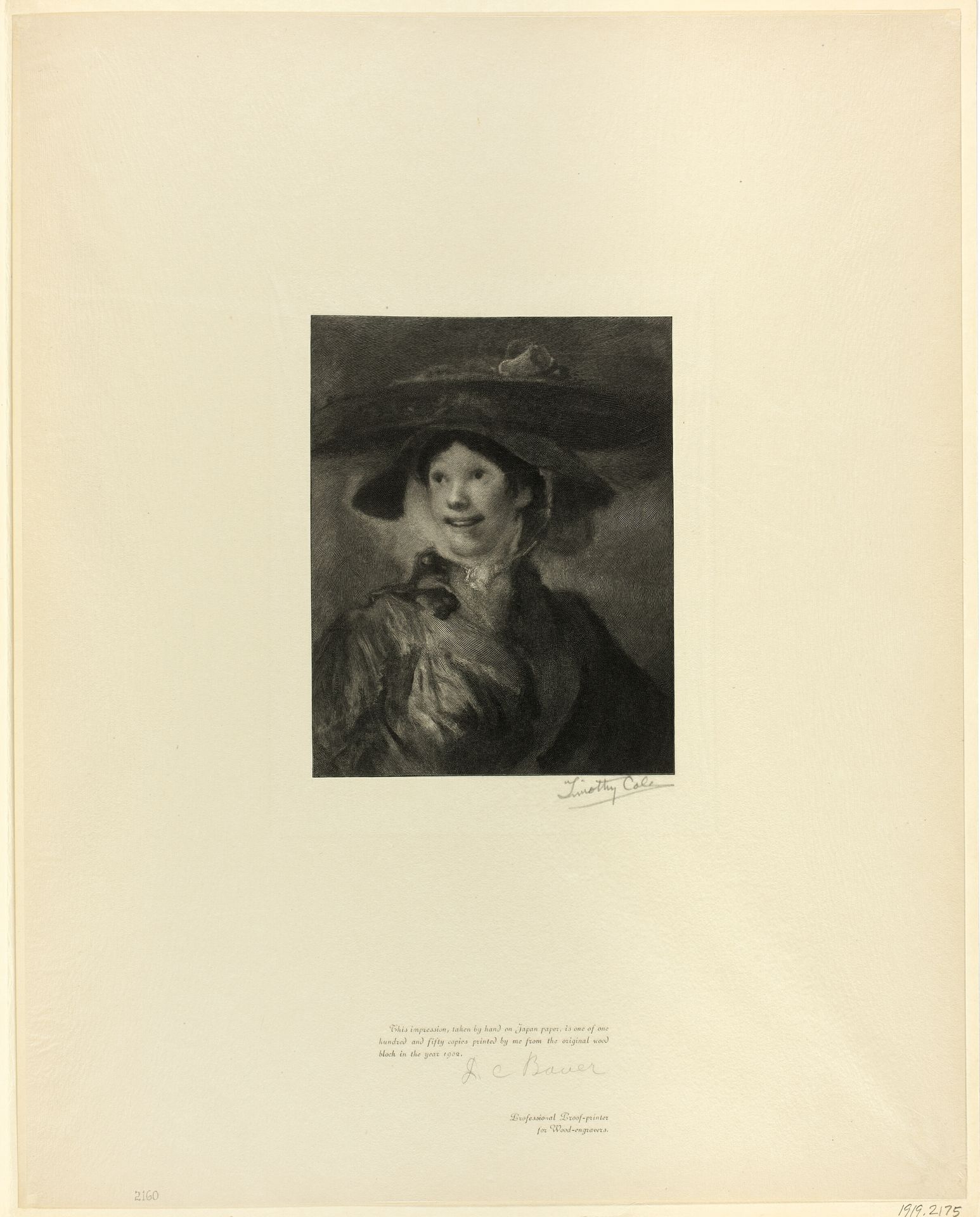
Editor: This is Timothy Cole's "The Shrimp Girl, from Old English Masters," dating back to possibly 1896-1902, an engraving print housed here at the Art Institute of Chicago. The young woman's engaging gaze and delicate shading create such a charming image, very lighthearted. What draws your attention to this piece? Curator: Well, let's consider the title – "The Shrimp Girl." Even without knowing the original painting, the very term 'shrimp girl' carries associations. What emotions or cultural memories does that evoke in you? Editor: Perhaps images of labor, the everyday life of working-class women? A kind of youthful energy, a simple beauty? Curator: Precisely. The hat, slightly tilted, the direct yet cheerful gaze—these weren't accidental. Consider the symbolism: hats can indicate social status, aspiration. What might Cole, as an engraver interpreting an older painting, be saying about *access* to this type of portraiture? The original was by William Hogarth. How does Cole's *copy* relate to the history of English painting and its symbolism? Editor: So it is an engagement with the *idea* of a 'master,' looking back to Hogarth. Curator: Yes! Consider this engraving as a layered engagement. It reflects the layers of imagery. It’s not just a copy; it is another version of social aspirations, charm, labor, gender, class... All seen through the lens of a specific artistic choice. Look how her mouth breaks to an asymmetric grin -- it really pushes towards "accessible." The "shrimp girl" is someone we might know. Does that reframe how we look at "portraiture?" Editor: Absolutely, viewing it as a social and art-historical layering enriches it. I now see beyond a pretty picture! Curator: And that deeper engagement, the awareness of embedded meaning, is the journey an image can take us on, generation to generation.
The Shrimp Girl, from Old English Masters
Possibly 1896 - 1902


Artwork details
- Medium
- drawing, print, paper, pencil, engraving
- Dimensions
- 435 × 345 mm (sheet)
- Location
- The Art Institute of Chicago
- Copyright
- Public Domain
Tags
Comments
Share your thoughts
About this artwork
Editor: This is Timothy Cole's "The Shrimp Girl, from Old English Masters," dating back to possibly 1896-1902, an engraving print housed here at the Art Institute of Chicago. The young woman's engaging gaze and delicate shading create such a charming image, very lighthearted. What draws your attention to this piece? Curator: Well, let's consider the title – "The Shrimp Girl." Even without knowing the original painting, the very term 'shrimp girl' carries associations. What emotions or cultural memories does that evoke in you? Editor: Perhaps images of labor, the everyday life of working-class women? A kind of youthful energy, a simple beauty? Curator: Precisely. The hat, slightly tilted, the direct yet cheerful gaze—these weren't accidental. Consider the symbolism: hats can indicate social status, aspiration. What might Cole, as an engraver interpreting an older painting, be saying about *access* to this type of portraiture? The original was by William Hogarth. How does Cole's *copy* relate to the history of English painting and its symbolism? Editor: So it is an engagement with the *idea* of a 'master,' looking back to Hogarth. Curator: Yes! Consider this engraving as a layered engagement. It reflects the layers of imagery. It’s not just a copy; it is another version of social aspirations, charm, labor, gender, class... All seen through the lens of a specific artistic choice. Look how her mouth breaks to an asymmetric grin -- it really pushes towards "accessible." The "shrimp girl" is someone we might know. Does that reframe how we look at "portraiture?" Editor: Absolutely, viewing it as a social and art-historical layering enriches it. I now see beyond a pretty picture! Curator: And that deeper engagement, the awareness of embedded meaning, is the journey an image can take us on, generation to generation.
Comments
Share your thoughts