About this artwork
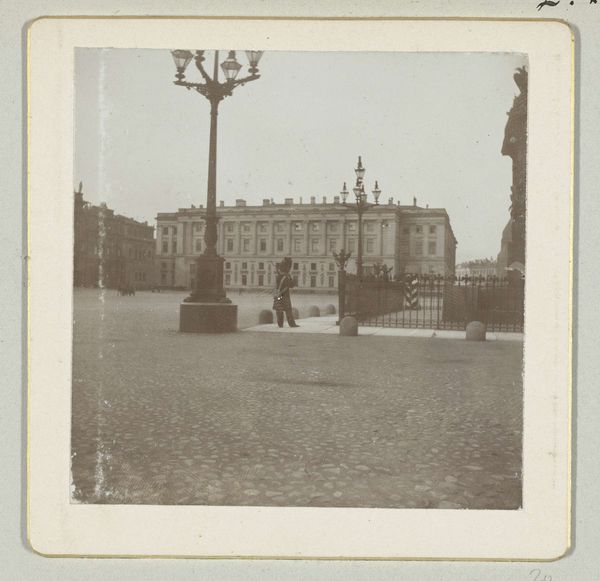
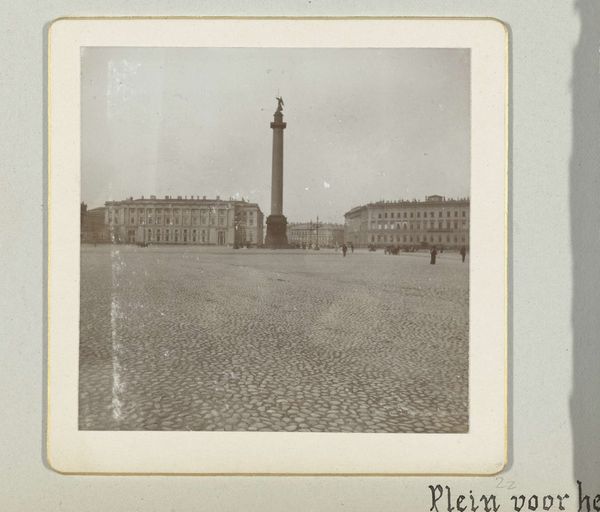
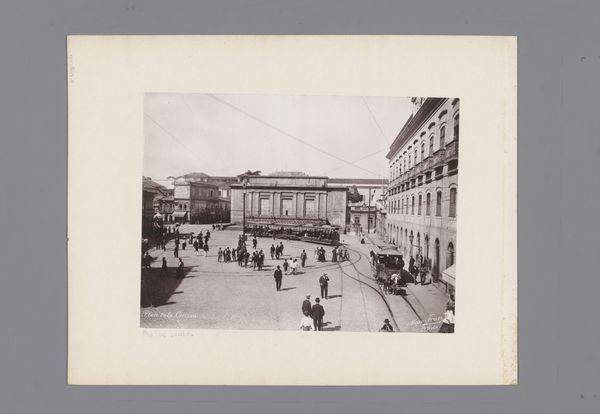
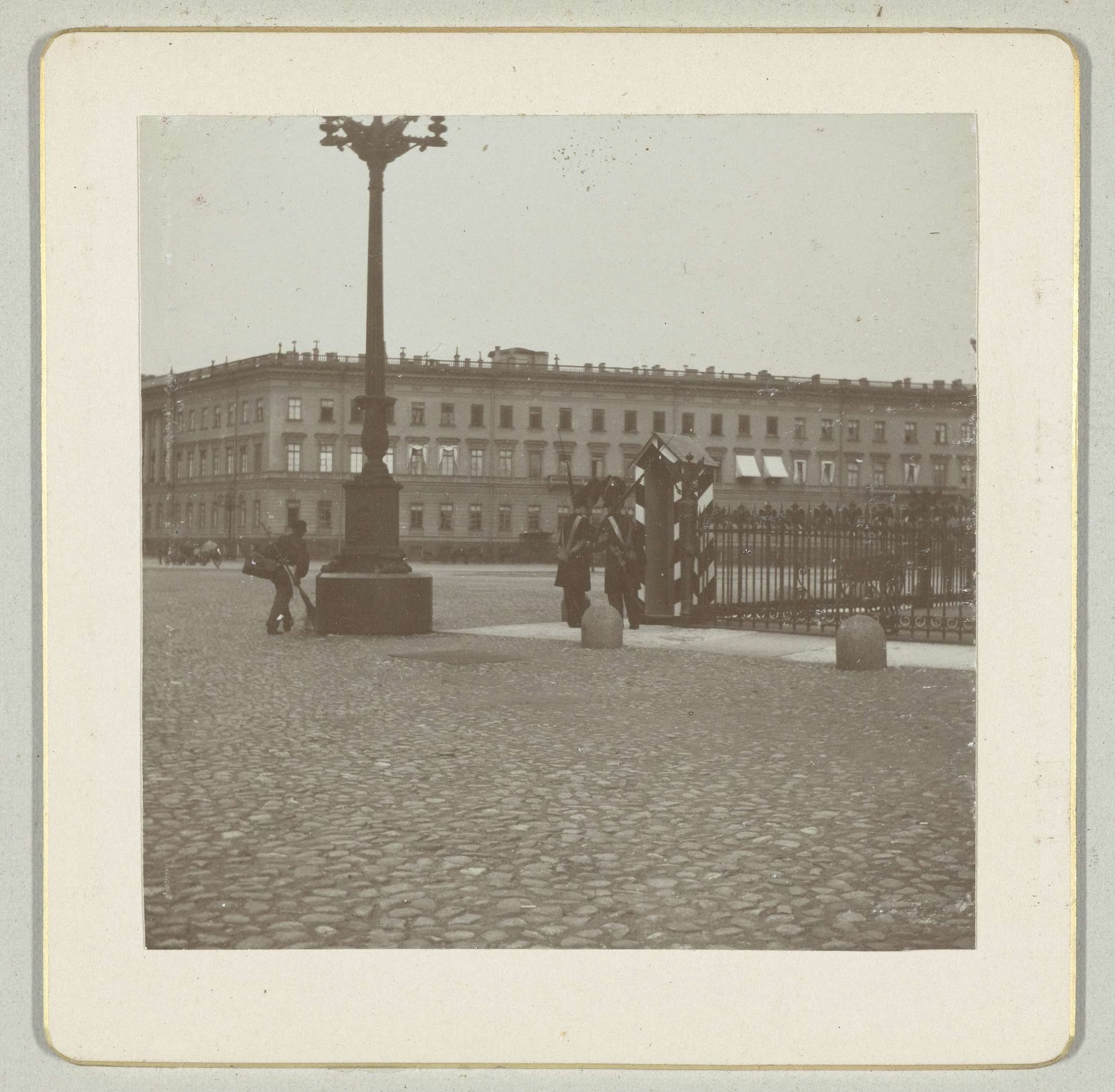
Editor: This is "Het plein voor de Hermitage in Sint-Petersburg," taken in 1898 by Henry Pauw van Wieldrecht. It's a gelatin silver print capturing a street scene. The first thing that strikes me is the rigid formality, emphasized by the stark, near-monochromatic tones. What do you see in this piece, considering its formal qualities? Curator: The image, beyond its representational function, is deeply structured by contrasting geometric forms. Observe the stark verticality of the lamp post and the guardhouses against the long, low horizontal expanse of the Hermitage itself. How do these opposing forces affect the composition? Editor: I see what you mean. The verticals almost seem to interrupt the horizontal flow, creating a visual tension. They are undeniably graphic. Is the use of light significant here? Curator: Absolutely. Note the even distribution of light, creating a nearly shadowless scene, rendering form through subtle tonal variations rather than dramatic chiaroscuro. It flattens the image, emphasizing its planar qualities. What does this flatness suggest to you? Editor: It creates a sense of detachment, maybe even anonymity. The figures almost blend into the architecture. Are the repeating patterns in the architecture of interest here? Curator: Precisely. The repetition of windows creates a rhythmic structure that contrasts with the seemingly random placement of the figures on the square. The photographer seems keen to capture depth through patterns rather than light play. It’s a play of textures: smooth building versus cobbled surface. It evokes rhythm. Editor: That’s fascinating. I hadn’t considered how the texture contributes to the structure. Curator: Indeed. It illustrates how seemingly simple visual elements—light, shape, and texture—can deeply structure our experience of a photographic image. This photograph shows not what it depicts, but the arrangement of the forms it constructs. Editor: So, seeing past the obvious, finding visual building blocks in images. I’ll definitely carry that insight with me.
Het plein voor de Hermitage in Sint-Petersburg
1898

Henry Pauw van Wieldrecht
1863 - 1912Location
RijksmuseumArtwork details
- Dimensions
- height 100 mm, width 100 mm, height 259 mm, width 365 mm
- Location
- Rijksmuseum
- Copyright
- Rijks Museum: Open Domain
Comments
Share your thoughts
About this artwork
Editor: This is "Het plein voor de Hermitage in Sint-Petersburg," taken in 1898 by Henry Pauw van Wieldrecht. It's a gelatin silver print capturing a street scene. The first thing that strikes me is the rigid formality, emphasized by the stark, near-monochromatic tones. What do you see in this piece, considering its formal qualities? Curator: The image, beyond its representational function, is deeply structured by contrasting geometric forms. Observe the stark verticality of the lamp post and the guardhouses against the long, low horizontal expanse of the Hermitage itself. How do these opposing forces affect the composition? Editor: I see what you mean. The verticals almost seem to interrupt the horizontal flow, creating a visual tension. They are undeniably graphic. Is the use of light significant here? Curator: Absolutely. Note the even distribution of light, creating a nearly shadowless scene, rendering form through subtle tonal variations rather than dramatic chiaroscuro. It flattens the image, emphasizing its planar qualities. What does this flatness suggest to you? Editor: It creates a sense of detachment, maybe even anonymity. The figures almost blend into the architecture. Are the repeating patterns in the architecture of interest here? Curator: Precisely. The repetition of windows creates a rhythmic structure that contrasts with the seemingly random placement of the figures on the square. The photographer seems keen to capture depth through patterns rather than light play. It’s a play of textures: smooth building versus cobbled surface. It evokes rhythm. Editor: That’s fascinating. I hadn’t considered how the texture contributes to the structure. Curator: Indeed. It illustrates how seemingly simple visual elements—light, shape, and texture—can deeply structure our experience of a photographic image. This photograph shows not what it depicts, but the arrangement of the forms it constructs. Editor: So, seeing past the obvious, finding visual building blocks in images. I’ll definitely carry that insight with me.
Comments
Share your thoughts