About this artwork
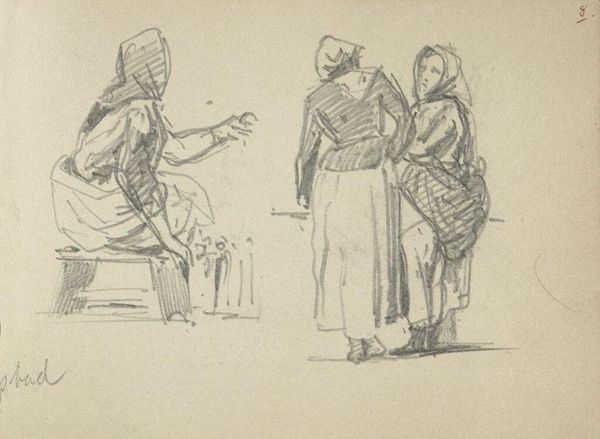
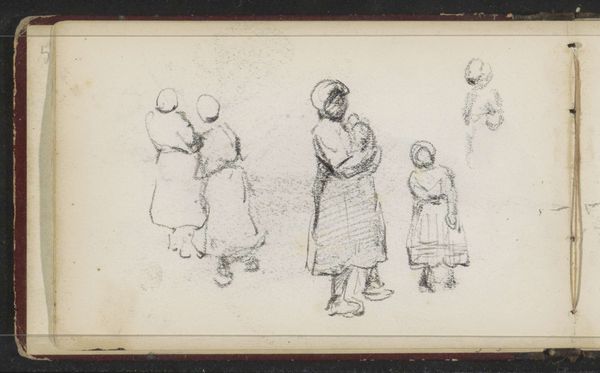
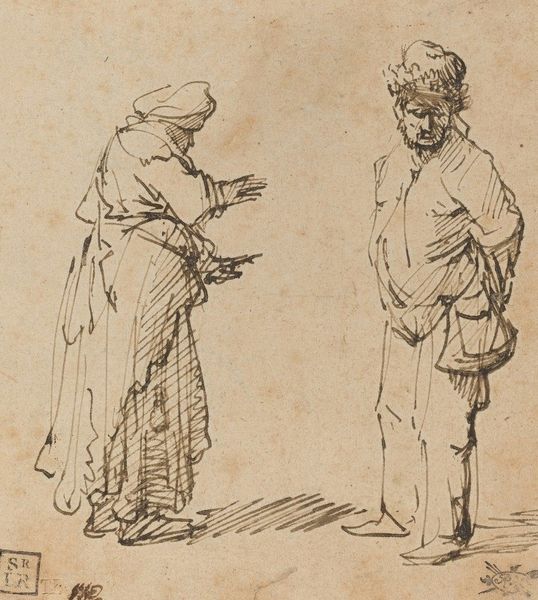
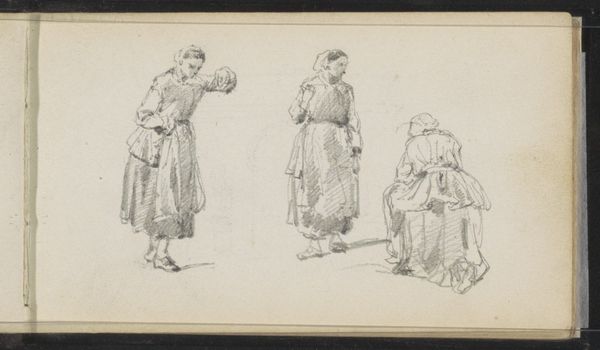
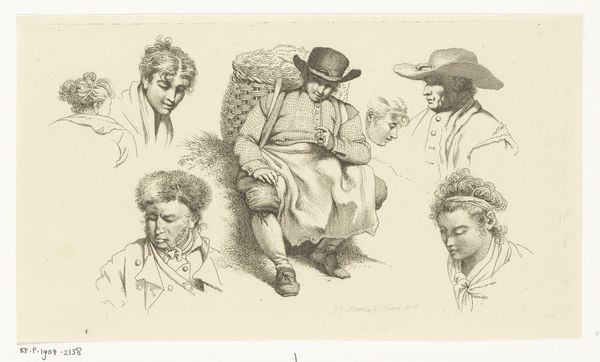
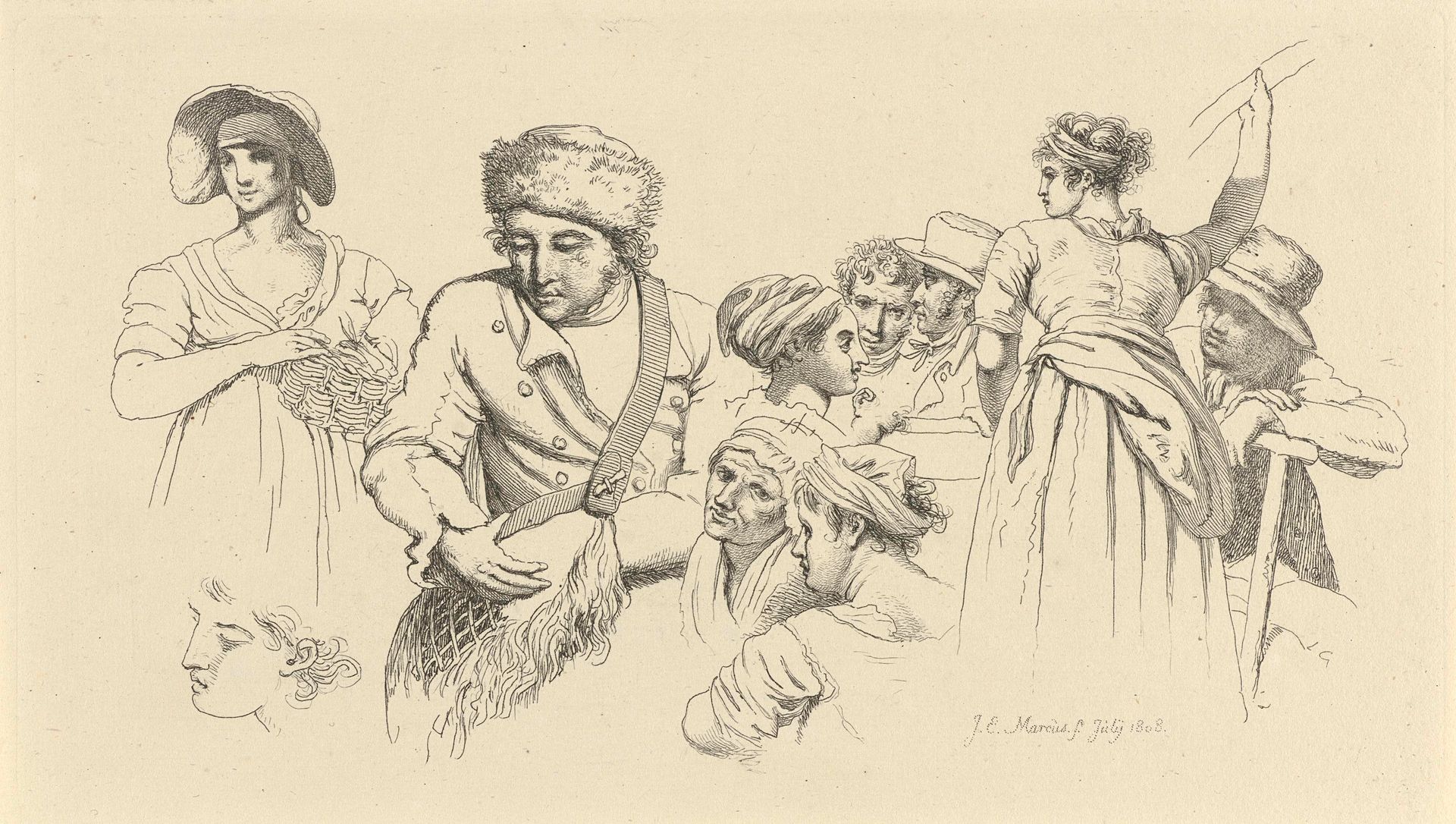
Editor: Looking at Jacob Ernst Marcus’s “Studieblad met figuren en koppen” from 1808, what immediately strikes me is its spontaneous character—a medley of faces rendered in delicate pen strokes. Curator: Indeed. This ink drawing on paper, currently held at the Rijksmuseum, showcases a fascinating interplay of Neoclassical and genre influences. Editor: There's a real sense of immediacy, almost as if we’re peering into the artist’s personal sketchbook. You can almost feel the pen’s movement across the paper, a very tactile sensation. What materials would an artist like Marcus typically use to achieve such fine lines? Curator: The fineness of the lines does speak volumes about the artist’s control and perhaps the quality of both paper and ink accessible during that era. He really harnesses line and tone to create form, almost sculptural in effect, especially in the detailed renderings of the faces. The composition directs your eye purposefully through each grouping, uniting diverse studies into a whole. Editor: And speaking of faces, they seem to represent a range of social classes. Observe the detailed fur cap, juxtaposed with simpler headscarves. I imagine each element was carefully considered not only aesthetically but also in how it related to Dutch society at the time. Can we say anything about its labor process? Curator: Without extensive documentation, definitively attributing direct social implications is speculative. Yet, stylistically, the careful organization of figures and the rendering of clothing, with varying degrees of detail, evoke a narrative tableau reminiscent of contemporary Dutch society's rigid structures and customs. Notice too, how different portraitures interact and invite our interpretive intervention. Editor: I'm curious to see how viewers react to its casual nature despite these constraints. A certain human element shines through—the individual personalities of each person shine. Curator: The skill in Marcus's line work alone demonstrates his firm grasp and ability. Ultimately it invites closer looking as it reveals how through formal means, a moment in history comes to life. Editor: An invitation indeed; to engage not just with the image, but with the moment of its making.

Artwork details
- Medium
- drawing, paper, ink
- Dimensions
- height 123 mm, width 219 mm
- Location
- Rijksmuseum
- Copyright
- Rijks Museum: Open Domain
Tags
portrait
drawing
imaginative character sketch
neoclacissism
pen sketch
figuration
paper
personal sketchbook
ink
idea generation sketch
sketchwork
pen-ink sketch
line
sketchbook drawing
genre-painting
storyboard and sketchbook work
fantasy sketch
initial sketch
Comments
No comments
About this artwork
Editor: Looking at Jacob Ernst Marcus’s “Studieblad met figuren en koppen” from 1808, what immediately strikes me is its spontaneous character—a medley of faces rendered in delicate pen strokes. Curator: Indeed. This ink drawing on paper, currently held at the Rijksmuseum, showcases a fascinating interplay of Neoclassical and genre influences. Editor: There's a real sense of immediacy, almost as if we’re peering into the artist’s personal sketchbook. You can almost feel the pen’s movement across the paper, a very tactile sensation. What materials would an artist like Marcus typically use to achieve such fine lines? Curator: The fineness of the lines does speak volumes about the artist’s control and perhaps the quality of both paper and ink accessible during that era. He really harnesses line and tone to create form, almost sculptural in effect, especially in the detailed renderings of the faces. The composition directs your eye purposefully through each grouping, uniting diverse studies into a whole. Editor: And speaking of faces, they seem to represent a range of social classes. Observe the detailed fur cap, juxtaposed with simpler headscarves. I imagine each element was carefully considered not only aesthetically but also in how it related to Dutch society at the time. Can we say anything about its labor process? Curator: Without extensive documentation, definitively attributing direct social implications is speculative. Yet, stylistically, the careful organization of figures and the rendering of clothing, with varying degrees of detail, evoke a narrative tableau reminiscent of contemporary Dutch society's rigid structures and customs. Notice too, how different portraitures interact and invite our interpretive intervention. Editor: I'm curious to see how viewers react to its casual nature despite these constraints. A certain human element shines through—the individual personalities of each person shine. Curator: The skill in Marcus's line work alone demonstrates his firm grasp and ability. Ultimately it invites closer looking as it reveals how through formal means, a moment in history comes to life. Editor: An invitation indeed; to engage not just with the image, but with the moment of its making.
Comments
No comments