1719
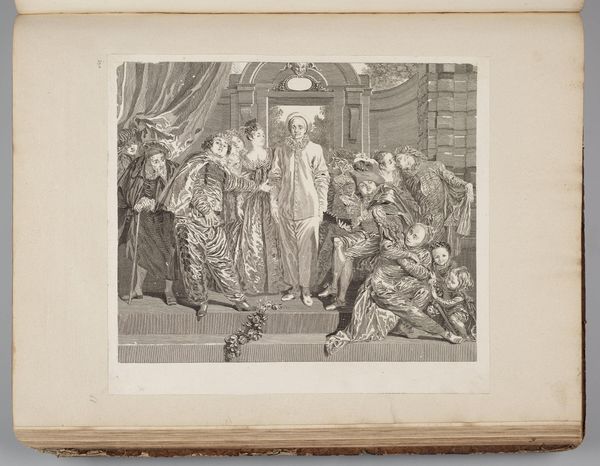
Figuren uit de Commedia dell'arte

Louis Surugue
1686 - 1762Location
RijksmuseumListen to curator's interpretation
Curatorial notes
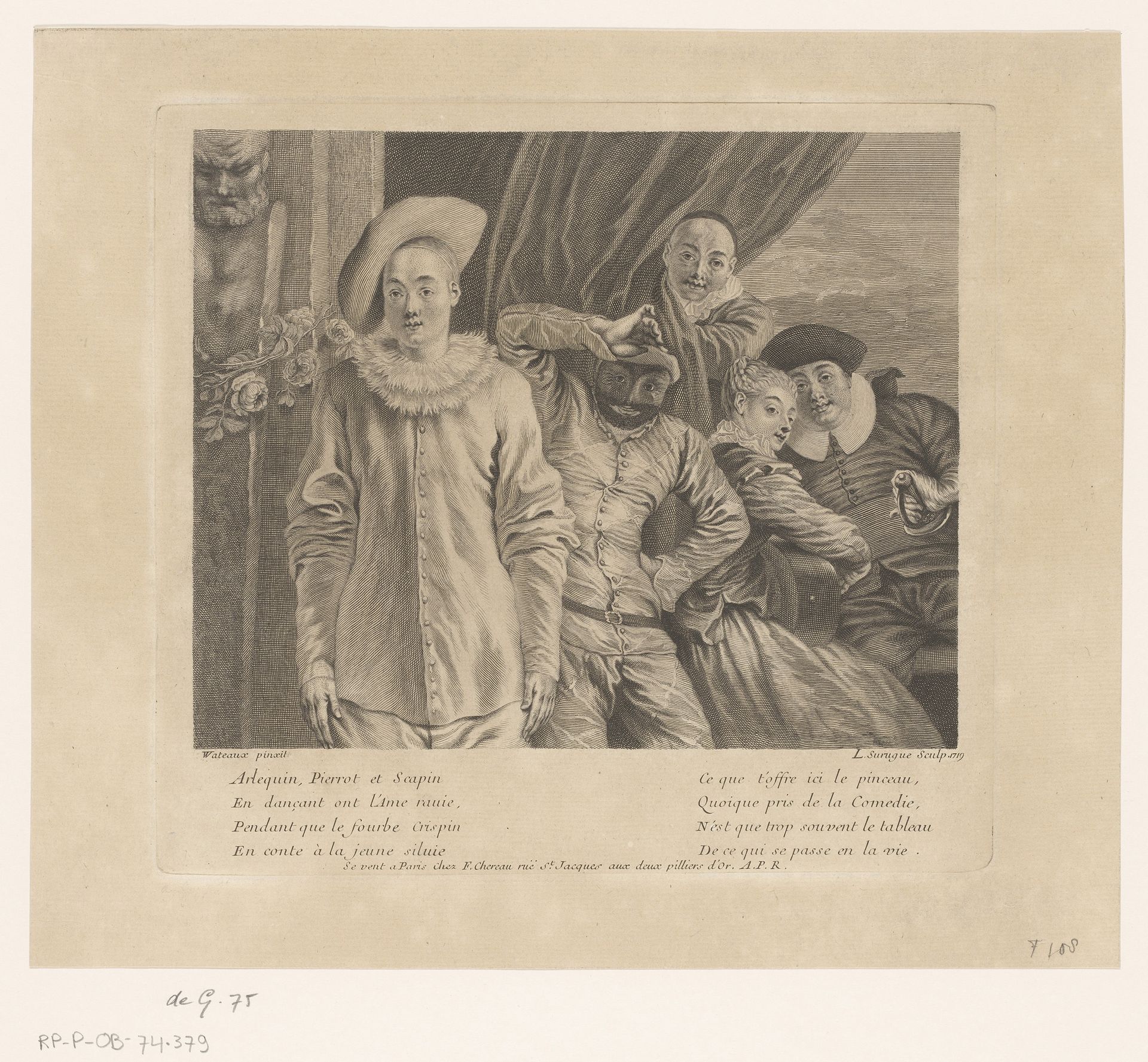
Curator: This engraving by Louis Surugue, dating from 1719, is titled "Figuren uit de Commedia dell'arte." It’s currently housed here at the Rijksmuseum. What strikes you initially? Editor: The monochrome palette establishes a very subdued atmosphere. Although the scene supposedly captures figures of the Commedia dell'arte, there is a distinct lack of liveliness in the tonality, which seems counterintuitive. Curator: The characters themselves certainly carry layered historical and cultural significance. We see what appears to be Harlequin, Pierrot, and Scapin, all central figures within the Commedia dell'arte tradition. It is a convergence of archetypes. Harlequin's agility, Pierrot's melancholy, and Scapin’s cunning are cornerstones of performance culture. Editor: And observe how Surugue orchestrates them compositionally. Pierrot is the central axis of this constructed theater, yet the gaze avoids connecting. What semiotic purpose might this fragmentation serve in representing the dynamic tensions amongst these theatrical characters? Curator: It speaks to the inherent ironies embedded in comedy itself. The performance, while ostensibly lighthearted, masks deeper currents of social commentary and human experience. Commedia dell'arte served as a powerful tool for critiquing societal norms. Editor: True, and it isn't only about social structures, it seems deeply entrenched with humanity and is reflective of that. The rendering has an uncanny echo, where the bodies possess a certain symbolic density. It hints at hidden, unspoken, layers beneath the masquerade. Curator: Exactly, consider the mask – a recurring motif. Masks liberate and conceal, transforming identity. The Commedia dell'arte thrived on subversion, using recognizable characters to challenge power structures. Editor: This detailed study certainly demonstrates how structural examination can illuminate so many potential angles within the art; the convergence between comedy and art lies not just in superficial performance but a reflective, if distorted, lens reflecting humanity back to itself. Curator: Absolutely. This piece is more than just an amusing snapshot, I see cultural continuity through symbolic form here. It resonates, prompting dialogue across centuries and culture.