About this artwork
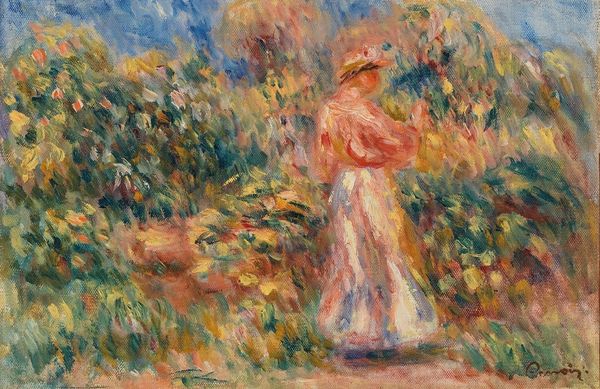
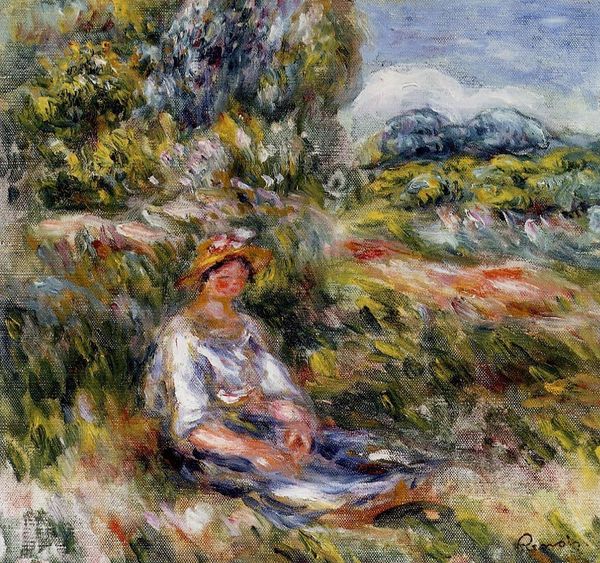
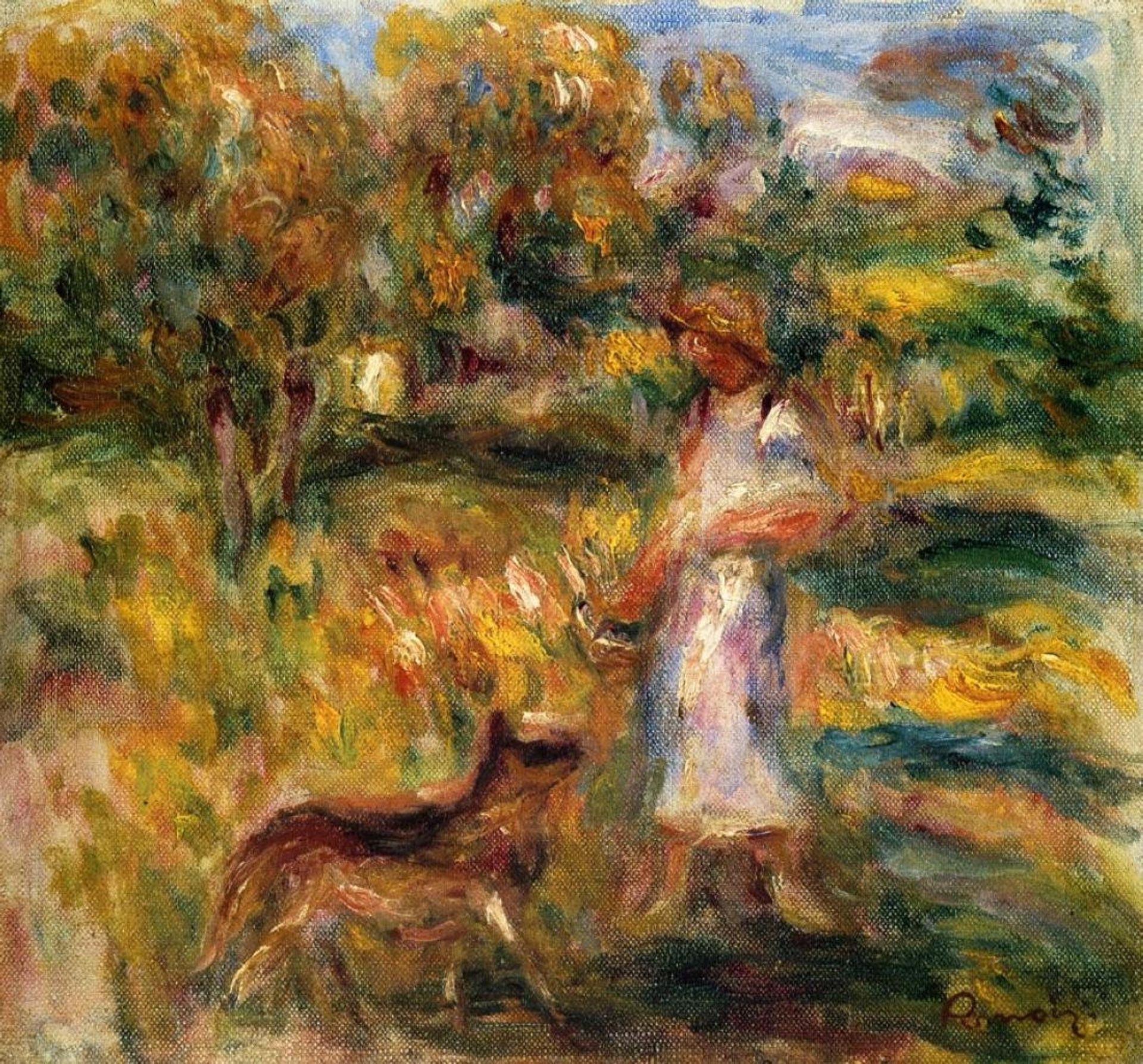
Editor: So, here we have Renoir's "Woman in Blue and Zaza in a Landscape," painted in 1919 using oil on canvas. It’s quite striking – a woman, almost dissolved into the landscape with a dog nearby. How would you interpret this piece? Curator: What captivates me is how Renoir intertwines the figure with the landscape. It isn't merely a woman *in* a landscape; she seems born *of* it. Consider the blue dress – a direct echo of the sky above, isn’t it? And the way Zaza, the dog, emerges from the earthy tones below? It suggests a return to primal harmony, an unbroken connection between humanity, animal nature, and the land. Does it strike you as timeless, somehow? Editor: I see that now! The blending creates this ethereal, almost dreamlike quality. It’s like Renoir is hinting at a shared essence between them all. Curator: Precisely. It goes beyond a visual representation. Renoir often used symbolism, especially in his later works. Ask yourself, what does the dog represent here? Fidelity? Instinct? The untamed aspects of ourselves mirrored in the domestic sphere? The possibilities open new lines of inquiry into a psychological space between them. Editor: That’s a fascinating take. I’d just assumed it was a cute detail. Curator: It’s both! Renoir understood that powerful imagery doesn't need to be heavy-handed; sometimes, the most potent symbols are the most familiar. This piece is not just about what we see but also what we feel and remember on a subconscious level. Editor: It’s really altered how I see the painting – less a scene and more of an experience. Thanks for your perspective. Curator: My pleasure! And isn't it exciting to uncover these subtle layers in something we thought we already understood? It keeps art alive!
Woman in Blue and Zaza in a Landscape
1919

Pierre-Auguste Renoir
1841 - 1919Location
Private CollectionArtwork details
- Location
- Private Collection
- Copyright
- Public domain
Comments
Share your thoughts
About this artwork
Editor: So, here we have Renoir's "Woman in Blue and Zaza in a Landscape," painted in 1919 using oil on canvas. It’s quite striking – a woman, almost dissolved into the landscape with a dog nearby. How would you interpret this piece? Curator: What captivates me is how Renoir intertwines the figure with the landscape. It isn't merely a woman *in* a landscape; she seems born *of* it. Consider the blue dress – a direct echo of the sky above, isn’t it? And the way Zaza, the dog, emerges from the earthy tones below? It suggests a return to primal harmony, an unbroken connection between humanity, animal nature, and the land. Does it strike you as timeless, somehow? Editor: I see that now! The blending creates this ethereal, almost dreamlike quality. It’s like Renoir is hinting at a shared essence between them all. Curator: Precisely. It goes beyond a visual representation. Renoir often used symbolism, especially in his later works. Ask yourself, what does the dog represent here? Fidelity? Instinct? The untamed aspects of ourselves mirrored in the domestic sphere? The possibilities open new lines of inquiry into a psychological space between them. Editor: That’s a fascinating take. I’d just assumed it was a cute detail. Curator: It’s both! Renoir understood that powerful imagery doesn't need to be heavy-handed; sometimes, the most potent symbols are the most familiar. This piece is not just about what we see but also what we feel and remember on a subconscious level. Editor: It’s really altered how I see the painting – less a scene and more of an experience. Thanks for your perspective. Curator: My pleasure! And isn't it exciting to uncover these subtle layers in something we thought we already understood? It keeps art alive!
Comments
Share your thoughts