About this artwork
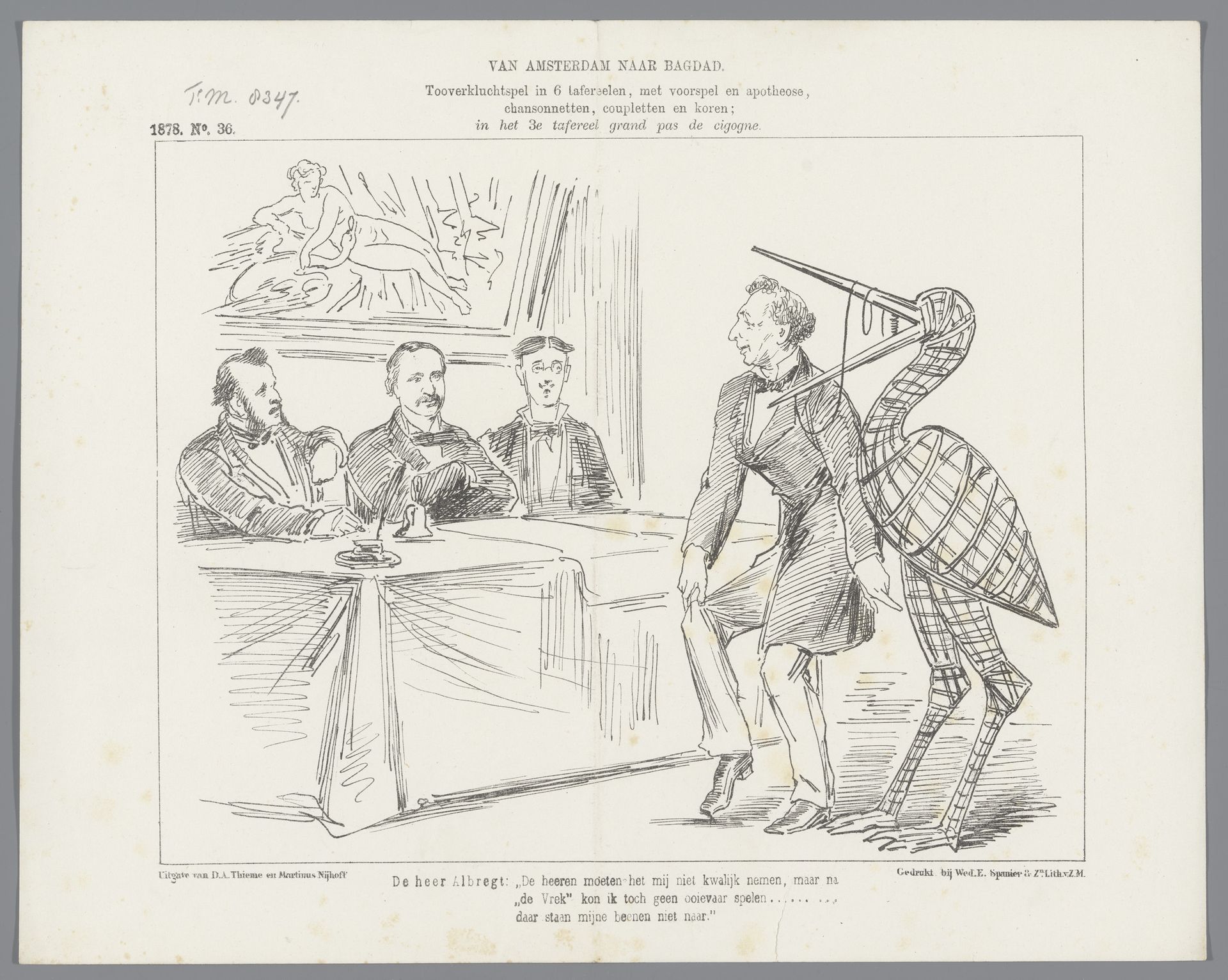
This print, titled "Spotprent," was created in 1878 by Johan Michaël Schmidt Crans. It’s a satirical illustration referencing a "magic comedy" called "From Amsterdam to Baghdad," a play in six scenes. The humor here seems rooted in societal critique. On the left, we see what appears to be a panel of critics or judges, perhaps representing the establishment or arbiters of taste. To the right stands a figure awkwardly attached to a stork, seemingly representing the playwright or perhaps the play itself. The stork is a metaphor, suggesting a clumsy or perhaps unnatural attempt at flight or fancy. The Dutch text beneath the image adds another layer. The figure laments that despite his attempts, he cannot play the fool, suggesting a struggle to entertain or perhaps a critique of the play's own shortcomings. It speaks to the tension between artistic ambition and public reception. Ultimately, the print invites us to reflect on the relationship between art, criticism, and the artist's struggle to find their place within a complex cultural landscape. It hints at the personal and emotional toll of artistic creation and the ever-present fear of failure or ridicule.

Artwork details
- Medium
- drawing, print, pen
- Dimensions
- height 215 mm, width 275 mm
- Copyright
- Rijks Museum: Open Domain
Tags
Comments
Share your thoughts
About this artwork
This print, titled "Spotprent," was created in 1878 by Johan Michaël Schmidt Crans. It’s a satirical illustration referencing a "magic comedy" called "From Amsterdam to Baghdad," a play in six scenes. The humor here seems rooted in societal critique. On the left, we see what appears to be a panel of critics or judges, perhaps representing the establishment or arbiters of taste. To the right stands a figure awkwardly attached to a stork, seemingly representing the playwright or perhaps the play itself. The stork is a metaphor, suggesting a clumsy or perhaps unnatural attempt at flight or fancy. The Dutch text beneath the image adds another layer. The figure laments that despite his attempts, he cannot play the fool, suggesting a struggle to entertain or perhaps a critique of the play's own shortcomings. It speaks to the tension between artistic ambition and public reception. Ultimately, the print invites us to reflect on the relationship between art, criticism, and the artist's struggle to find their place within a complex cultural landscape. It hints at the personal and emotional toll of artistic creation and the ever-present fear of failure or ridicule.
Comments
Share your thoughts