About this artwork
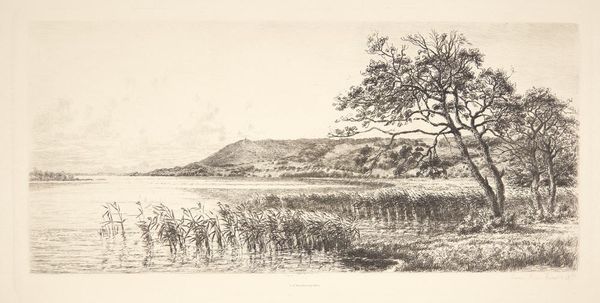
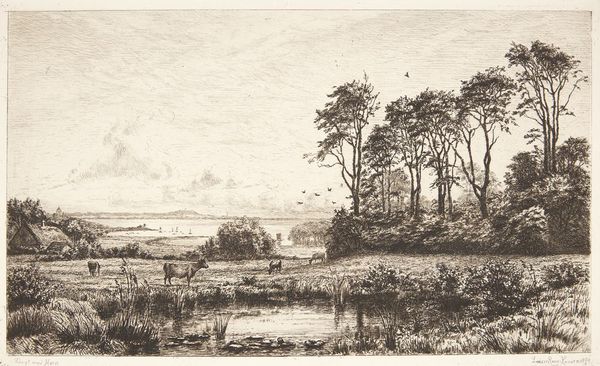
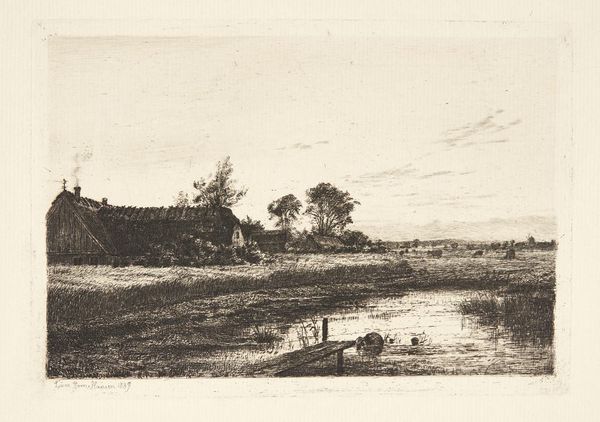
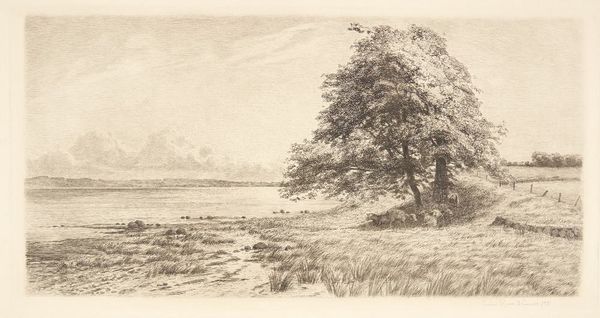
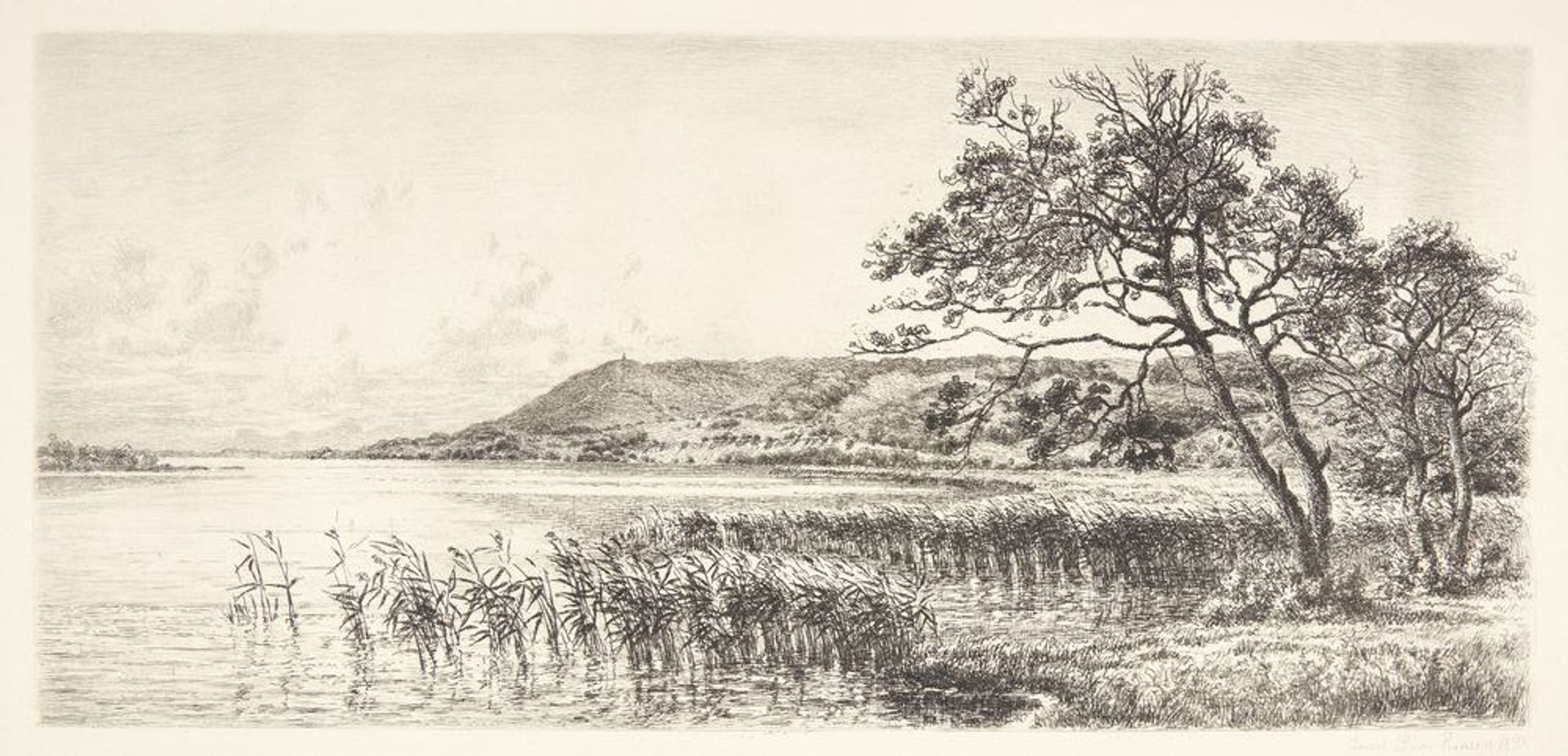
Editor: This is Louise Ravn-Hansen’s 1898 etching, "Juul sø ved Himmelbjerget," or "Lake Juul by Himmelbjerget.” It’s a really delicate landscape. It makes me think of a quiet, personal observation. What do you see in this piece? Curator: I see a landscape, yes, but also a coded commentary on nationhood and belonging. Ravn-Hansen, working in a period of intense national romanticism in Denmark, subtly questions the dominant narrative. Look at the way the Himmelbjerget, a national symbol, is rendered: it's present, but not overpowering. Editor: I see what you mean. It’s in the background, almost understated. So, is she critiquing this nationalistic fervor? Curator: Perhaps not a direct critique, but certainly a broadening of the conversation. Consider that Ravn-Hansen was a woman artist in a patriarchal society. The act of depicting the landscape from her own perspective, emphasizing the quiet beauty of the lake and reeds, becomes a feminist act. Editor: That's interesting. I hadn't considered the gendered aspect of landscape art. So, by focusing on the more intimate details, she is making a statement? Curator: Exactly! She is carving out a space for alternative voices within the national narrative. Her careful, detailed work gives importance to other, less-celebrated aspects of the land. Think of it as an intersectional approach avant la lettre! Editor: I hadn't thought of it that way. It makes me look at the print with fresh eyes, realizing that even seemingly traditional landscapes can hold layered meanings. Curator: Indeed. Ravn-Hansen reminds us that even in idyllic landscapes, questions of identity, power, and representation are at play. Art invites critical thinking and constant inquiry. Editor: Thank you; that gives me a completely new perspective! It highlights the potential of landscapes to carry so many layers of social commentary.
Juul sø ved Himmelbjerget
1898


Artwork details
- Dimensions
- 195 mm (height) x 396 mm (width) (plademål)
- Location
- SMK - Statens Museum for Kunst
Comments
Be the first to share your thoughts about this work.
About this artwork
Editor: This is Louise Ravn-Hansen’s 1898 etching, "Juul sø ved Himmelbjerget," or "Lake Juul by Himmelbjerget.” It’s a really delicate landscape. It makes me think of a quiet, personal observation. What do you see in this piece? Curator: I see a landscape, yes, but also a coded commentary on nationhood and belonging. Ravn-Hansen, working in a period of intense national romanticism in Denmark, subtly questions the dominant narrative. Look at the way the Himmelbjerget, a national symbol, is rendered: it's present, but not overpowering. Editor: I see what you mean. It’s in the background, almost understated. So, is she critiquing this nationalistic fervor? Curator: Perhaps not a direct critique, but certainly a broadening of the conversation. Consider that Ravn-Hansen was a woman artist in a patriarchal society. The act of depicting the landscape from her own perspective, emphasizing the quiet beauty of the lake and reeds, becomes a feminist act. Editor: That's interesting. I hadn't considered the gendered aspect of landscape art. So, by focusing on the more intimate details, she is making a statement? Curator: Exactly! She is carving out a space for alternative voices within the national narrative. Her careful, detailed work gives importance to other, less-celebrated aspects of the land. Think of it as an intersectional approach avant la lettre! Editor: I hadn't thought of it that way. It makes me look at the print with fresh eyes, realizing that even seemingly traditional landscapes can hold layered meanings. Curator: Indeed. Ravn-Hansen reminds us that even in idyllic landscapes, questions of identity, power, and representation are at play. Art invites critical thinking and constant inquiry. Editor: Thank you; that gives me a completely new perspective! It highlights the potential of landscapes to carry so many layers of social commentary.
Comments
Be the first to share your thoughts about this work.