About this artwork
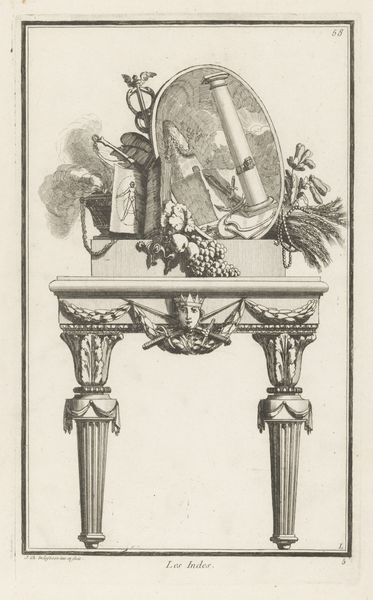
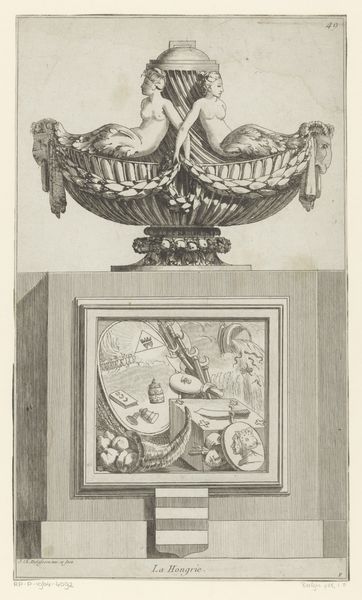
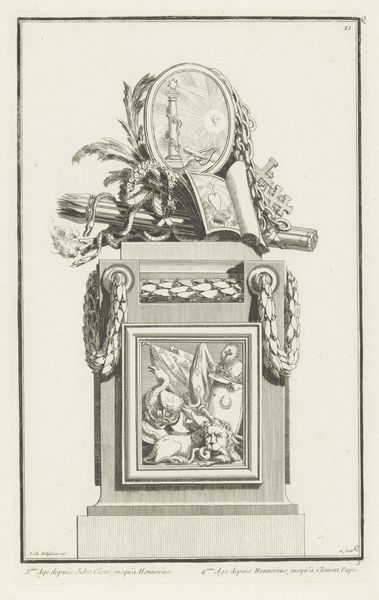
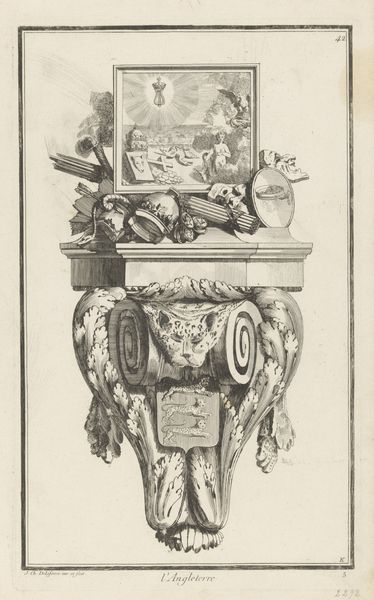
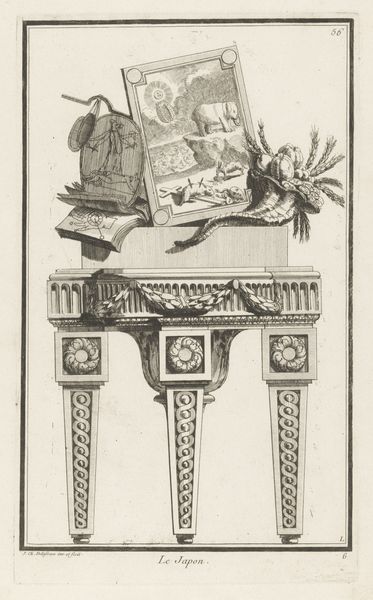
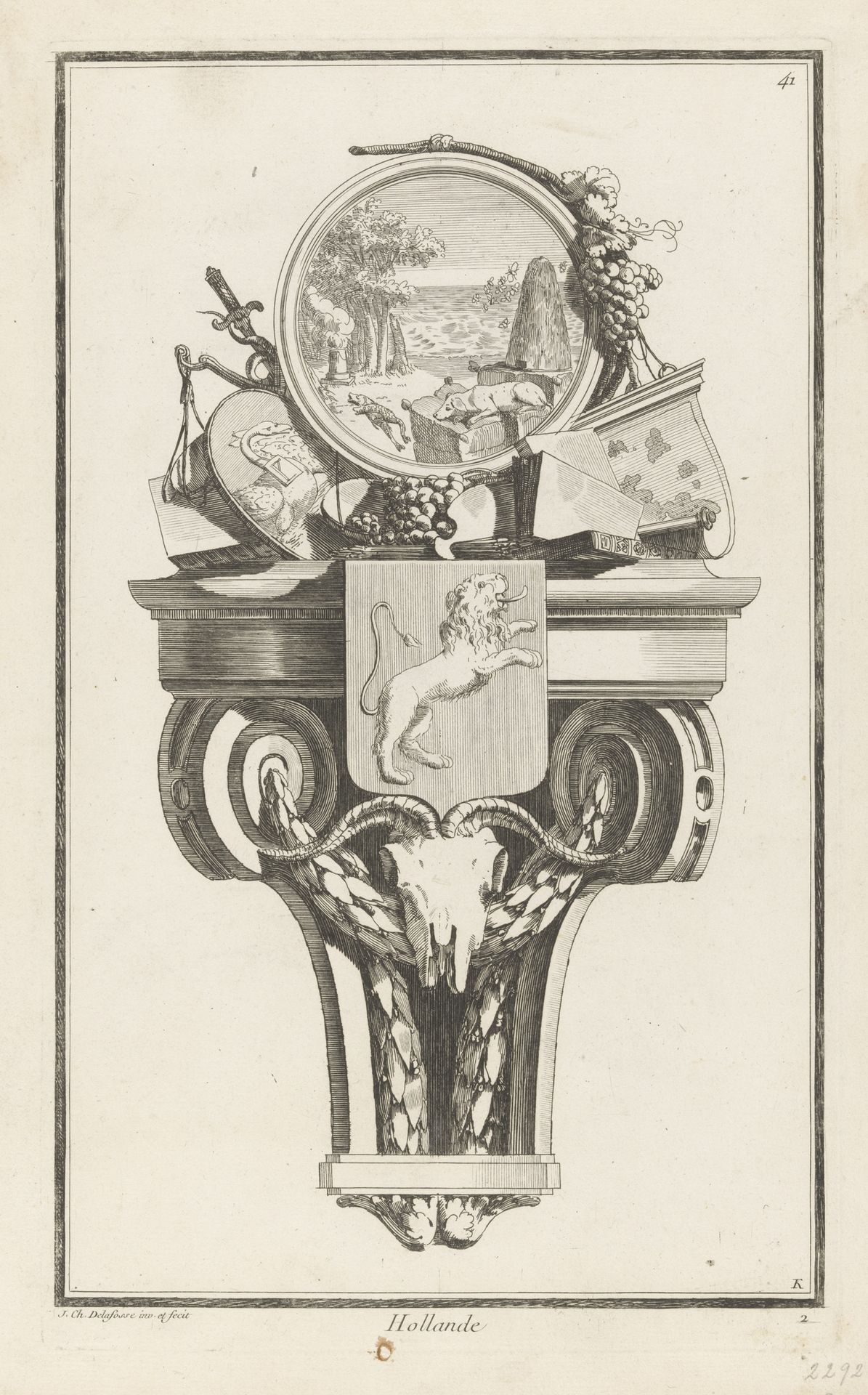
Jean Charles Delafosse created this engraving, simply titled "Holland," in the late 18th century. It is a complex allegorical depiction of the region, laden with symbols of power, nature, and history. The rampant lion on the central shield is the Dutch national symbol, projecting strength and pride. But beneath it, a ram's skull—a memento mori—reminds us of mortality and the transience of earthly power. We see this skull motif echoing through centuries, from ancient Roman vanitas to the still life paintings of the Dutch Golden Age, each time reminding viewers of life's fleeting nature. Above the lion, the pastoral scene enclosed in a circle suggests Holland's landscape and its bounty. Here we find a connection to the ancient Roman concept of the locus amoenus—an idealized, safe space in nature. The inclusion of weaponry, the scales of justice, and the map speak to governance, law, and geographical identity. The way these symbols converge speaks to a powerful collective memory.

Artwork details
- Medium
- drawing, print, etching, paper, engraving
- Dimensions
- height 377 mm, width 229 mm
- Location
- Rijksmuseum
- Copyright
- Rijks Museum: Open Domain
Tags
drawing
neoclacissism
aged paper
allegory
etching
old engraving style
paper
geometric
pen-ink sketch
sketchbook drawing
history-painting
engraving
Comments
No comments
About this artwork
Jean Charles Delafosse created this engraving, simply titled "Holland," in the late 18th century. It is a complex allegorical depiction of the region, laden with symbols of power, nature, and history. The rampant lion on the central shield is the Dutch national symbol, projecting strength and pride. But beneath it, a ram's skull—a memento mori—reminds us of mortality and the transience of earthly power. We see this skull motif echoing through centuries, from ancient Roman vanitas to the still life paintings of the Dutch Golden Age, each time reminding viewers of life's fleeting nature. Above the lion, the pastoral scene enclosed in a circle suggests Holland's landscape and its bounty. Here we find a connection to the ancient Roman concept of the locus amoenus—an idealized, safe space in nature. The inclusion of weaponry, the scales of justice, and the map speak to governance, law, and geographical identity. The way these symbols converge speaks to a powerful collective memory.
Comments
No comments